Though many people have a desire to recycle and practise sustainable living, many find it hard to make a change to the habits of a lifetime, believing that the change will be difficult and time-consuming. A major reason for this is that the majority of people have not been brought up thinking about sustainable practises and so the change in lifestyle seems arduous. However, if a child is taught about recycling, sustainable food, and green transportation at an early age, then all these practises will be second nature to them as an adult, with sustainability seeming less of a chore.
Considering that the global population of the planet is set to rise to around 9.1 billion by the year 2050, a child today will have to have sustainable practises ingrained from an early age for the planet to be able to cope. Sustainable practises are simple to understand, infinitely interesting and, when approached correctly, a lot of fun. It is never too soon to start understanding the world and our place within it.
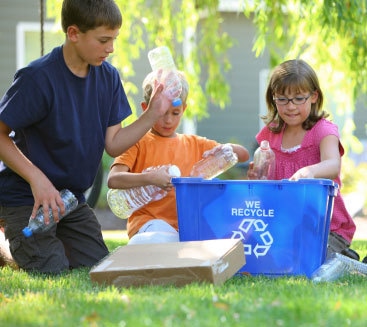
It’s easy for kids to get into recycling, a skill that will stay with them for life. Image Credits: http://frederickcountymd.gov/index.aspx?NID=4797
Be Creative
The golden rule when trying to engage a child in any activity is make it fun.
Kids love nothing more than getting creative (and messy) and producing great works of art for their rooms or the fridge. Instead of using brand new art supplies, recycled printer paper or old cereal boxes will work just as well for their latest masterpiece. In fact, even empty toilet rolls or washing up liquid bottles can provide hours of artistic entertainment and save waste and money.
It may come as a surprise to jaded modern parents, but children today can still be prized away from screens and consoles given the right incentive. Having a day free of electronic gadgets once a week will save energy, money and may lead to a kid developing a passion for something they had never considered before. Even a heated game of Snap or Monopoly can be just as much fun as completing a video game for the 6th time.
Relinquish Control
Another sure-fire way of getting a child’s attention is letting them be the grown-up in a situation. When preparing waste for recycling, let your child make a valid contribution by stomping on cardboard boxes, milk cartons and drinks cans to flatten them for recycling. Not only are they playing their part in the recycling process, but it allows them to smash something without being shouted at!
Another novel way to get kids thinking about energy efficiency is to make them the referee of the light switch. Any time you leave a room without switching the light off, it is the little ref’s job to remind you to do a double-take. They can even issue cards to repeat offenders! Not only does this teach the child the importance of saving energy, it will also keep your eco-credentials in check.
Novel Ideas
Many good children’s books have been published over the years with sustainable morals, and just a few pages at bedtime will help the green message sink in. Top of the bedtime book list is The Lorax by Dr Seuss, the story of a creature (The Lorax) that speaks for the trees against the ‘Once-lers’, who are destroying the planets forests. First published in 1972, The Lorax has now been made into a blockbuster film, so if you can’t convince your youngster to read the book, the movie will do just as well.
Furthermore, some of the books are packed with fun activities and games to help fill those long summer holidays. Examples are listed below:
- 50 Simple Things Kids Can Do to Recycle. Earthworks Press
- The Great Trash Bash. Loreen Leedy
- Bob The Builder: Bob's Recycling Day. Annie Auerbach
- Ecology Crafts for Kids: 50 Great Ways to Make Friends with Planet Earth (Science crafts for kids). Bobbe Needham
Online Resources
There are countless sites available online that have games, videos and tutorials specifically designed to help kids learn about recycling and sustainability.
Here are a few of the best to get started:
- National Geographic Kids' Recycle Roundup: In this endearing game from National Geographic, kids get to play as Gus, the superhero Gorilla on a mission to save the world from poorly sorted waste. Though it has a fun exterior, this game has a serious message and will help children distinguish which waste is recyclable, non-recyclable and compostable. Another great game in the same vein is Creek Cleanup, which has been extensively tested by the AZoCleantech editorial team! The National Geographic site also has plenty of serious recycling information and tips aimed at children and adults alike.
- Recycle City: The Environmental Protection Agency has created a large-scale cartoon town which kids are free to explore. Possibly containing a little too much information for younger children, the site nevertheless gives a great insight into how communities can work together to protect the environment. Once kids have finished exploring the town, they can play the Dumptown game, in which the child becomes the New City Manager of Dumptown.
- Kids Be Green: On this fun and informative site, youngsters can learn about the 3 R’s of sustainability- Reduce, Reuse and Recycle. Another great game is available, as are informative and interesting factsheets as well as a plethora of other resources to keep kids happy.
Disclaimer: The views expressed here are those of the author expressed in their private capacity and do not necessarily represent the views of AZoM.com Limited T/A AZoNetwork the owner and operator of this website. This disclaimer forms part of the Terms and conditions of use of this website.