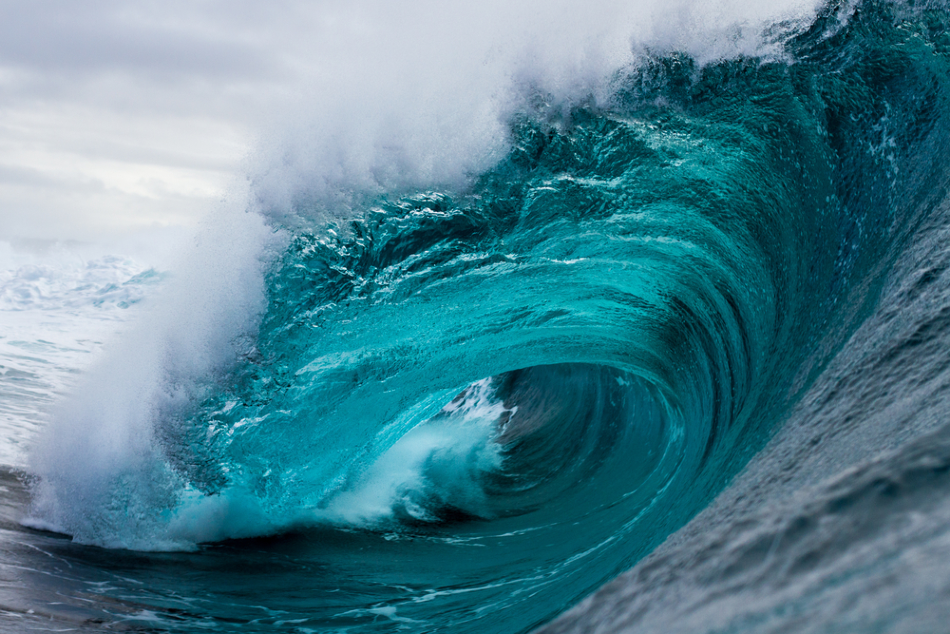
Image Credit: Brett Allen/Shutterstock.com
Many of us are familiar with the concept that energy from ocean waves can be used for useful work, including electricity generation, water desalination, and pumping reservoir water. However, the theory and physics behind the waves are often poorly understood. Having a strong knowledge of how ocean waves work will is an enormous advantage in a rapidly expanding business sector, with such knowledge forming the foundations of innovations, improved energy efficiency, and wise business investment.
Anatomy of a Wave
Waves are simply water surface oscillations, which propagate across a body of water and are an everyday phenomenon. Although in nature waves can take on very different forms, they all have the same basic properties. These are:
- Wavelength: Distance from one crest to the next
- Peak or Crest: The highest point of a wave
- Trough: The lowest point of a wave
- Height: Difference between trough and crest
- Period: Time taken for one wave to pass a fixed point
- Frequency: Number of waves per second that pass a fixed point
- Velocity: Speed with which the waves are moving past a fixed point
- Steepness: The ratio of height to width
How are Waves Formed and Destroyed?
Waves are generally generated by wind passing over the surface of the sea, but can also form via atmospheric pressure and gravitational attraction. Landslides and other Earth movements (tectonic movement) can also create waves, demonstrated with catastrophic effect by the Japanese Tsunami of 2011.
The wind attempts to ‘stretch’ the surface of the sea by rubbing against the surface of the water. This causes water molecules on the surface to move in the same direction as the wind. The water molecules collide with each other and so start moving forward. It's just basic friction. As long as the waves move forward slower than the wind speed just above the waves, energy moves from the wind to the waves.
If the wind is continuous the wave period and height grow together. Low pressure behind wave also contributes to forward motion. The wave height is determined by wind speed, how long the wind has been blowing, the fetch (the distance over which the wind excites the waves) and by the depth and surface of the seafloor (which can focus or disperse the energy of the waves). Given wind speed has a matching practical limit over which time or distance will not produce larger waves. When this limit has been reached the sea is said to be "fully developed”.
Waves are destroyed mainly by gravity or ‘breaking’ on land. For very small waves surface tension can flatten waves.
Wave Power Formula
In general, larger waves are more powerful but wave power is also determined by wave speed, wavelength, and water density. The power of a wave is determined by the ‘Wave Power Formula’. In this case, the ‘power’ does not refer to the power that would be produced by a wave power machine, rather it means the ‘wave energy flux’, or the transport rate of wave energy. In deep water where the water depth is larger than half the wavelength, the wave power is found using the following equation:
.jpg)
Where P is the wave energy flux per unit of wave-crest length, Hm0 the significant wave height, T the wave period, ρ the water density and g the acceleration by gravity. The above formula also says that wave power is proportional to the wave period and to the square of the wave height. If the significant wave height is given in meters, and the wave period in seconds wave power has units of kilowatts (kW) per meter of wavefront length.
Wave Energy
In average ocean conditions, the average energy density per unit area of sea surface waves is proportional to the wave height squared, shown in the following equation:
.jpg)
where E is the mean wave energy density per unit horizontal area (J/m2), the sum of kinetic and potential energy density per unit horizontal area. The potential energy density is equal to the kinetic energy, both contributing half to the wave energy density E.
Waves in Shallow and Deep Water
Ocean waves behave differently depending on the depth of the water they have formed in. ‘Deep’ water is generally considered to be when the water has a depth larger than half a wavelength, which is usually the case in the open ocean. In deep water:
- The velocity of a wave through water determined by the wavelength
- Longer waves move faster
- Typical speed=28 mph
In shallow water:
- The velocity of wave determined by water depth
- Speed (m/sec) = 3.1 x square root (depth)
- When a deep water wave moves into shallow water it slows down
- If wave=28 mph in deep water, in 1-meter deep water speed is 7 mph
More uniform ‘Deep’ water waves offer the opportunity for the development of technology that will not get damaged as heavily as near-shore machines.
Sources and Further Reading
This article was updated on 18th February, 2020.
Disclaimer: The views expressed here are those of the author expressed in their private capacity and do not necessarily represent the views of AZoM.com Limited T/A AZoNetwork the owner and operator of this website. This disclaimer forms part of the Terms and conditions of use of this website.