May 22 2012
The Mass Transportation Authority (MTA) today unveiled its new hydrogen fuel cell bus and opened their alternative fuel facility in Grand Blanc Township. The MTA is the first transportation agency in the Midwest with a hydrogen fuel cell vehicle. The vehicles will be stored at the Grand Blanc Service Center and Alternative Fuel Facility location.
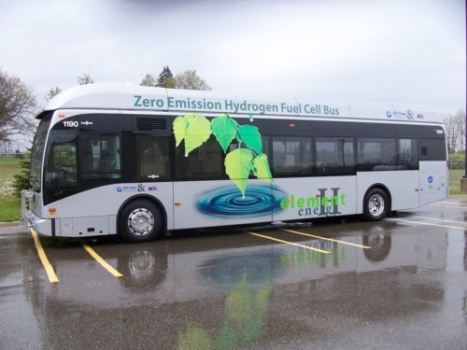 Mass Transportation Authority (MTA) today unveiled its new hydrogen fuel cell bus and opened their alternative fuel facility in Michigan's Grand Blanc Township. The MTA is the first transportation agency in the Midwest with a hydrogen fuel cell vehicle in commercial operation.Image credit:(PRNewsFoto/Mass Transportation Authority)
"Hydrogen as an alternative fuel for the public transit industry is environmentally friendly, reduces the carbon footprint and is technically feasible for a sustainable future," said Ed Benning, MTA General Manager.
A fuel cell running on pure hydrogen, like the UTC Power PureMotion® system utilized in this MTA bus, emits zero emissions at the source. In fact, the only thing that comes out of the tailpipe is water.
Fuel cells do not burn the fuel they use. Instead, they combine hydrogen with oxygen from the air electrochemically to produce electricity and emit only water vapor. MTA's new fuel cell bus is hybrid-electric, zero emission and powered by a 120 kW UTC Power PureMotion fuel cell system. When compared to a diesel version, every bus equipped with a PureMotion system reduces nitrogen oxide emissions equivalent to removing 77 cars from the road per year and achieves the same carbon dioxide reductions as planting 31 acres of forest.
"With the introduction of a bus powered by a PureMotion fuel cell system, MTA is leading by example and reaping the benefits of superior efficiency, increased reliability and reduced emissions for environmentally responsible operations," said Joe Triompo, VP and General Manager, UTC Power. "We're very proud that one of our fuel cells will be helping to serve theFlint community."
The MTA will be procuring additional hydrogen vehicles in the near future. The Grand Blanc service center garage will be expanded to provide storage for hydrogen and CNG vehicles and provide a work bay for the MTA maintenance.
The MTA will issue a request for proposals (RFP) to purchase additional hydrogen vehicles within the next year.
The fuel facility will be cutting edge technology in all aspects and the first of its kind in Michigan. The facility will generate sufficient hydrogen for the fuel cell buses. Modeled on a facility in Toronto, it will also serve as an educational training ground for Kettering University students and the larger community. The station will also be designed to generate compressed natural gas (CNG). Natural gas is a resource that will be readily available in the United States for decades. The CNG electric hybrid vehicles will be a clean running improvement over diesel. There will be five CNG vehicles purchased for MTA's regional transportation. A storage and maintenance facility will be built to address these new vehicles in the 2013-2014 time frames.
During the second phase of construction, the MTA plans include an educational research facility and a public fuel station operated by the private sector. This is expected to be ready by fall of 2013. The MTA will work with local colleges to further develop the alternative fuels. The site will provide a classroom in which area students can be involved in the research of alternative fuel sources.
During the third phase of construction, plans include the use of solar power capable of generating the electricity necessary to fulfill the needs of the proton electrolyzer, a unit which is used to provide a mix of electricity and water to generate hydrogen. A needs assessment will be conducted to establish alternative fuel requirements throughout Genesee County and municipalities and private businesses. The MTA will build a new alternative fuel maintenance facility which will include the installation of a static fuel cell that will generate both electricity for the fueling facility as well as hot water heat for the site.
To Benning, this project is the beginning to a road with a greener future for the community at large.
"The use of alternative fuels will position the MTA to address transportation needs today and in the future with a responsible, sustainable approach that improves the environment in our community and reduces our dependency on fossil fuels."