Virginia Tech electrical engineers, Reza Arghandeh and Robert Broadwater have developed an economically viable method of storing solar energy in current residential power networks.
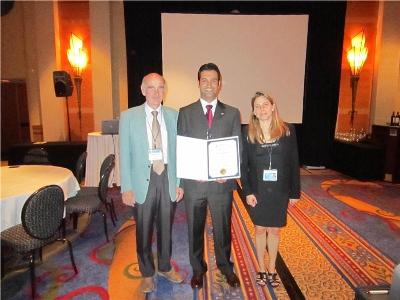
Members of the conference organizing committee, Wolfgang Hansen, far left, of Technische Universitat Dresden, Germany, and Sama Bilbao y Leon, right, of Virginia Commonwealth University, congratulate Reza Arghandeh, middle, Virginia Tech doctoral candidate in electrical and computer engineering, for winning the international best paper award.
Arghandeh’s work with Broadwater earned him the best student paper award at the 20th International Conference on Nuclear Engineering, conducted along with the American Society of Mechanical Engineering Power 2012 Conference in Anaheim, California.
Arghandeh and Broadwater’s research offers an optimization algorithm for a distributed energy storage (DES) system on a large scale. They have developed a storage system comprising a fleet of batteries linked to distribution transformers. This system can then be utilized to store distributed photovoltaic power prior to it is offered to market.
Arghandeh informed that storing distributed photovoltaic power obtained from systems like rooftop panels symbolizes a gaming method to achieve more revenues owing to the time varying cost of electricity. It is possible to control the adoption of distributed photovoltaic power using real-time electricity price and load profile.
Present power systems are shifting towards the concept of smart grid to enhance their consistency, sustainability, efficiencies and economics. Arhhandeh and Broadwater want to ensure integration between solar technologies and energy storage and control systems. Especially, the distributed energy storage system computation devised by them is dubbed as a discrete ascent optimal programming approach, which assures connection of different power systems subsequent to a fixed number of computational iterations.
A solution based on their approach relies on the day ahead forecast of photovoltaic production, market prices and load variation. The outcome of their optimization algorithm is a charging and discharging schedule of distributed energy with optimized operational benefits.
This work was funded by Electrical Distribution Design.
Disclaimer: The views expressed here are those of the author expressed in their private capacity and do not necessarily represent the views of AZoM.com Limited T/A AZoNetwork the owner and operator of this website. This disclaimer forms part of the Terms and conditions of use of this website.