The MINIVAP ON-LINE is a process monitoring analyzer built to measure the vapor pressure of gasoline, crude oil, LPG, and NPG, as well as the vapor-liquid ratio (LVR) of gasoline. It operates on the same measuring principle as the widely used VPV Pro laboratory instruments, ensuring fully comparable results.
The analyzer can connect to up to two separate sample streams and meets all applicable ASTM standards: ASTM D6378 for gasoline, ASTM D6377 for crude oil, and ASTM D6897 for LPG.
Its exceptional accuracy helps refineries to save thousands of dollars each day.
Applications
The MINIVAP ON-LINE meets all relevant specifications, applying the same high-precision methodologies as the laboratory analyzers cited by the US EPA.
This versatile instrument can measure the vapor pressure of gasoline (ASTM D6378/D5191), crude oil (ASTM D6377/D323), and liquefied petroleum gas (ASTM D6897/D1267), as well as the vapor-liquid ratio temperature of gasoline (ASTM D5188). It can connect to up to two separate sample streams for increased efficiency.
Grabner/Reid Vapor Pressure On-Line Analyzer
Features
- Multi-point measurements at various nominal pressures
- Online compliance monitoring for the vapor pressure of gasoline, LPG, and crude oil, as well as the vapor/liquid ratio temperature of gasoline (V/L = 20)
- Automatic calibration and offset correction
- Seven minute cycle time
- Single instrument capable of handling up to two sample streams
- Temperature-controlled sample conditioning system
- Explosion-proof – Class I
- NFPA 496 (US)
- EN 60079-2 and EN 60079-0 (EU)
Vapor Pressure Tester Standards
- JIS K2258-2, SHT 0769, GOST 52340
- ASTM D6897 - Latest standard for Vapor Pressure of LPG
- ASTM D6378 - Vapor Pressure of Gasoline (VP4)
- ASTM D6377 - Vapor Pressure of Crude Oil
- ASTM D5191
- ASTM D4953
- ASTM D5188 - V/L-Ratio: T (V/L = 20)
- ASTM D1267
- ASTM D323
- EN 13016 - 1+2
- IP 394, 409, 481
Technical Data
Source: Grabner Instruments
| |
|
| Temperature Range |
20 to 60 °C (68 to 140 °F) |
| Pressure Range |
0 to 1000 kPa (0 to 145 psi) |
| Power Requirements |
100/120/230/240 V AC, 50/60 Hz, 110 W |
| Field Application |
12 V/4A DC (vehicle battery) |
| Physical Dimensions |
580 x 1060 x 260 mm (23.7" x 43.3" x 10.6") |
| Weight |
50 kg (110 lb) |
Source: Grabner Instruments
| Precision Data |
MINIVAP 37.8 °C @ 70 kPa) |
ASTM D323 (Wet Reid Bomb) |
| Repeatability |
±0.3 kPa (0.04 psi) |
±3.2 kPa (0.46 psi) |
| Reproducibility |
±0.7 kPa (0.10 psi) |
±5.2 kPa (0.75 psi) |
Principle
The sample is delivered into the measuring chamber through the conditioning system using a quick connector (4) and inlet valve (4). A piston equipped with an integrated pressure transducer (1) performs automatic sample introduction and volume adjustment. The measuring chamber (2), with a total volume of 5 mL, is first rinsed with 2.5 mL of the sample and then filled with 1 mL.
Once the valve (4) is closed, single or triple expansion to 5 mL, under vacuum conditions, is achieved through additional piston strokes. The measuring cell’s temperature is regulated by a high-power thermoelectric module (5) and monitored by a precision platinum sensor (6). For rapid pressure stabilization, particularly with crude oil, the measuring unit is rocked during testing.
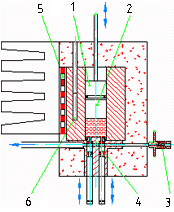
Automatic piston lubrication is processed with every piston stroke. Image Credit: Grabner Instruments

Image Credit: Grabner Instruments
Videos
Workshop | VP ON-LINE
MINIVAP Online Operation Workshop
Video Credit: Grabner Instruments