In this interview, AZoCleantech speaks with Lucivan Barros, Extrusion Application Scientist, and Ron Rubinovitz, FTIR Senior Application Scientist, at Thermo Fisher Scientific, about how polymer upcycling is helping to build a more circular plastics economy.
They discuss how reactive extrusion and advanced analytical techniques, such as FTIR microscopy, are enabling manufacturers to transform plastic waste into high-value, high-performance materials while reducing environmental impact.
Can you please introduce yourselves and your roles at Thermo Fisher Scientific?
Lucivan Barros: My name is Lucivan Barros, and I am an Extrusion Application Scientist at Thermo Fisher Scientific.
My role is dynamic and customer-focused. I work with both industrial and academic partners to help them better understand their polymer processing applications. Every project is different, which makes the role incredibly rewarding.
A big part of my work involves supporting material development, especially where process conditions influence polymer structure, morphology, and final properties.
Ron Rubinovitz: I am Ron Rubinovitz, and I work with the FTIR (Fourier Transform Infrared Spectroscopy) product line at Thermo Fisher Scientific. My role overlaps significantly with Lucivan’s in that I collaborate with customers to determine how our analytical technologies can support their research or industrial needs.
FTIR spectroscopy is used across a wide range of applications, from materials research to quality control, so each day presents a new technical challenge and learning opportunity.
Why is polymer upcycling becoming increasingly important from a sustainability perspective?
Lucivan Barros: The urgency stems from the sheer scale of plastic production. In the last 50 years, over 8 billion tons of plastic have been produced, with 36 % of that generated in just the past decade.
If current production rates continue, projections suggest that by 2050, there could be more plastic mass in the oceans than fish.
From a cleantech and sustainability perspective, this is not only a waste management issue but also a resource efficiency challenge. Plastics are derived from valuable raw materials and energy-intensive processes. Polymer upcycling allows us to retain that embedded value instead of losing it through downcycling or disposal.
Recycling must go beyond simple reuse. The recycled product must still perform. If recycled plastics lose their mechanical integrity or functionality, they cannot replace virgin materials, and the environmental benefit is limited.
What are the primary challenges in recycling plastics?
Lucivan Barros: One of the biggest challenges is sorting and ensuring batch homogeneity. Plastics come in many different types, and they are often thermodynamically incompatible with one another. That incompatibility makes mechanical blending difficult because different polymers tend to segregate rather than mix uniformly.
Without proper compatibility, recycled materials often suffer degraded mechanical properties, leading to what we call downcycling rather than upcycling.
Click here to watch Analyze That episode 5 - Polymer upcycling via reactive extrusion: FTIR microscopy insight into blend compatibilization
What are the main recycling routes currently used?
Lucivan Barros: There are three main approaches:
- Incineration, which eliminates waste but generates emissions and ash.
- Mechanical recycling, where plastics are shredded, melted, and reshaped. This is cost-effective but often degrades material properties.
- Chemical recycling, which breaks plastics back down into raw materials. While promising, it is energy-intensive and requires additional processing.
Polymer upcycling seeks to go further by creating materials with equal or improved performance compared to the original.
How does reactive extrusion support polymer upcycling?
Lucivan Barros: Reactive extrusion allows us to perform chemical reactions inside an extruder. A twin-screw extruder consists of a barrel with two rotating screws that provide pressure and intensive mixing. In reactive extrusion, the extruder acts as a continuous chemical reactor.
For example, in one project, we blended recycled polypropylene with polyamide (nylon), a higher-performance polymer. These two materials are normally incompatible, so we added a compatibilizer to improve miscibility. The extruder ensures homogeneous mixing, while the chemical reaction enhances interfacial adhesion between phases.
What factors must be optimized during the upcycling process?
Lucivan Barros: Several variables influence success:
- Residence time inside the extruder
- Temperature profile
- Screw configuration and mixing intensity
- Feed rate
- Composition ratios between polymers and compatibilizer
To efficiently explore these variables, we typically recommend lab-scale extruders. These systems offer flexibility and require much smaller material volumes, which is critical during research and development.
Click here to watch Analyze That episode 5 - Polymer upcycling via reactive extrusion: FTIR microscopy insight into blend compatibilization
Could you explain what FTIR spectroscopy is and why it was used in this study?
Ron Rubinovitz: Fourier Transform Infrared Spectroscopy is a molecular vibrational technique. We shine infrared light onto a sample and measure how that light interacts with the molecular bonds. From that interaction, we can extract chemically specific information about the material.
The method is non-destructive, which makes it especially useful for polymer identification. When we use FTIR, we can reach a spatial resolution better than 10 microns. That allows us to look very closely at localized regions within individual polymer pellets rather than just getting an average signal.
In our specific case, we analyzed pellets produced both with and without a compatibilizer. Because polypropylene and polyamide each have distinct infrared spectral features, we were able to track their relative distribution across the surface of the pellet.
For the pellets that contained the compatibilizer, the ratio of polypropylene to polyamide signals stayed consistent across the sample. That consistency points to uniform dispersion. In contrast, the pellets without the compatibilizer showed significant spatial variation, which is a clear indication of phase segregation.
We then translated those spectral ratios into chemical maps and supporting statistical data. That step allowed us to move beyond visual observation and make an objective comparison between the different formulations.
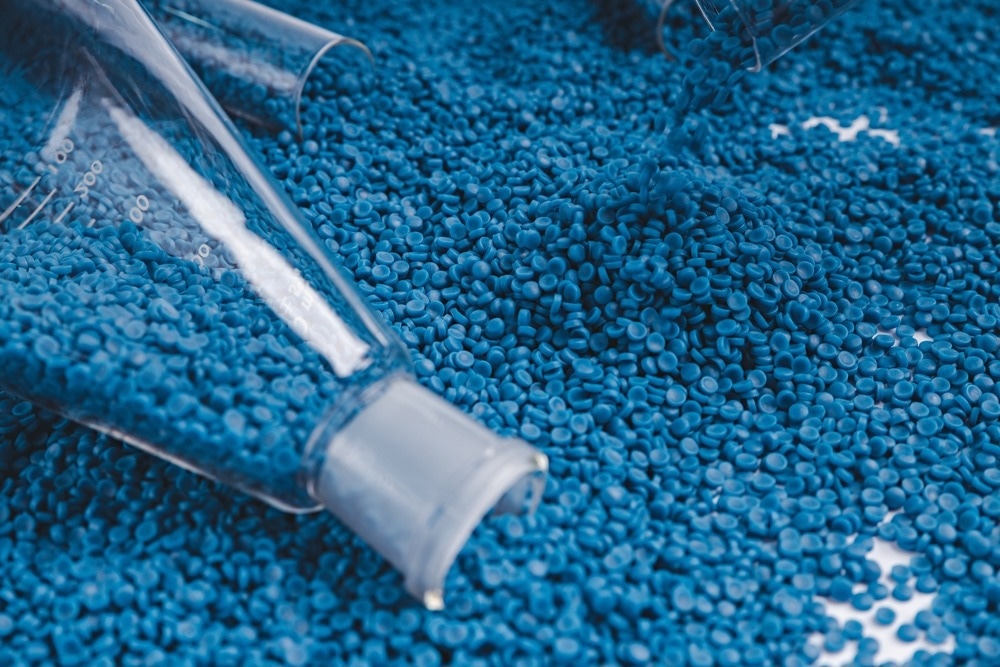
Image Credit: Meaw_stocker/Shutterstock.com
What are the environmental and economic benefits of polymer upcycling?
Lucivan Barros: Upcycling allows us to incorporate up to 50 % recycled material into high-performance polymers without sacrificing properties. This reduces reliance on virgin resin, lowers energy consumption associated with new polymer production, and diverts plastic waste from landfills and oceans.
From a sustainability standpoint, this directly supports circular economy principles by keeping materials in productive use for longer. It transforms waste streams into value streams.
Ron Rubinovitz: Recycling is only truly effective if the resulting materials have continued industrial value. If we can produce consistent, high-quality materials from waste streams, polymer upcycling becomes a scalable cleantech solution. It enables manufacturers to meet performance standards while simultaneously reducing their environmental footprint.
Analyze That episode 5 - Polymer upcycling via reactive extrusion: FTIR microscopy insight into blend compatibilization
Polymer upcycling via reactive extrusion: FTIR microscopy insight into blend compatibilization
About Lucivan Barros 
Lucivan Barros is an Extrusion Application Scientist at Thermo Fisher Scientific, specializing in polymer processing and reactive extrusion technologies. He holds a degree in Materials Engineering and developed his expertise in polymer processing during his academic research. His work focuses on structure–processing–property relationships in polymer systems and advancing sustainable material solutions.
About Ron Rubinovitz
Ron Rubinovitz is a Senior Application Scientist at Thermo Fisher Scientific, specializing in Fourier Transform Infrared (FTIR) spectroscopy.  With a background in chemistry and optical spectroscopy, he supports customers in applying vibrational spectroscopy techniques for polymer identification, compositional analysis, and materials characterization.

This information has been sourced, reviewed and adapted from materials provided by Thermo Fisher Scientific.
For more information on this source, please visit Thermo Fisher Scientific/PolymerAnalysis.
Disclaimer: The views expressed here are those of the interviewee and do not necessarily represent the views of AZoM.com Limited (T/A) AZoNetwork, the owner and operator of this website. This disclaimer forms part of the Terms and Conditions of use of this website.