Mar 29 2018
According to a recently published paper in the journal Limnology and Oceanography Letters, lake size and nutrients trigger how much greenhouse gases are released worldwide from lakes into the atmosphere.
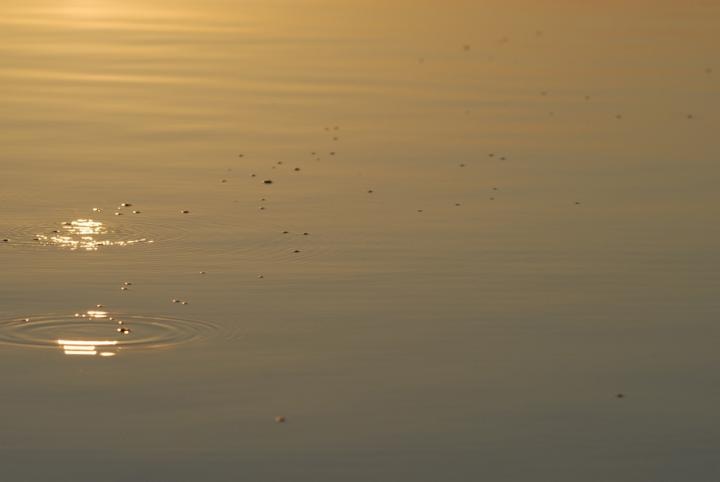 Methane bubbles to the surface Lake Kariba, Africa, of the world's largest man-made lake and reservoir by volume. (Image credit: Christian Dinkel)
"Our research pioneers a new way of determining the global atmospheric effect of lakes using satellite information on lake greenness and size distribution," said co-author John A. Downing, University of Minnesota Sea Grant director and professor of biology at the University of Minnesota Duluth. "This is important because the world's lakes and surface waters will emit more greenhouse gases as they become greener and more nutrient-rich."
Greenhouse gases emitted into the atmosphere trigger global climate change. Although carbon dioxide is the most notorious greenhouse gas, nitrous oxide, and methane, which are also discharged from lakes, could be far more disturbing because they have much higher warming potential.
Our work shows conclusively that methane, which is emitted from lakes in bubbles, is the dominant greenhouse gas coming from lakes and surface waters globally. The greener or more eutrophic these water bodies become, the more methane is emitted, which exacerbates climate warming.
Tonya DelSontro, Lead Author & Researcher - University of Geneva.
Green lakes result from disproportionate fertilization by nutrients, such as nitrogen and phosphorus, and when sediment amasses in lakebeds. Such "greening" is referred to as eutrophication.
Our research team assembled the largest global dataset on lake emission rates of carbon dioxide, methane and nitrous oxide. When we analyzed the data, we found that emissions of greenhouse gases to the atmosphere were influenced by the amount of eutrophication but also that lake size matters a lot for carbon dioxide and nitrous oxide.
John A. Downing
If the lakes and other surface waters around the world become more eutrophic it could negate the cutbacks that society makes by decreasing fossil fuel emissions.
"We need to know how much of these greenhouse gases are being emitted to be able to predict how much and how fast the climate will change," said DelSontro. "This paper is significant because we developed a more effective approach to estimate current and future global lake emissions."
The authors point to four main advancements that enabled their results to be more accurate than earlier estimates: Modern advances in satellite and sensor technology, availability of comprehensive geographical data on lakes, a growing number of global lake observations, and enhanced statistical survey designs.
The authors also offer certain fairly simple things people in any place can do to protect the water in their community:
- Decrease fertilizer application on urban and agricultural land
- Manage septic systems to guarantee they work well
- Maintain large buffer or filter strips of vegetation that intercepts stormwater runoff
- Keep streets and curbs clean
Even moderate increases in lake and surface water eutrophication over the next 50 years could be equivalent to adding 13 percent of the effect of the current global fossil fuel emissions. By keeping our community waters clean, we make better water available to future generations and we decrease worldwide emissions of methane that speed climate change.
John A. Downing