Plastics are employed across a wide range of industries thanks to their malleability, slow decomposition, and low corrosiveness. Though these properties make plastics versatile, they also mean that plastics contribute to increasing environmental concerns.
Microplastics are persistent in ecosystems, evident in ocean pollution and present in food and water, underscoring the challenges they pose for waste management.
260 Mt of plastics is produced annually, with roughly 38 % of this used for packaging. This packaging usually reaches its final destination in the waste bin after it has fulfilled its purpose. Take plastic packaging, for instance; it accounts for approximately 76 % of disposed plastic in the European Union.1,2
Made out of non-renewable petrochemicals, recycling plastic waste is an important strategy to minimize plastic waste and help to lessen the worldwide reliance on fossil fuels.
Plastic Recycling with Twin-Screw Extruders
One of the most common approaches to recycling plastics involves melting the material down and re-extruding it into a new form.
Typically, single-screw extruders are used in the first stage to reshape shredded plastic waste. In the second stage, co-rotating twin-screw extruders are introduced to blend in colorants, fillers, and other additives, helping to refine the final material.
More advanced twin-screw solutions are also now available, including systems that combine two twin-screw extruders. These setups are designed to improve degassing and reduce unwanted odors.
Smaller, down-scaled extruders also play an important role, particularly in research and development. They allow teams to test recycling methods and develop new additive formulations while saving both time and material.
Thermo Scientific™ offers a range of lab-scale and pilot-scale twin-screw extruders, with throughputs ranging from 200 grams per hour up to 30 kilograms per hour.
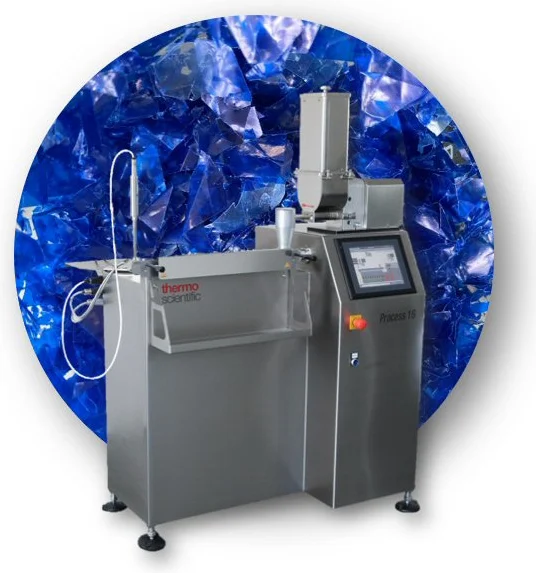
Figure 1. Thermo Scientific Process 16 twin-screw compounder and twin-screw feeder for foil shred recycling. Image Credit: Thermo Fisher Scientific – Materials & Structural Analysis
There are multiple benefits to using co-rotating twin screw extruders for plastic recycling applications, such as:
- Delivering excellent dispersive and distributive mixing to compensate for variations in input material properties
- Facilitating efficient degassing through continuous surface renewal of the melt, which in turn provides a large surface area for the removal of volatile contaminants and odors
- Optional melt stripping can be performed using water, nitrogen, or carbon dioxide to further improve degassing performance
Thermo Scientific Process 16: The Pilot Extruder for Foil Shred Recycling
Generally, it is easy to feed high-density regrind into the extruder, but low-bulk-density fibers and fluffy foil shreds often cause complications. Therefore, it is generally faster to shred material to reduce its compaction and size further.
The Process 16 Twin-Screw Extruder from Thermo Scientific features an especially wide feed throat, making it easier to feed larger foil shreds. This also stops blockages and allows for extra stuffer feeders. Special wide throat screw elements in the feed section enhance the fast conveying of shreds into the extruder barrel.
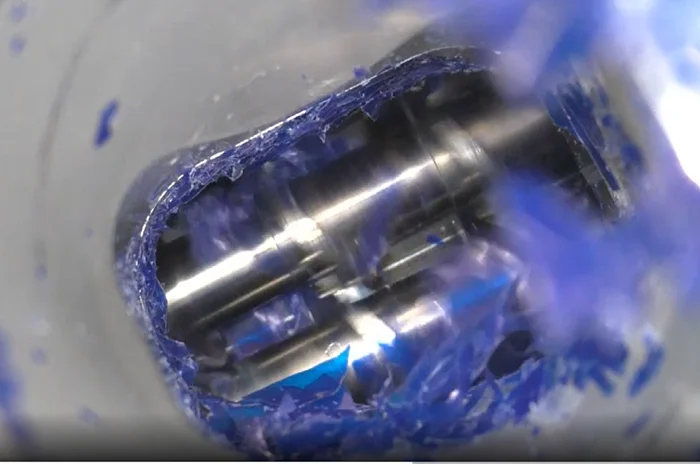
Figure 2. The large primary feed port of the Thermo Scientific Process 16 twin-screw extruder with wide throat feed screw elements ensures the uptake of larger foil shreds. Image Credit: Thermo Fisher Scientific – Materials & Structural Analysis
An agitated twin-screw feeder is fitted with spiral screws, which offer an adjustable screw speed and facilitate the dosage of foil shred into the extruder. This feeder continuously conveys foil shreds with a large size distribution (Figure 3) into the extruder.
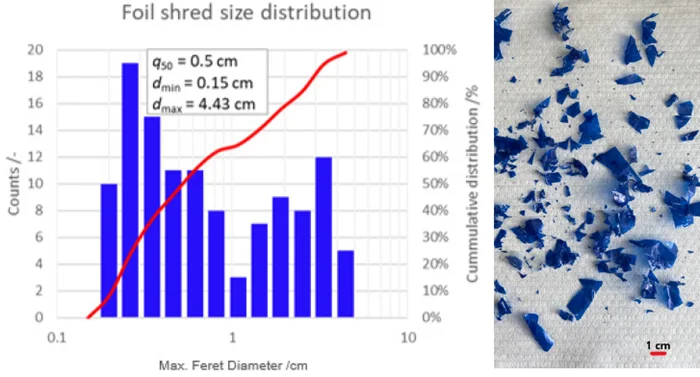
Figure 3. Maximum Feret length distribution (left) of foil shreds obtained by analysis of the displayed image (right). Image Credit: Thermo Fisher Scientific – Materials & Structural Analysis
Another common challenge that is associated with the handling of plastic foil shreds is the stickiness that electrostatic charge can cause. Foil shreds can potentially attach to surfaces like the feed funnel and feeder outlet. Ultimately, larger amounts can often pile up and cause a blockage.
By placing an ionisator at the feeder outlet (Figure 4), these shreds can be discharged, which helps to maximize the feeder output.
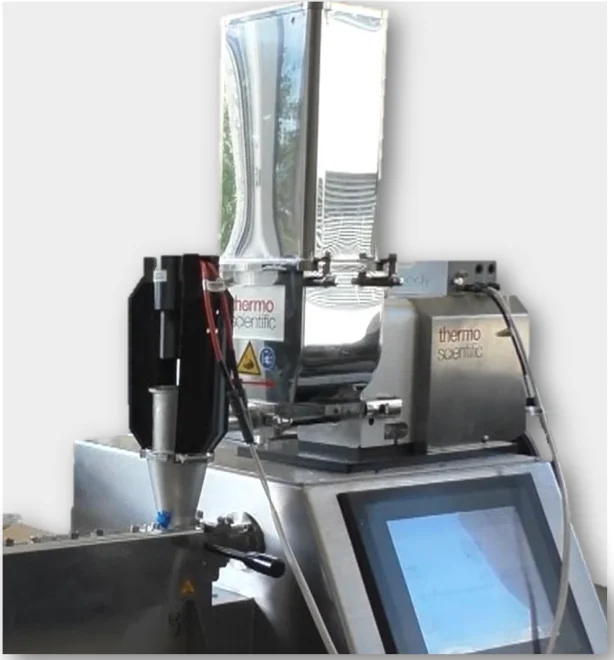
Figure 4. Twin-screw feeder with Ionisator at the outlet tube prevents feed funnel blockage by electrostatically charged foil shreds. Image Credit: Thermo Fisher Scientific – Materials & Structural Analysis
References and Further Reading
- Hundertmark, T., et al. (2018). How plastics waste recycling could transform the chemical industry. (online) McKinsey & Company. Available at: https://www.mckinsey.com/industries/chemicals/our-insights/how-plastics-waste-recycling-could-transform-the-chemical-industry.
- Sati Manrich and Santos, A. (2009). Plastic recycling. ResearchGate, (online) pp.1–99. Available at: https://www.researchgate.net/publication/324156265_Plastic_recycling (Accessed 13 Sep. 2025).
Acknowledgments
Produced from materials originally authored by Annika Völp from Thermo Scientific.

This information has been sourced, reviewed and adapted from materials provided by Thermo Fisher Scientific – Materials & Structural Analysis.
For more information on this source, please visit Thermo Fisher Scientific – Materials & Structural Analysis.