Heavy metal contamination of soil has become a major environmental problem due to its negative impact on food quality, groundwater, microorganisms, and plant growth.
The most significant sources of heavy metals in the environment are human activities such as mining, smelting, traffic, agriculture, and domestic activities, and industries such as iron, steel, and chemicals.
Global environmental consciousness is expanding as more information about the detrimental impacts of heavy metals becomes known. As a result, public pressure around the world has resulted in more regulations and laws:
- Limiting heavy metal emissions from industrial or mining activity.1
- Conducting risk assessments and monitoring for contaminated agricultural land, residential, commercial, and industrial sites.
These statutes have resulted in the implementation of legal limitations for heavy metals. Now, sites must be inspected swiftly to verify regulatory compliance.
Because of their high-density in situ testing capabilities, handheld X-ray fluorescence (XRF) analyzers are well-suited for mapping a site's pollution, establishing the extent and boundaries of contamination, and outlining necessary remediation solutions.
Handheld XRF can also be used to prescreen samples before submitting them to a confirming laboratory.
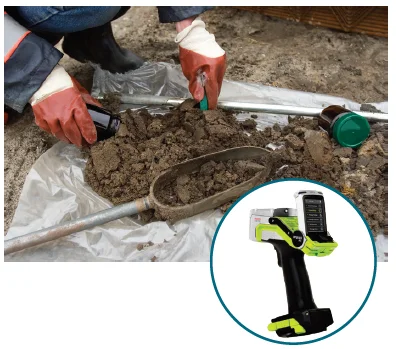
The Thermo Scientific™ Niton™ XL5 Plus Handheld XRF Analyzer. Image Credit: Thermo Fisher Scientific – Handheld Elemental & Radiation Detection
The US EPA Method 62002,3 and ISO 13196 norm4,5 recognize handheld XRF as an approved method for soil analysis. For decades, Niton handheld XRF analyzers have helped environmental professionals, universities, companies, and regulators screen and quantify heavy metals in soils and sediments.
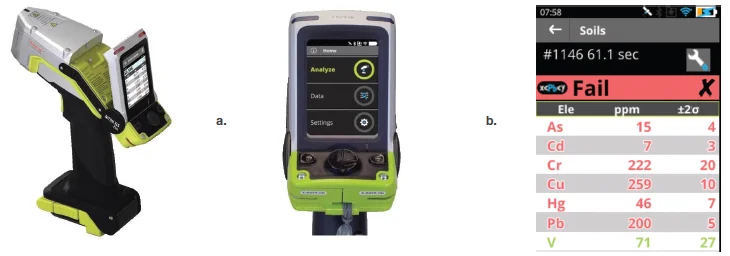
Figure 1. a) Niton XL5 Plus handheld XRF analyzer b) Display of pass/fail result and elemental analysis of soil sample. Image Credit: Thermo Fisher Scientific – Handheld Elemental & Radiation Detection
Instrumentation and Features
The Niton XL5 Plus handheld XRF analyzer (Figure 1a) considerably improves analytical performance and operation in soil analysis due to its state-of-the-art proprietary miniaturized 5 W/50 kV X-ray tube, cutting-edge silicon-drift-detector (SDD) technology, and lightweight and compact design.
The Niton XL5 Plus soils mode can monitor elements ranging from sulfur to uranium by combining up to three distinct filter and voltage combinations, which increase the signal-to-noise ratios of fluorescence lines over the whole energy range.
The soils mode generates accurate findings using a unique Fundamental Parameter (FP) technique. This approach accounts for the matrix's absorption and secondary excitation effects, which contribute to the large variability in sample composition. The Niton XL5 Plus analyzer shows the results in real time on the screen (Figure 1b).
Users can customize the soils mode by adjusting measurement time differences, pass/fail criteria, data field sets, element display formats, pseudo-elements, and matrix-specific calibrations. Users can save modified parameters in separate soils mode profiles.
These profiles permit multiple setups on the same instrument, allowing for quick measurements with the right settings. In addition, the Niton XL5 Plus analyzer has integrated GPS that allows for spatial data display, site mapping, and heavy metal contamination modeling.
Users can also connect external GPS systems to the Niton XL5 Plus analyzer via Bluetooth. Measurement data can be sent to PCs by USB or wireless communication, such as Wi-Fi.
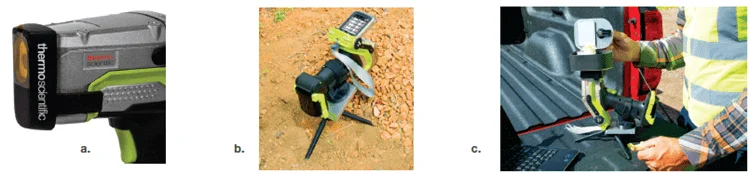
Figure 2. Accessories for the Niton XL5 Plus handheld XRF analyzer: a) Soil guard to protect window bracket b) Tripod for in situ measurements c) Mini test stand. Image Credit: Thermo Fisher Scientific – Handheld Elemental & Radiation Detection
Sample Presentation
When using the instrument, users can perform soil analysis in two modes: in situ point and shoot and invasive.2 In point-and-shoot mode, the user will aim the Niton XL5 Plus handheld XRF analyzer straight at the soil surface after clearing away trash, tiny stones, or vegetation.
This analysis is suitable for screening and produces both qualitative and semi-quantitative data, allowing for speedy identification of pollution hotspots. To maintain the cleanliness of the analyzer's window bracket, a soil guard can be used (Figure 2a).
Users can operate a tripod to operate the analyzer upside down, which improves the ergonomics of point-and-shoot measurements (Figure 2b).
When operating in intrusive mode,2,5 users will remove a portion of the soil from the site, homogenize it with a mortar or grinder, filter it, and dry it as needed.
The resulting powder is then transferred to a sample bag or cup and injected into the analyzer via a mini-test stand (Figure 2c). Intrusive analysis, which includes basic sample preparation, can be performed on site or in a lab.
The analysis of sample containers containing homogenized powder often takes longer (30 seconds to several minutes). This approach detects components at lower concentrations with greater precision than point-and-shoot tests.
Analytical Performance
Sensitivity
Over the last 25 years, significant improvement has been made in the sensitivity of heavy metal detection in soils.
Figure 3 shows the Niton XRF analyzer limits of detection (LOD) for the elements chromium (Cr), nickel (Ni), copper (Cu), zinc (Zn), mercury (Hg), arsenic (As), selenium (Se), lead (Pb), cadmium (Cd), tin (Sn), antimony (Sb), and barium (Ba). The continuous technological improvement of X-ray sources, detectors, and electronics has increased LODs for certain elements by one to two orders of magnitude.
The Niton XL5 Plus handheld XRF offers enhanced sensitivity.
This sensitivity is very useful for detecting heavy metals present in low concentrations, such as Hg or Cd. Users may now detect heavy metals at levels below 10 parts per million (ppm) in as little as 20 seconds per filter.
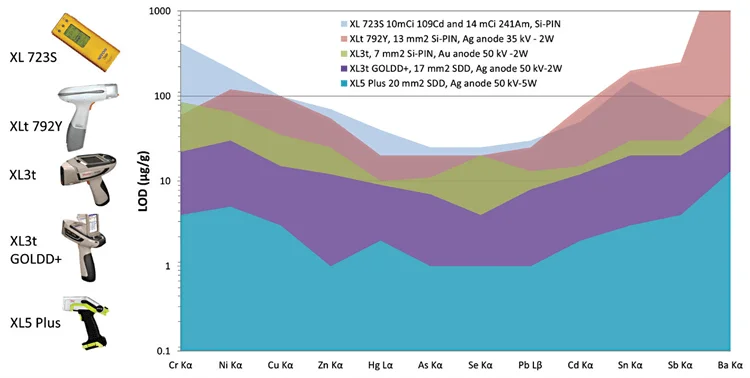
Figure 3. Limits of detection (60 seconds per filter) in ppm in pure silica for a selection of heavy metals. Niton XL5 Plus handheld XRF analyzer (2021) vs. legacy analyzers: XL3t GOLDD+ (2010), XL3t (2007), XLt 792(2003) and XL 723S (1997). Image Credit: Thermo Fisher Scientific – Handheld Elemental & Radiation Detection
Accuracy
In situ point-and-shoot analysis often produces qualitative or semi-quantitative data.
This data may be sufficient to determine the presence or absence of heavy metal contamination or to distinguish between areas with high and low concentrations. However, in soil sample analysis, the most significant uncertainty does not stem from the analytical equipment or method (laboratory-based procedures or handheld XRF).
This uncertainty originates from the sampling technique, which may not accurately reflect the spatial distribution of pollutants.6 Hence, extensive sample mixing, quartering, particle size reduction, and homogenization are required for precise quantitative results.
When samples are homogeneous and representative, the analyzer's soils mode provides very accurate heavy metal content readings right out of the box.
Figure 4 shows a positive correlation between certified and measured values for vanadium (V), Cr, Cu, Zn, As, Cd, Hg, and Pb obtained from a set study of 28 commercially available standard reference materials with concentrations ranging from a few to several thousand parts per million (ppm).
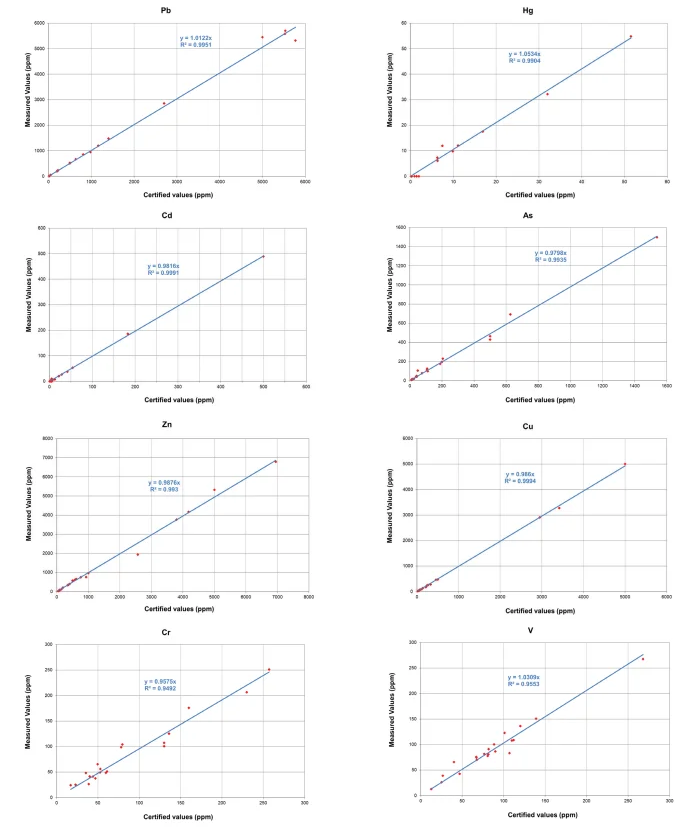
Figure 4. Correlation plots between certified and measured values using a Niton XL5 Plus handheld XRF analyzer (30-second measurement time per filter) for V, Cr, Cu, Zn, As, Cd, Hg and Pb in a set of 28 soil powder standard reference materials. Samples were introduced into cups fitted with a 4 µm polypropylene film. Image Credit: Thermo Fisher Scientific – Handheld Elemental & Radiation Detection
Conclusion
Handheld XRF analysis enables users to maximize their time and efficiency by performing real-time assessments and decreasing the quantity of soil samples sent to a lab via prescreening. The Niton XL5 Plus handheld XRF analyzer, with improved sensitivity and mobility, brings next-level power and innovations to customers today by:
- Detecting extremely low amounts of heavy metals in a point-and-shoot manner
- Producing high-quality analytical data in the field with minimal sample preparation
- Providing powerful elemental analysis in a compact, lightweight instrument
Environmental professionals, regulatory agencies, and construction firms may transform their environmental hazard assessment into an efficient, on-site, and cost-effective process that supports faster return on investment with:
- In situ measurements and site characterization that enable real-time decisions on metal pollutant hotspots in accordance with EPA Method 6200 and ISO 13196
- Triad7 strategy that manages uncertainty in the field
- Reduced external lab expenditures by in-house analysis and sample prescreening
- Maintaining contamination levels below thresholds and minimizing excavated soil volume by using post-extraction measurements
- Screening and clearing construction sites to prevent delays
- Instant measurement of eight RCRA elements and 12 EPA prioritized pollutants
- Higher sample density leads to more reliable field decisions that reflect site conditions
- Screen hazardous garbage and capture images using the onboard camera
- Monitoring brownfield cleanup efforts
References
- Federal Register. (2019). Resource Conservation and Recovery Act (RCRA). Available at: https://www.federalregister.gov/resource-conservation-and-recovery-act-rcra-.
- US EPA Method 6200. Field Portable x-ray fluorescence spectrometry for the determination of elemental concentrations in soils and sediments
- EPA (1998). Environmental Technology Verification Report Field Portable X-ray Fluorescence Analyzer Niton XL Spectrum Analyzer Environmental Technology Verification Program 058CMB98. (1998). Available at: https://archive.epa.gov/nrmrl/archive-etv/web/pdf/01_vr_niton.pdf.
- ISO. ISO 13196 Soil Quality - Screening soils for selected elements by energy dispersive X-ray fluorescence spectrometry using a handheld or portable instrument. Available at: https://www.iso.org/obp/ui/es/#iso:std:iso:13196:dis:ed-2:v1:en.
- ISO 13196, Validation Report, Soil Quality - Screening soils for selected elements by energy dispersive X-ray fluorescence spectrometry using a handheld or portable instrument
- Ramsey, M. (2008). Chapter 3: Contaminated Land: Cost-effective Investigation within Sampling Constraints. Royal Society of Chemistry. Doi: 10.1039/9781847558640-00039. https://books.rsc.org/books/edited-volume/1731/chapter-abstract/1033305/Contaminated-Land-Cost-effective-Investigation?redirectedFrom=fulltext.
- Triad Resource Center | Triad Overview. Available at: https://triadcentral.clu-in.org/over/index.cfm.
Acknowledgments
Produced using materials originally authored by M. Bauer from Thermo Fisher Scientific.

This information has been sourced, reviewed and adapted from materials provided by Thermo Fisher Scientific – Handheld Elemental & Radiation Detection.
For more information on this source, please visit Thermo Fisher Scientific – Handheld Elemental & Radiation Detection.