The wind energy giant Siemens Gamesa is establishing a pioneering wind-to-hydrogen project in Denmark and has chosen Green Hydrogen Systems (GHS) as its electrolysis partner.
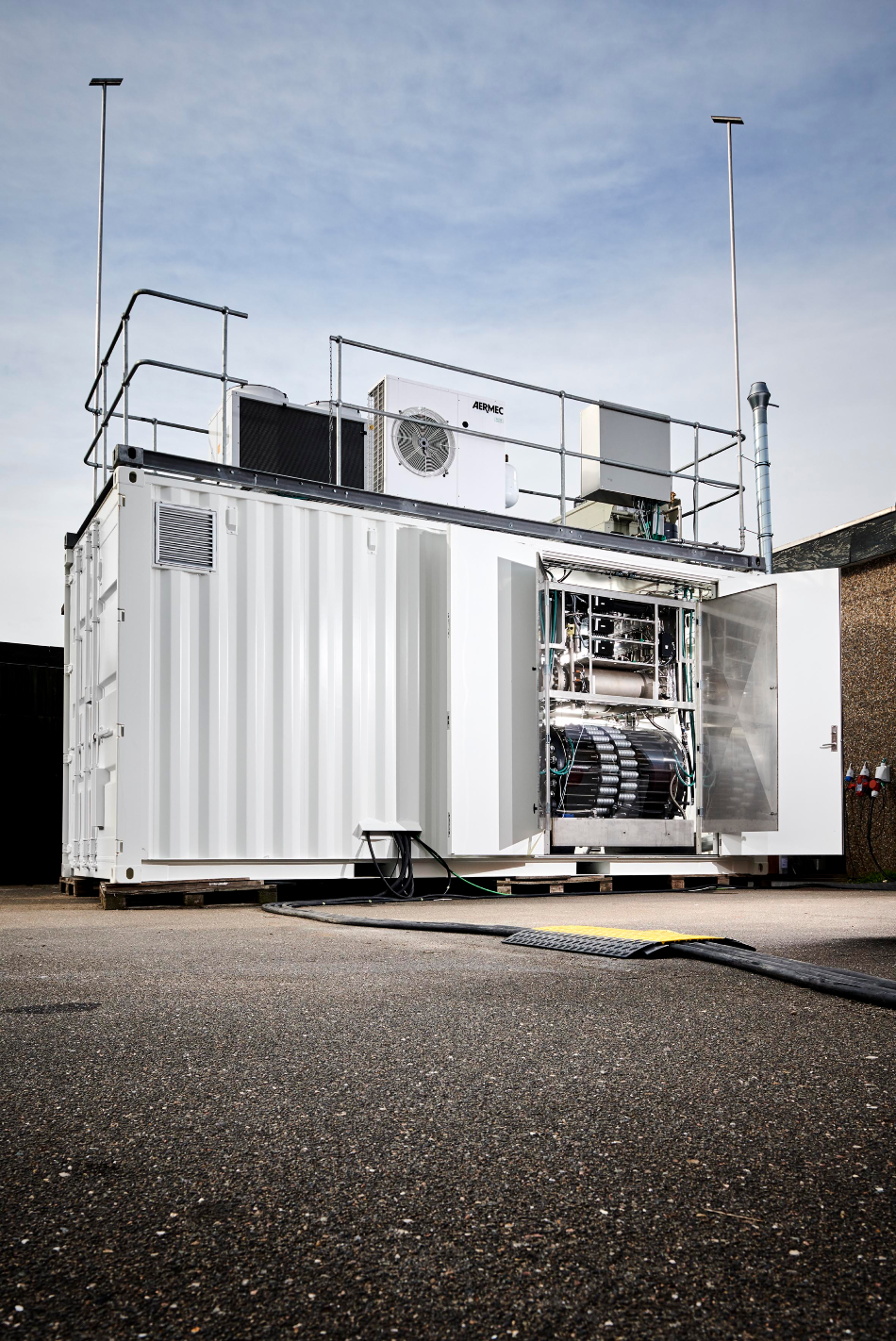 GHS electrolyzers are supplied as complete containerized solutions
The project will involve a 3 MW Siemens Gamesa wind turbine that feeds electricity into a GHS electrolyzer, which then uses the electricity to split water into its constituent parts, hydrogen and oxygen. The oxygen will be released into the atmosphere, and the hydrogen will be stored for subsequent distribution and use as a fuel for hydrogen-powered buses, taxis and cars.
Explosive growth in green hydrogen demand
Demand for hydrogen produced from renewable energy is seeing explosive growth, with the global project pipeline skyrocketing from 3.2 to 15 GW within the past year alone. The EU recently announced an ambitious hydrogen strategy targeting 6 GW of installed capacity in by 2024 and 40 GW by 2030. In addition to this, Germany, the Netherlands, France, Portugal and Norway have established ambitious national strategies for green hydrogen production.
To illustrate the business potential associated with these targets, the EU has outlined an investment scheme that allocates EUR 24–42 billion for scaling up electrolyzer capacity, and EUR 220–340 billion for the 80–120 GW of additional wind and solar capacity needed to power the electrolyzers.
“We are excited to launch this pioneering project and to have chosen Green Hydrogen Systems as our electrolysis partner. Their electrolyzer will form a key component in the project, which we hope will lead to a very lean and cost-effective means of storing and utilizing green energy from wind turbines,” says Finn Daugaard Madsen, Innovation Manager for Power-2-X applications at Siemens Gamesa.
Green Hydrogen Systems CEO Niels-Arne Baden says, “Europe is really banking on sustainable energy, and green hydrogen will and must play at vital role in the coming transition. Siemens Gamesa, which has recently launched the world’s largest wind turbine, is an obvious leader in making wind-hydrogen production the next big power-2-x application. We are very proud to have been chosen as electrolysis partner for this important and visionary project.”
Storable green energy
In conventional wind turbine operation, the turbine is connected to the power grid, and the energy it produces must be consumed immediately or go to waste. With this project, Siemens Gamesa will operate the turbine in “island mode.” Instead of feeding the power grid with electricity, the turbine will convert the electricity into hydrogen that can be stored and used at any time, with no waste. Successful island-mode production will constitute a major step forward for the industry – and sustainable energy in general.
High efficiency, low cost
GHS, which is already supplying its pressurized alkaline electrolyzers to hydrogen refueling stations and power-2-x facilities around Scandinavia, will provide Siemens Gamesa with a single HyProvide™ A-Series electrolyzer. Supplied as a complete containerized solution with all required installations included, the 400 kW system is designed to accommodate the fluctuating power output of wind turbines and ensure high efficiency. Combined with the on-site production approach, this enables the solution to produce green hydrogen at the lowest levelized cost available, and on the way to cost parity with fossil-based hydrogen.
The new Siemens Gamesa facility is expected to start hydrogen production in January 2021.