The rising demand for sustainable energy technologies has inspired researchers to develop multifunctional electrocatalysts capable of operating efficiently across multiple electrochemical reactions.
This study demonstrates how the solution-phase synthesis of an ordered Pd3Ni intermetallic compound is possible, a system typically considered difficult to obtain due to the frequent occurrence of disordered alloy formation in adjacent transition metals.
However, the ordered Pd3Ni intermetallic (Pd3Ni-IM) demonstrates excellent tetrafunctional electrocatalytic activity, supporting the hydrogen evolution reaction (HER) concurrently with the oxygen evolution reaction (OER), oxygen reduction reaction (ORR), and ethanol oxidation reaction (EOR). This unique combination means Pd3Ni intermetallic can be used in both water electrolyzers and fuel cell technologies.
This work also introduces “local entropy tailoring” as a key concept. This is where the reduced configurational entropy of the ordered intermetallic lattice, compared with its alloy counterpart, leads to improved site-specific structural stability. Differential scanning calorimetry and detailed structural analysis verify entropy-driven stabilization. To determine the reaction mechanism at the atomic level and discern between ordered and disordered Pd3Ni compounds, several operando spectroscopic and analytical techniques have been employed throughout this study.
Differential electrochemical mass spectrometry (DEMS) measurements acquired with a Hiden HPR-40 DEMS system (Type Cell A) were vital for elucidating the reaction pathways and product formation during electrochemical operation. DEMS also facilitated real-time identification of reaction products during ethanol oxidation in alkaline media. this reveals how CO2 is formed along with CH3CHO and CH3COOH for the Pd3Ni-IM catalyst.
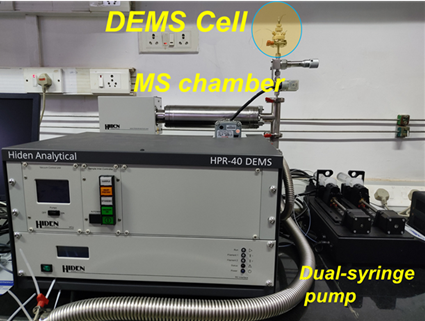
Figure (a). Full Hiden HPR-40 DEMS setup. Image Credit: Hiden Analytical
Therefore, it was possible to immediately confirm C-C bond cleavage and a 12-electron transfer pathway. On the other hand, the disordered Pd3Ni alloy catalyst exhibited no CO2 evolution, signaling only partial oxidation via a 4-electron pathway. These observations offer clear mechanistic evidence for the exceptional catalytic behavior of the ordered intermetallic.
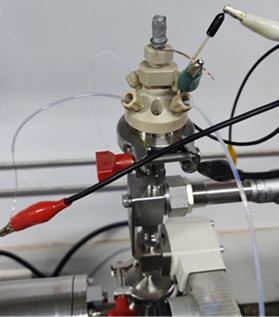
Figure (b). Type A cell with electrolyte inlet and outlet pipes. Image Credit: Hiden Analytical
The combination of DEMS and ATR-FTIR captures the in-situ evolution of surface-bound reaction intermediates and their time-dependent transformation during EOR, while simultaneously providing direct, real-time detection of volatile and gaseous products produced at the electrode-electrolyte interface. The excellent synergy demonstrated between these operando methods enables distinct correlation between surface chemistry, C-C bond cleavage, and electron-transfer pathways.
This reveals a novel and powerful approach for the mechanistic elucidation of complex electrocatalytic reactions.
Moreover, the application of DEMS analysis during HER and OER verified the parallel evolution of H2 and O2, which further demonstrates the multifunctional nature of the Pd3Ni-IM catalyst.
PXRD studies conducted post-reaction showed how the ordered intermetallic phase remains stable under HER, ORR, and EOR conditions up to 1.2 V vs RHE, while higher anodic potentials during OER trigger a movement toward a more disordered alloy phase.
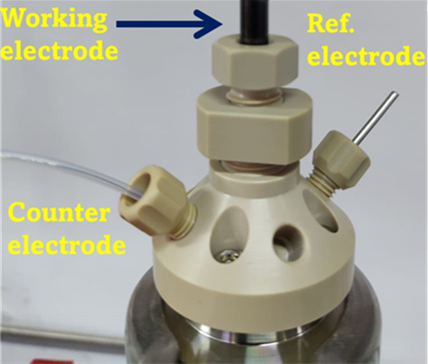
Figure (c). Type A cell with electrolyte inlet and outlet pipes. Image Credit: Hiden Analytical
This phase transformation acquired using PXRD is well-supported by in-situ XAS and in-Raman spectroscopic analysis during OER.
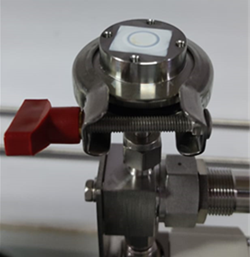
Figure (d). Pervaporation membrane on steel fruit. Image Credit: Hiden Analytical
This phase evolution underscores the crucial role pH plays as well as its operating potential in preserving intermetallic order under working conditions. Overall, this study reveals how DEMS analysis can deliver sophisticated mechanistic insights and guide the design of powerful, multifunctional electrocatalysts for next-generation energy conversion systems.
References
- Mondal, S., et al. (2026). Unravelling the Growth Mechanism of Local Entropy Tailored Intermetallic Pd3Ni Exhibiting Tetrafunctional Activity in a Water Electrolyzer and Fuel Cell. ACS Nano, 20(4), pp.3886–3903. DOI: 10.1021/acsnano.5c21752. https://pubs.acs.org/doi/10.1021/acsnano.5c21752?__cf_chl_f_tk=jWFGBqTjlk85u833QMPE9BZauliAWGr_p48oWeIj6yw-1782972281-1.0.1.1-kpfjpb1Frrnx5JLbEUSRxYir3qwGqyOQxTywoiwkiZ4.
Hiden Product: HPR-40 DEMS.

This information has been sourced, reviewed and adapted from materials provided by Hiden Analytical.
For more information on this source, please visit Hiden Analytical.