Vinyl chloride is an organochloride with the formula CH2 = CHCl. This important industrial chemical, also known as chloroethene and vinyl chloride monomer (VCM), is primarily used in the production of polyvinyl chloride (PVC).
Vinyl and PVC products are the third-most widely produced synthetic plastic polymer in the world, with approximately 34 million tons consumed globally.1
Vinyl chloride is an extremely flammable gas that is also potentially explosive. Virtually all vinyl chloride is produced by reacting ethylene and chlorine. This process initially produces ethylene dichloride (EDC), also known as 1,2-dichloroethane (DCE).
CH2 = CH2 + Cl2 → ClCH2CH2Cl
Next, ethylene dichloride is cracked at high temperature and pressure to produce vinyl chloride and hydrogen chloride.
ClCH2CH2Cl → CH2 = CHCl + HCl
Workplace Monitoring of Vinyl Chloride and Ethylene Dichloride
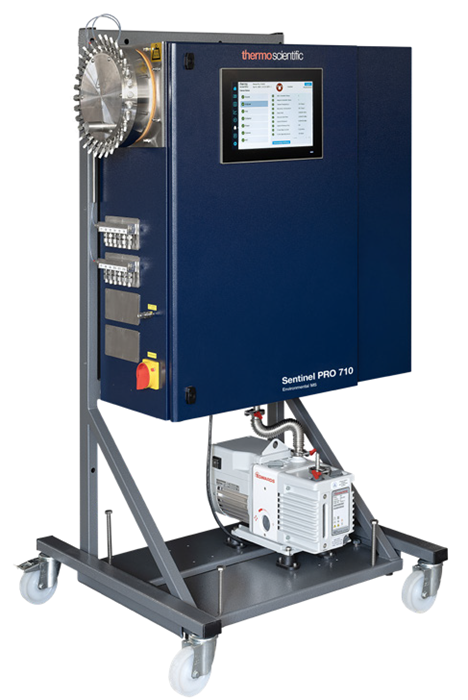
Thermo Scientific™ Sentinel PRO™ 710 Mass Spectrometer. Image Credit: Thermo Fisher Scientific – Environmental and Process Monitoring Instruments
Early laboratory studies have revealed that vinyl chloride can be a carcinogen, with the first fatalities linked to exposure to VCM reported in the 1970s. It can also cause angiosarcoma (cancer of the liver’s blood vessels).
These findings led to changes in production processes to protect workers. Governments around the world also began to mandate maximum allowable exposure levels in industrial settings.
The US Occupational Safety and Health Administration (OSHA) specifies a short-term exposure limit for vinyl chloride at 5 ppm (12.8 mg/m3) for any 15-minute period. This is the most common permissible exposure limit (PEL).
OSHA also states that “No employee may be exposed to vinyl chloride at concentrations greater than 1 ppm (2.56 mg/m3) averaged over any eight-hour period.”2
An ‘action level’ for VCM of 0.5 ppm is provided by OSHA as an eight-hour time-weighted average (TWA). This low limit indicates the VCM level that requires increased industrial hygiene, medical, or biological monitoring.
VCM is defined as a ‘potential occupational carcinogen’ by the US National Institute for Occupational Safety and Health (NIOSH), which suggests minimizing recommended exposure limits (RELs) to the lowest practical limit.3
Table 1 displays the OSHA short-term and TWA limits for both vinyl chloride and ethylene dichloride.
EDC is not as hazardous as VCM, but VCM production can potentially lead to the release of both EDC and VCM into the workplace. It is, therefore, important that any VCM monitoring system can differentiate between VCM and EDC.
This is key to ensuring false VCM alarms are not triggered by EDC levels that are high, but below the permitted exposure level.
Table 1 also shows the detection limits for the Thermo Scientific™ Sentinel™ PRO 710 Mass Spectrometer for comparison. These detection limits are considerably lower than the legal requirements, allowing leaks to be identified and corrected long before specified action limits are reached or exceeded.
Table 1. Typical exposure limits and Sentinel PRO detection limits for vinyl chloride and ethylene dichloride. Source: Thermo Fisher Scientific – Environmental and Process Monitoring Instruments
| Compound |
MW |
OSHA PEL 15-minute
STEL ppm2 |
OSHA PEL eight-hour
TWA ppm2 |
Sentinel PRO
detection limit |
| Vinyl chloride |
62 |
5 |
1 |
<20 ppb |
| Ethylene dichloride |
98 |
200 |
50 |
<20 ppb |
Area Monitoring Using Mass Spectrometry
Thermo Fisher Scientific has supplied online mass spectrometers (MS) for over 30 years. These instruments offer rapid, multi-component, multi-point gas analysis of VCM and EDC.
A single mass spectrometer can deliver total plant coverage. For example, the Sentinel PRO 710 Mass Spectrometer can monitor a single sample point for both VCM and EDC in just 12 seconds, including stream-settling time.
This short measurement time means that 60 sample points can be monitored in just 12 minutes, assuming that every point has been assigned equal priority.
In settings where some sample points are more important than others, for example, due to a higher risk of leaks or a higher level of personnel activity, it is possible to ensure these points are monitored more frequently by assigning them a higher priority.
A membrane inlet can be used to improve the system’s sensitivity to volatile organic compounds (VOCs). VOCs have higher permeability through the membrane than inorganic air gases, so this inlet increases their relative concentrations inside the MS to address this issue.
Electron ionization is then used to ionize and fragment the molecules. Each molecule generates a distinct ‘fragmentation pattern’ that can be employed in the identification and quantification of the various gas components found in a typical chemical plant atmosphere.
The range of fragmentation and isotope possibilities for all VOCs present in a typical plant environment creates a complicated composite spectrum.
Figure 1 features VCM and EDC mass spectra fragmentation patterns from the National Institute of Standards and Technology (NIST) library.
Although there are clear peaks at mass 98 and mass 100 that are specific to EDC, a significant overlap is observable at all the main peaks. This means that for the MS to differentiate between low levels of carcinogenic VCM and high levels of relatively harmless EDC, it must be able to accurately measure these interfering fragmentation patterns.
The MS must also offer high availability and avoid frequent recalibrations, which means these fragmentation patterns must remain stable over time.
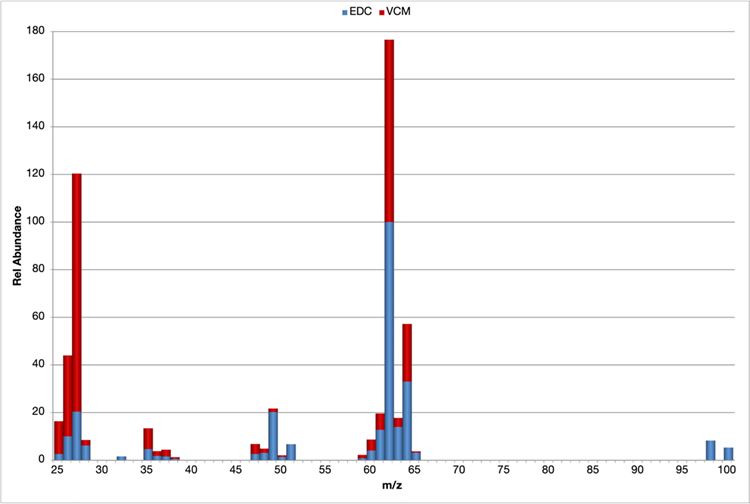
Figure 1. Composite mass spectrum of ethylene dichloride and vinyl chloride (NIST). Image Credit: Thermo Fisher Scientific – Environmental and Process Monitoring Instruments
Benefits of Magnetic Sector Mass Spectrometry
Two types of MS have historically been used for process and environmental monitoring over the past three decades: quadrupole and magnetic sector.
Thermo Fisher Scientific manufactures both of these MS types, with the company’s extensive industrial experience highlighting that the magnetic sector-based analyzer offers the best performance for both process and environmental industrial gas analysis.
Quadrupole MS was employed in earlier systems monitoring VCM in air, but these systems were susceptible to interference between VCM and EDC.
For example, the combination of membrane selectivities and varying MS sensitivities delivers a response ratio of 10:1 for EDC:VCM on a quadrupole MS. The equivalent response ratio for a magnetic sector MS is 3:1, highlighting that the magnetic sector’s selectivity toward VCM is over three times better than that of a quadrupole.
Other key benefits of magnetic sector analyzers include enhanced accuracy and precision, resistance to contamination, and extended periods between calibrations. Depending on the gases analyzed and mixture complexity, the analytical precision of a magnetic sector is typically two to 10 times better than that of a quadrupole analyzer.
Figure 2 features the Sentinel PRO 710 Mass Spectrometer’s magnetic sector analyzer, highlighting its characteristic flat-top peaks.
The peak’s height is directly proportional to the molecules’ concentration, meaning it is possible to measure peak height anywhere across the peak top to determine the correct result. This feature means that the magnetic sector analyzer is inherently fault-tolerant.
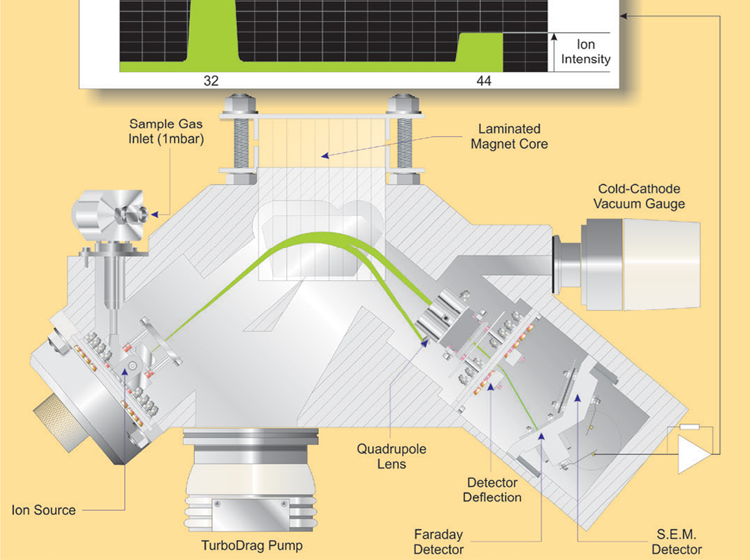
Figure 2. Sentinel PRO’s magnetic sector analyzer showing characteristic flat-top peaks. Image Credit: Thermo Fisher Scientific – Environmental and Process Monitoring Instruments
Multi-Stream Sampling
A robust multi-stream sampling system is needed to ensure that the MS provides total plant coverage. This system must offer rapid, reliable stream switching while ensuring there is no cross-contamination between streams.
The original RMS Rapid Multistream Sampler was developed by Thermo Fisher Scientific 35 years ago to meet these requirements. This highly reliable and essentially maintenance-free device is now on its third generation.
The RMS is available with either 32 or 64 sample points. Two RMS units can be used in series if more sample points are required, offering a total of 127 sample points.
Many hundreds of these stream selectors are installed worldwide across a wide range of process and environmental settings. The RMS remains the only multi-stream sampling system that comes with a three-year warranty as standard.
The selected sample is diverted from the RMS, past the membrane inlet, and into the mass spectrometer ion source, where it is permeated by sample gas. It is then ionized via collisions with a high-energy electron beam.
Next, the resulting positively charged ions are accelerated into the scanning magnetic sector, sequentially separating the ions and measuring the signal’s intensity as it is generated at the detector.
This setup delivers measurements that are linear across several orders of magnitude and remain extremely stable. Configuring the Sentinel PRO 710 Mass Spectrometer for fugitive emissions monitoring enables routine attainment of detection limits in the parts-per-billion (ppb) range.
The highly precise nature and short interval between measurements ensure that leaks can be identified and corrected long before specified action limits are reached or exceeded.
Stability
Figure 3 displays a 24-hour stability check on a cylinder that nominally contains 5 ppm VCM in air. The readings are highly stable with a standard deviation of just 18 ppb absolute (0.36% relative). This data was reviewed using the Thermo Scientific™ GasWorks Data Review facility.
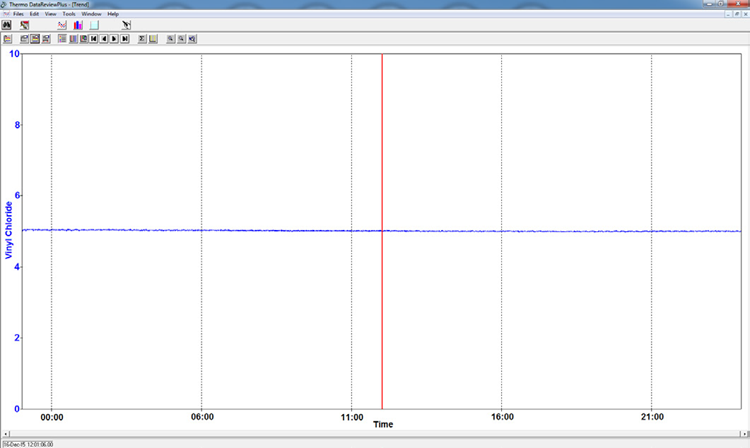
Figure 3. 24-hour stability run on 5 ppm VCM. Image Credit: Thermo Fisher Scientific – Environmental and Process Monitoring Instruments
Selectivity and Flexibility
VCM and EDC remain the most common combination of VOCs measured using the Sentinel PRO 710 Mass Spectrometer, although some processes require monitoring of a different set of chlorinated compounds. Table 2 features the analysis specification for multi-point monitoring of ppm levels of vinyl chloride, ethyl chloroformate and vinyl acetate in ambient air.
Table 2. Analysis specification for VCM, ECF and VA. Source: Thermo Fisher Scientific – Environmental and Process Monitoring Instruments
| Component |
Vinyl chloride
(VCM) |
Ethyl chloroformate
(ECF) |
Vinyl acetate
(VA) |
| Molecular weight |
62 |
108 |
86 |
| Formula |
C2H3Cl |
C3H5ClO2 |
C4H6O2 |
Sentinel PRO lower
detection limit (LDL) |
20 ppb |
20 ppb |
20 ppb |
Table 3 features the analysis configuration that enabled this specification. GasWorks software supports multiple analysis methods and can apply different methods to different sample streams.
For example, this means that the Sentinel PRO 710 Mass Spectrometer can be configured to provide total site coverage, measuring VCM and EDC at specific sample locations and VCM, ECF, and VA at other locations.
Table 3. Analysis configuration for VCM, ECF and VA. Source: Thermo Fisher Scientific – Environmental and Process Monitoring Instruments
| Component |
Air |
VCM |
ECF |
VA |
| Detector |
Multiplier |
Multiplier |
Multiplier |
Multiplier |
Typical relative sensitivity (compared
with air measured at mass 34) |
1 |
8000 |
25,000 |
10,000 |
| Measurement masses |
| m/z 34 |
100 |
|
|
|
| m/z 62 |
|
100 |
|
|
| m/z 63 |
|
20 |
100 |
|
| m/z 86 |
|
|
|
100 |
Summary
The Sentinel PRO 710 Mass Spectrometer delivers rapid response and broad coverage when configured to monitor point-source and fugitive emissions.
The incidence of alarms is often high when the equipment is first installed, but experience has shown that the efficient correction of accumulated leaks and improvements to standard operating procedures help to enable a considerable reduction in toxic emissions throughout the facility.
The technology’s reliable nature and its flexible configuration options ensure a low cost of ownership, while its capacity to measure VCM and other chlorinated hydrocarbons with ppb repeatability ensures there is no risk of future environmental regulations compromising the installation.
The Sentinel PRO 710 Mass Spectrometer offers a range of benefits, including:
- An RMS inlet for rapid, reliable multipoint sampling: Up to 127 sample points
- A membrane inlet to ensure high sensitivity: Detection limits far lower than legal exposure limits
- A magnetic sector MS with the highest stability and precision: Optimal selectivity against ethylene dichloride; identification of trace components, even in complex mixtures; and maximum availability due to the need for infrequent calibration
- Multiple compounds monitored via a single system: Other VOCs can be added with no additional hardware, and a remote analyzer can be connected for other gas analyzers
- A three-year warranty as standard
References and Further Reading
- British Plastic Federation (2019). The UK’s Leading Plastic Trade Association. Available at: http://www.bpf.co.uk/.
- OSHA. 1910.1017 - Vinyl chloride. | Occupational Safety and Health Administration. Available at: https://www.osha.gov/laws-regs/regulations/standardnumber/1910/1910.1017.
- CDC (2019). CDC - NIOSH Pocket Guide to Chemical Hazards - Vinyl chloride. Available at: http://www.cdc.gov/niosh/npg/npgd0658.html.

This information has been sourced, reviewed, and adapted from materials provided by Thermo Fisher Scientific – Environmental and Process Monitoring Instruments.
For more information on this source, please visit Thermo Fisher Scientific – Environmental and Process Monitoring Instruments.