The legacy of a world record-breaking solar car, developed by and raced by Charles Darwin University (CDU) students and staff, will be preserved and celebrated in the Northern Territory’s premier museum.
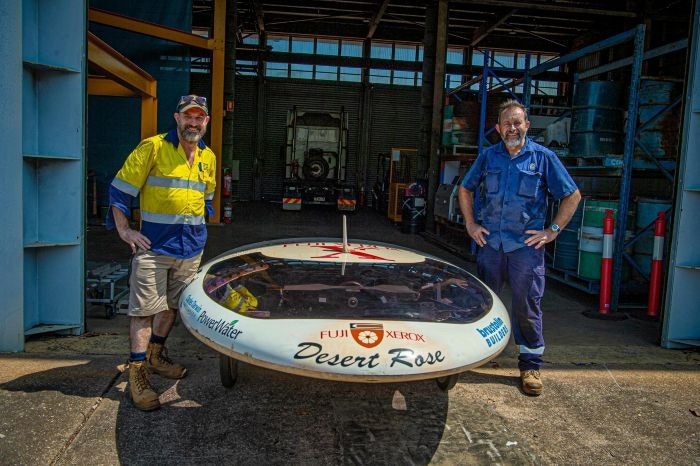 Museum and Art Gallery of the Northern Territory History Curator Jared Archibald (right) with the Desert Rose solar car. Image Credit: Charles Darwin University
The Desert Rose solar car represented the Northern Territory multiple times in the World Solar Car Challenge, breaking a world record holding a speed of over 106km/h over a test track during Sunrace in 2000 in Australia.
This week, it was donated to the Museum and Art Gallery of the Northern Territory (MAGNT). The Desert Rose’s legacy has recently been celebrated at CDU’s Casuarina Library, which has facilitated the donation.
CDU Director Library Services Bernadette Royal and her team were thrilled for the car’s next historic journey.
"The car represents a milestone in the Territory's history in renewable energy and innovation, and we are really excited to be able to donate it to MAGNT," Ms Royal said.
"MAGNT will preserve and eventually have the Desert Rose on display as it's story deserves to be shared more widely."
CDU alumnus and current PhD candidate Steven Camilleri was part of the Desert Rose’s team from 1995 to 2002.
He and teammate Byron Kennedy developed the drive system which led the car to break the world speed record for solar cars in 2000.
Mr Camilleri cited the Desert Rose as playing a crucial part of his engineering career, including leading to the founding of high-speed, metal 3D printing company SPEE3D with Mr Kennedy.
"The solar car gave me tools to gain practical experience, and helped propel my own career in engineering," Mr Camilleri said.
"I always wanted my work to be about making a difference, to have this preserved I know means a lot to me but also will to all the former Desert Rose solar car team members."
MAGNT History Curator Jared Archibald was delighted to welcome this remarkable piece of Territory history into the museum's collection.
"This solar car tells an important story about the Territory’s world class leadership in multiple World Solar Challenges and the people who helped make it happen," Mr Archibald said.
"In preserving this vehicle, we will continue to share this story with future generations, celebrating the legacy of Territory ingenuity, innovation and ambition."
Next year marks the 40th anniversary since the first World Solar Challenge, which continues to showcase the development of advanced automotive technology and promote alternatives to conventional vehicle engines.