In this interview, AZoCleantech speaks with Alex Mellor, Director of Engineering at Naked Energy, about heat decarbonization, which he argues has been overlooked compared with electricity decarbonization. Combining solar thermal technologies, like Naked Energy's Virtu, with heat pumps and existing infrastructure can cut emissions, reduce costs, and accelerate industrial and commercial heat decarbonization.
You’ve described heat as the “forgotten 40%” of global carbon emissions. From your perspective, why has heat decarbonization lagged so far behind power decarbonization, and what are the biggest misconceptions you still encounter about it?
Heat has lagged behind power largely because it’s less visible and more complex. Electricity has benefited from clear infrastructure, strong policy support, and technologies like wind turbines and solar panels that are easy for people to understand. Heat, by contrast, is deeply embedded in buildings and industrial processes, making it harder to standardize and, historically, easier to overlook.
One of the biggest misconceptions is that electrification alone will solve the problem. Heat pumps are a critical part of the solution, but if we try to electrify all heat without considering system efficiency, we risk increasing consumer costs and placing a huge strain on the grid.
The current plans by the National Grid to upgrade its network across the country are set to cost up to £35 billion from 2026 to 2031, and this is before you take into account that electricity will grow by 50% in the next decade.
At the consumer level, replacing gas boilers with heat pumps is a like-for-like swap that increases energy bills for many consumers, which is a barrier to uptake.
However, by combining technologies such as solar thermal and heat pumps in integrated systems, energy bills can be reduced rather than increased when de-gassing a site. This is particularly interesting in the commercial and industrial applications that account for 70% of global heat use.
Viewed this way, the costs and demand growth prove that heat needs its own dedicated strategy, rather than being treated as an extension of electricity.
There’s also a perception that decarbonizing heat requires entirely new or unproven technologies. Solutions like solar thermal are already deployed at scale and can deliver immediate impact, particularly in commercial and industrial settings where year-round demand for hot water and process heat is high.
The challenge of heat decarbonization is significant, but so is the opportunity it presents. By combining proven technologies with smarter system design, including storage and integration with existing infrastructure, we can decarbonize heat far more quickly than many expect. However, this requires a shift in mindset to treat heat as a priority rather than an afterthought.
Industrial heat demands are notoriously variable and site-specific. How do you integrate Naked Energy's Virtu technology into existing industrial processes and district energy systems without disrupting reliability or production?
In most cases, Virtu is integrated alongside existing infrastructure rather than replacing it outright.
For example, if you install it with a heat pump, solar thermal preheats water before it enters the main process. Essentially, you are giving the heat pump a head start: it doesn't need to meet the full heat load, and the gap between the heat generated by Virtu and the temperature it needs is closed. Therefore, it reduces the heat pump's overall electrical consumption and the business’s operational costs.
In district energy systems, the principle is similar. Solar thermal can be integrated to reduce the overall heat input required and, when combined with heat pumps, can lower grid demand. So, it increases overall efficiency while reducing OpEx costs.
The challenge often centers on temperature compatibility, particularly in older networks, but this can be addressed through system design and gradual optimization.
An additional benefit businesses receive when pairing Virtu with their existing heating technologies is the flexibility for their heat decarbonization plans. They can start by immediately reducing a portion of fossil fuel use without major disruption, then add more renewable heat technologies over time.
Solar thermal technologies are the ideal roadmap technologies enabling heat decarbonization in line with the realities of industrial operations.
The British Library project is now the largest solar thermal installation in the UK. What were the main engineering and heritage-related constraints on that site, and how did they shape decisions around system design, controls, and integration with the Library’s existing plant?
The British Library is a great example of how you can deploy large-scale renewable heat in a highly constrained, real-world environment.
From an engineering perspective, one of the main challenges was integrating into an existing, complex energy system without disrupting operations. The library has a continuous demand for hot water and strict requirements around environmental control, so reliability was critical.
We designed the system to connect to the existing plant, allowing the solar thermal to preheat water and reduce the load on the primary heating system.
On the heritage side, the constraints were equally important. The building has a distinctive architectural profile and is Grade I listed, so any installation had to be invisible from street level while meeting energy demand within the given roof space.
That’s where the high-energy density of Virtu really matters, as it allows you to generate more energy from a smaller footprint, making it viable even on constrained sites. Its tubular flat design also made it invisible from street level, meaning it was the only solar technology that could get through the strict planning hurdles.
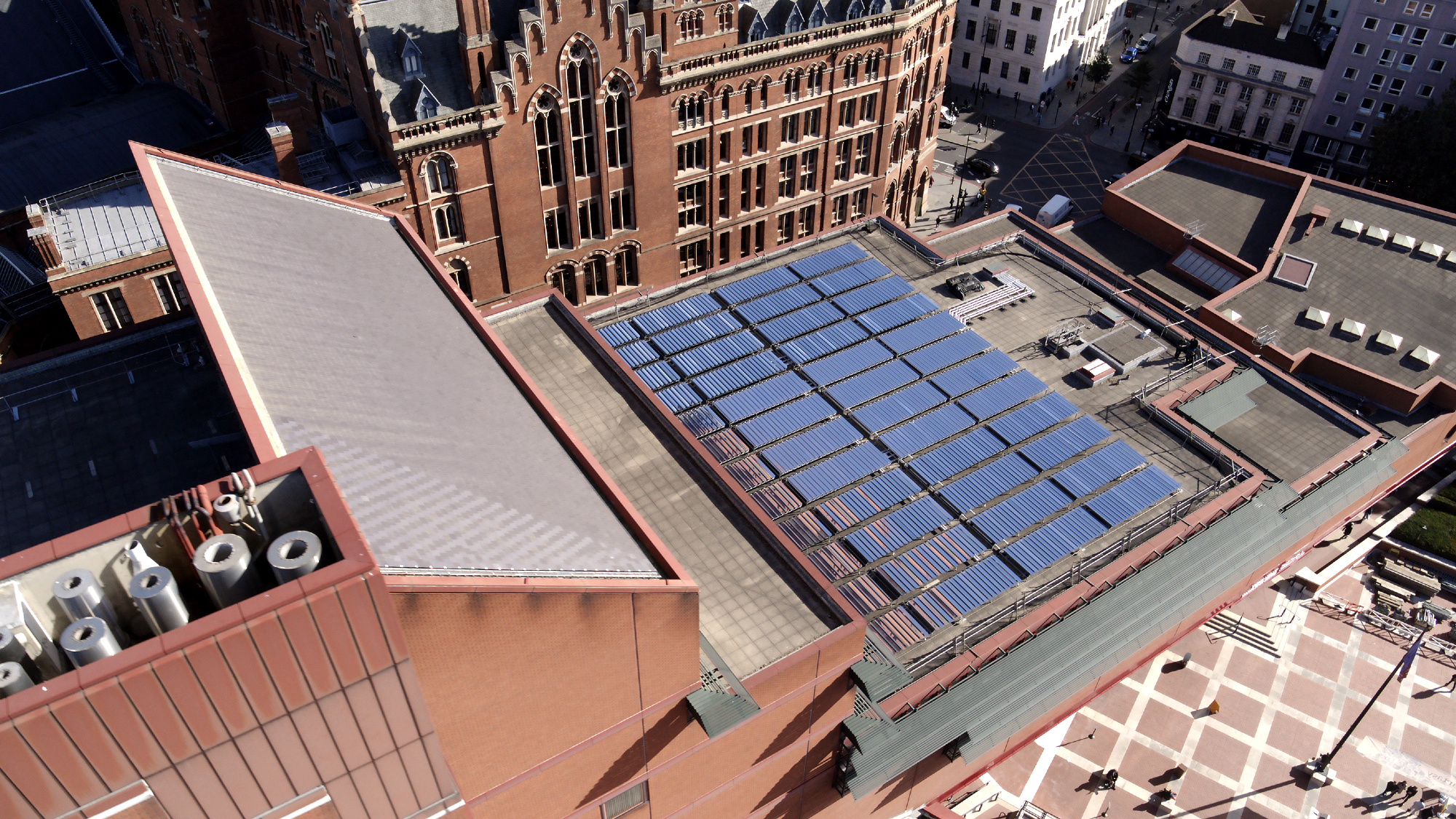
The British Library Project. Image Credit: Naked Energy
Beyond emissions reduction, the British Library project is also about protecting rare and sensitive collections. How does having on-site, solar-derived heat and electricity affect environmental control strategies, redundancy, and risk management for critical buildings like this?
The British Library’s humidity control system uses steam and desiccant dehumidifiers. The heated water from the collectors contributes to the latter by heating the air to 60 °C, which then passes through the dehumidifier to remove moisture.
Conventionally, this is done via a ‘space heating loop’ or LTHW headers, and since the Virtu system contributes to space heating, it is also connected to the desiccant dehumidification system.
Virtu has achieved TÜV “gold standard” certification, including operation from -40 to 240 °C and resistance to extreme hail and lightning. Which design and materials choices were most critical in achieving that level of robustness, and how does this durability translate into lifecycle cost and bankability?
The key challenge is maintaining a vacuum over a long period in a cost-effective way. Outdoor conditions expose solar technologies to UV light, extreme temperatures, and humidity, which vary by location.
If materials, especially vacuum seals, are not well chosen and designed, this can lead to degradation and a loss of performance over the product’s lifetime.
Naked Energy has put a lot of work into this, and we now have an evacuated solar thermal technology with a 20- to 25-year outdoor lifetime. This has been proven by subjecting Virtu to environmental testing. We’ve actually subjected it to four times more testing than required by the testing standard.
It also delivers up to 50% higher financial return per m2 compared to conventional solar PV, as it generates power from the same space as PV, which translates to better net savings.
All of these aspects combined lead to greater energy independence for the end customer.

Image Credit: Naked Energy
Scaling industrial heat decarbonization globally will require work across many climates and regulatory environments. Where do you see the strongest near-term opportunities for Virtu deployment, and what policy or market shifts would most accelerate adoption?
The strongest near-term opportunities are in sectors where heat demand is both high and consistent. Industries like food and beverage manufacturing, such as breweries, dairies, and distilleries, are great examples.
They all rely heavily on low- to medium-temperature heat for processes such as washing, pasteurization, and sterilization. That creates a constant demand profile, which is ideal for solar thermal because you can directly displace fossil fuels and start reducing carbon and costs from day one.
The same applies in settings such as hotels, leisure centers, and healthcare, where there’s a continuous need for hot water. In these environments, a similar reduction in costs is seen while generating renewable energy.
Geographically, Europe is a clear near-term opportunity because policy is starting to catch up with the reality that heat is a major part of the decarbonization challenge. We’re seeing more support for district heating, industrial decarbonization, and integrated energy systems. In the UK, retrofit projects in which organizations aim to reduce gas consumption without waiting for grid upgrades are particularly interesting.
Across these markets and sectors, we see a shift away from a single-technology mindset toward a more integrated technology mix. This shift leads to more requests to pair heat pumps with solar thermal, due to its benefits of electrical-load reduction, thereby lowering operating costs and improving overall system efficiency.
For organizations currently focused almost exclusively on electrification and rooftop PV, what questions should they ask to determine whether a solar heating solution could unlock greater decarbonization or cost savings?
The first question organizations should be asking is: what proportion of our energy use is for hot water, space heating, or process heat? In many commercial and industrial buildings, such can be the majority of total demand, so focusing only on electricity leaves a significant decarbonization opportunity untapped.
The second consideration is how that heat is currently being generated and what it costs. If you’re relying on gas or switching to a fully electric system, you’re either exposed to carbon or to volatile electricity prices. Understanding that baseline is key to evaluating alternatives.
They should also look at their demand profile and ask, “Do we have a consistent, year-round need for heat?” If the answer is yes, then technologies like solar thermal become much more compelling, because that energy can be generated and used directly on-site with very low operating costs. Heat generated by solar thermal can also be stored in specially insulated hot water tanks and used later.
Another important question is about space. Roof area is often limited, so how can energy output be maximized per square meter? That’s where high-density hybrid solutions can come into play.
Finally, it’s about system design. Instead of asking “how do we electrify everything?”, the better question is “what is the most efficient combination of technologies for our site and energy demand?”
Looking ahead over the next decade, what technical advances or system-level innovations do you think will be most transformative for decarbonizing medium- and high-temperature heat in industry and large commercial buildings?
In industry, a key challenge is delivering the required temperatures for industrial processes, using renewable heat sources. Naked Energy has an in-house design-engineering team working on total de-steaming of industrial sites using the combined systems I described earlier, which can provide process steam using a combination of solar and grid electricity while minimizing electrical input.
In a commercial setting, the focus is on achieving a very low-cost deployment for combined systems to reduce the levelized cost of heat. As well as continually reducing the cost and improving the performance of our hardware technology, Naked Energy has developed design software and a suite of standardized designs for commercial systems, which reduce design and sales costs, translating into savings for the end user.
Heat networks are also a growing means of delivering cleaner heat to multiple end users. Naked Energy has developed a large-scale version of our Virtu technology that can be deployed in solar fields in a cost-effective way, making it an ideal choice to supplement a heat network with low-cost, carbon-free solar heat.
These solutions are already making an impact in industry and commercial sectors, but further innovation and adoption will go a long way toward transforming heat decarbonization in these sectors.
About Dr. Alex Mellor

Dr. Alex Mellor is Director of Engineering at Naked Energy. He started out in solar R&D before joining Naked Energy in 2018, where his role spans hardware and software development of the Virtu product range and Clarity software suite, customer engagement, and project delivery.
Following a lifelong passion for solar, he has become fascinated by how we use heat across society, and how innovative technology can be brought to bear on its decarbonization.
Alex holds a PhD in Solar Energy Technology from the Institute of Solar Energy in Madrid, Spain. Prior to joining Naked Energy, he was a Marie Sklodowska-Curie Research Fellow at Imperial College and a visiting researcher at the Fraunhofer Institute in Germany.
Dr. Mellor has authored two patents and 21 published papers on PV-T technology, high-efficiency PV, off-grid systems for rural areas, and PV for space power, as well as a book on quantum solar cells.
His passion for research and teaching led him to perform spectroscopy on the 16th-century armor of Lord Buckhurst for the Wallace Collection and to deliver a series of solar-energy workshops at local schools.
Disclaimer: The views expressed here are those of the interviewee and do not necessarily represent the views of AZoM.com Limited (T/A) AZoNetwork, the owner and operator of this website. This disclaimer forms part of the Terms and Conditions of use of this website.