Sponsored by TOFWERKReviewed by Olivia FrostAug 20 2026
Road traffic generates a range of aerosols, from fine particulate matter to gaseous species. These aerosols include both polymeric and metallic particles.

Image Credit: captainX/Shutterstock.com
Motorized transport also produces non-exhaust vehicle emissions, as well as the expected combustion byproducts from fuel and lubricants. These emissions stem from road surface erosion, the mechanical abrasion of tires and brakes, and the resuspension of accumulated dust.
Each source releases metals with distinct chemical signatures. For example, road wear is characterized by crustal elements like magnesium (Mg), silicon (Si), aluminum (Al), and calcium (Ca).1
Tire wear is dominated by the key vulcanization additive zinc (Zn),2 and brake wear is associated with a complicated metallic profile that often contains chromium (Cr), manganese (Mn), barium (Ba), antimony (Sb), iron (Fe), copper (Cu), and tin (Sn).3,4
Non-exhaust vehicle emissions represent a major and widely underexplored urban particulate pollution source.
These metals are primarily released as airborne fine particulate matter ranging from 0.01 to 10 µm. These fine metal-containing particles can enter the respiratory tract,5 penetrating into lung tissue and inducing oxidative stress by interacting with metal-binding proteins.6
This key characteristic alone means that non-exhaust vehicle emissions are a vital public health concern, especially in densely populated urban environments. The European Union has introduced the EURO7 standard (Regulation 2024/1257) to help address these health concerns, marking a paradigm shift as the first framework explicitly created to regulate vehicles.
The framework seeks to better manage non-exhaust vehicle emissions, enforcing limits on particulate and metallic emissions from brake and tire wear.
This key regulatory evolution also creates an urgent need for appropriate, high-time-resolution methods able to perform real-world assessments of metal content in airborne fine particles.
Typical approaches to airborne metal measurement depend on trapping particles on filters over extended periods, typically several hours.7 These long averaging times fail to capture key time-dependent concentrations of non-exhaust vehicle emissions in the field, however.
For example, rapid fluctuations in traffic conditions are typically found at key emission sources like steep slopes, intersections, and tunnels, varying according to factors such as weather, time of day, and other environmental conditions, which cannot easily be documented.
This article outlines the use of a microwave inductively coupled plasma time-of-flight mass spectrometer (mipTOF) for real-time, mobile quantification of trace airborne metals.
The instrument in this example was integrated into the Paul Scherrer Institute’s MOSOUITA mobile laboratory and prepared for continuous sampling while driving through downtown Bern, Switzerland.
The captured measurements highlighted distinct, localized emission plumes of metals linked to non-exhaust vehicle emissions, especially those from brake wear.
It was also noted that these plumes peaked within a sloped motorway access tunnel, where concentrations of Fe and other specific metals reached up to 1000 times background levels.
Experimental Setup and Instrument Description
The mipTOF is the first commercially available high-power, nitrogen-plasma-driven, time-of-flight mass spectrometer.
The mipTOF is comprised of a microwave-induced plasma source (MICAP, Radom Corp., USA) that has been coupled to TOFWERK’s mass spectrometer. The spectrometer features ion optics designed to guide the ion beam and remove neutral species, while a notch filter selectively removes ions of a defined mass-to-charge ratio (m/O).
An orthogonally accelerating time-of-flight (TOF) mass analyzer facilitates the acquisition of full mass spectra with a high time resolution.
The mipTOF's plasma operates between 800 and 1500 W of power, is sustained with nitrogen (N2), and reaches a gas temperature >5000 K. These conditions facilitate vaporization, atomization, and ionization of aerosols directly injected into the plasma.
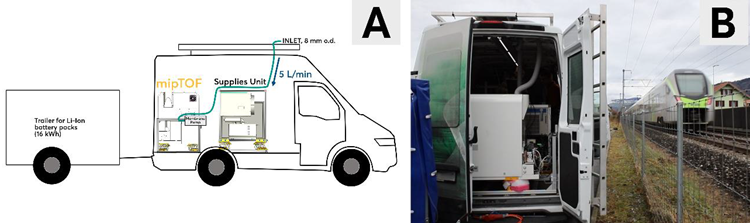
Figure 1. (A) mipTOF setup in MOSQUITA Car. Air sampled at 5 L/minute via 8 mm polymer tubing, routed directly or through a HEPA filter. (B) Field photo of the equipped vehicle near train tracks. Image Credit: TOFWERK
The mipTOF differs from conventional ICP-MS as it can directly analyze aerosol particles without the need for external dilution devices or gas exchange.8 Ambient air is drawn into the MICAP via a concentric pneumatic nebulizer (ARG 07 US6, Glass Expansion, Australia), which is operated as a Venturi pump.
A DryCal Defender 520 (MeasLabs, USA) was used to calibrate sample gas flow prior to performing any measurements. The instrument introduces ambient air into the N2 plasma’s central channel at a flow rate of approximately 120 cm3 per minute.
During analysis, average mass spectra are generated every 5 ms from a total of 167 individual TOF extractions. The accurate peak identification and isobaric species deconvolution are enabled by capturing complete spectra.
Integrated mass peaks across the entire elemental mass-to-charge range allow analyte time trends to be followed in real time.
Elemental concentrations of particulate matter in the measured aerosol were also calculated based on a combination of liquid multi-element standards, standard Ag nanoparticles, and a gas blank that had been filtered from air.
It was possible to determine the required transport efficiency parameter on a daily basis using the 'particle-size method'.9,10
Table 1 details the relevant instrument parameters.
Table 1. Instrument parameters. Source: TOFWERK
| |
|
| Gas Sampling Rate |
120 cm3/minute |
| MICAP Power |
1.45 kW |
| Plasma Sampling Depth |
3 mm |
| Spectral Generation Rate |
200 Hz |
To install mipTOF in the MOSOUITA vehicle, the main and supply units were mounted on vibration-dampening wire-loop isolators (Figure 1).
Base frames were directly secured to the vehicle floor, while power (around three hours of operation per charge) was supplied by two 8 kWh lithium-ion battery packs (EcoPowerTrolley, EcoVolta, Switzerland) housed in a trailer.
The air-sampling inlet was situated above the front window, allowing air to enter via an 8 mm OD polymer tube (PEN 8x1.25, Festo) at a rate of 5 liters per minute. Sampled air was either routed directly to the mipTOF or via a HEPA filter (Low Pressure Drop HEPA, TSI, USA) using shut-off valves.
Next, a subsample of air was introduced into the instrument at a rate of 120 cm3 per minute. It was likely that polymer tubing and non-full-bore valves led to limited large-particle transport efficiency, but this cutoff was not characterized.
Results
The mipTOF offers airborne metal analysis with high time resolution, offering a degree of temporal and spatial detail that is currently unavailable with alternative technologies.
Figures 2 and 3 highlight the value of this high-resolution data, allowing users to precisely identify emission sources or capture fast transient signals that are generally lost as a result of wider time-interval integration.
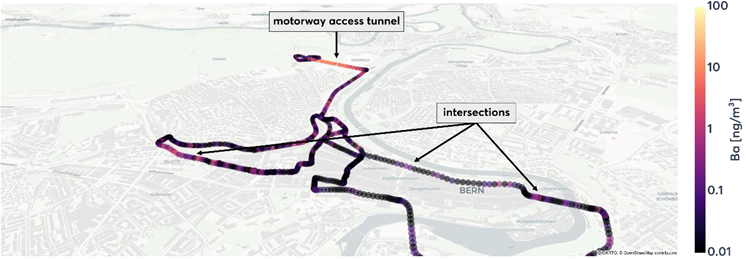
Figure 2. High-resolution mobile trace of airborne barium (Ba) concentrations across Bern, Switzerland. Data points represent three-second integrated averages. Elevated concentrations are highly localized, occurring primarily at major intersections and within the Neufe ld motorway access tunnel (as marked on the map). Image Credit: TOFWERK
Figure 2 shows a quantified time trace of airborne Ba concentrations. These concentrations provide a high-resolution view of aerosol dynamics recorded during a MOSOUITA vehicle ride through the city of Bern, with data points representing average concentrations calculated over three-second intervals.
The vehicle traversed several intersections during this measurement campaign, as well as passing through the Neufeld motorway access tunnel located in northern Bern.
The data shows highly localized elevated Ba concentrations present almost exclusively within the tunnel and at these specific intersections. These observations clearly highlight the potential for spatial variability in terms of non-exhaust vehicle emissions in real-world traffic conditions.
Figure 3 features time traces for a broader suite of elements during the tunnel transect, allowing the chemical composition of these hotspots to be further investigated.
This detailed view highlights concentrations of vehicle emissions in the confined tunnel space, showing a distinct clustering of metals, including Cr, Mn, Ba, Sb, Fe, Cu, and Sn.
The presence of these elements strongly suggests that the observed vehicle emissions are primarily comprised of non-exhaust emissions, particularly those typically linked to brake wear.3,4
Measured concentrations enable quantification of acute exposure levels for road workers, car passengers, and pedestrians, allowing these potentially health-affecting metals to be expressed as absolute mass per volume (ng/m3).
The mipTOF also allows assessment of metal content per particle (fg/particle), thereby enabling exposure studies that can be linked to particle-size data from complementary methods.
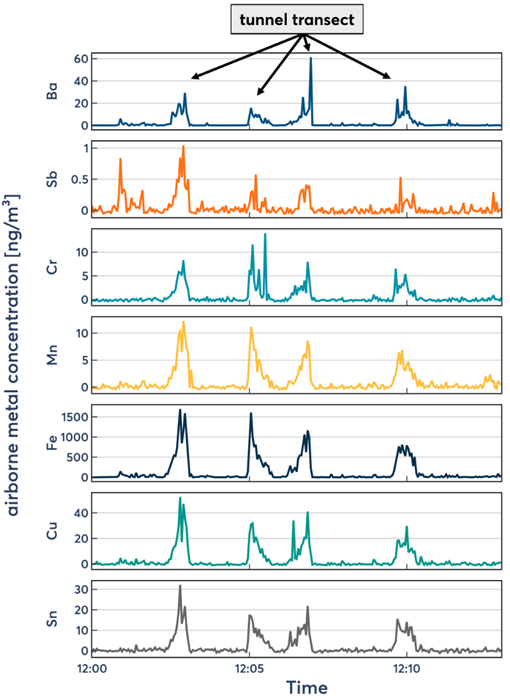
Figure 3. Time traces of airborne metal concentrations across the Neufeld tunnel transect, showing simultaneous spikes in Ba, Sb, Cr, Mn, Fe, Cu, and Sn. The co-occurrence of these specific elements within the tunnel points to non-exhaust emissions driven by brake wear abrasion as the source of the aerosol plume. Image Credit: TOFWERK
Conclusion
The mipTOF is a field-deployable, mobile mass spectrometer specifically engineered for direct, rapid elemental analysis of pollutants in ambient air.
This instrument delivers a combination of excellent sensitivity and high temporal resolution, allowing the precise characterization of airborne trace metals.
The mipTOF's unique capabilities have been successfully demonstrated via continuous, real-time measurements of vehicle emissions collected as part of a mobile laboratory vehicle ride-through campaign across a dense urban area.
This real-time metal aerosol detection allows researchers to rapidly identify and screen transient, highly localized emission sources with great spatial detail.
The study presented here successfully pinpointed distinct non-exhaust vehicle emissions arising from everyday traffic patterns.
These measurements facilitate an enhanced understanding of acute exposure risks, as well as the dynamic behavior of metal emissions and non-exhaust vehicle emissions in urban environments.
References and Further Reading
- Kupiainen, K., Tervahattu, H. and Räisänen, M. (2003). Experimental studies about the impact of traction sand on urban road dust composition. Science of TheTotal Environment, 308(1–3), pp.175–184. DOI:10.1016/S0048-9697(02)00674-5. https://www.sciencedirect.com/science/article/abs/pii/S0048969702006745.
- Jeong, H. (2022). Toxic metal concentrations and Cu–Zn–Pb isotopic compositions in tires. Journal of Analytical Science and Technology, 13(1). DOI:10.1186/s40543-021-00312-3. https://link.springer.com/article/10.1186/S40543-021-00312-3.
- Hagino, H., Oyama, M. and Sasaki, S. (2016). Laboratory testing of airborne brake wear particle emissions using a dynamometer system under urban city driving cycles. Atmospheric Environment, 131, pp.269–278. DOI:10.1016/j.atmosenv.2016.02.014. https://www.sciencedirect.com/science/article/pii/S135223101630125X.
- Hulskotte, J.H.J., Roskam, G.D. and Denier van der Gon, H.A.C. (2014). Elemental composition of current automotive braking materials and derived air emission factors. Atmospheric Environment, 99, pp.436–445. DOI:10.1016/j.atmosenv.2014.10.007. https://www.sciencedirect.com/science/article/abs/pii/S1352231014007845?via%3Dihub.
- Fussell, J.C., et al. (2022). A Review of Road Traffic-Derived Non-Exhaust Particles: Emissions, Physicochemical Characteristics, Health Risks, and Mitigation Measures. Environmental Science & Technology, 56(11), pp.6813–6835. DOI:10.1021/acs.est.2c01072. https://pubs.acs.org/esthag/article/56/11/6813/376321/A-Review-of-Road-Traffic-Derived-Non-Exhaust.
- Kelly, F.J. (2003). Oxidative stress: its role in air pollution and adverse health effects. Occupational and Environmental Medicine, 60(8), pp.612–616. DOI:10.1136/oem.60.8.612. https://oem.bmj.com/content/60/8/612.
- Windell, L.C., et al. (2025). Xact625i vs. PX-375: a comparative study of online XRF ambient multi-metal monitors vs. ICP-MS. Atmospheric Measurement Techniques, 18(22), pp.7021–7038. Nishiguchi, K., Keisuke Utani and Fujimori, E. (2008). Real-time multielement monitoring of airborne particulate matter using ICP-MS instrument equipped with gas converter apparatus. Journal of Analytical Atomic Spectrometry, 23(8), pp.1125–1125. DOI:10.1039/b802302f. https://pubs.rsc.org/ja/article-abstract/23/8/1125/260123/Real-time-multielement-monitoring-of-airborne?redirectedFrom=fulltext.
- Nishiguchi, K., Keisuke Utani and Fujimori, E. (2008). Real-time multielement monitoring of airborne particulate matter using ICP-MS instrument equipped with gas converter apparatus. Journal of Analytical Atomic Spectrometry, 23(8), pp.1125–1125. DOI:10.1039/b802302f. https://pubs.rsc.org/ja/article-abstract/23/8/1125/260123/Real-time-multielement-monitoring-of-airborne.
- Pace, H.E., et al. (2011). Determining Transport Efficiency for the Purpose of Counting and Sizing Nanoparticles via Single Particle Inductively Coupled Plasma Mass Spectrometry. Analytical Chemistry, 83(24), pp.9361–9369. DOI:10.1021/ac201952t. https://pubs.acs.org/ancham/article-abstract/83/24/9361/937673/Determining-Transport-Efficiency-for-the-Purpose?redirectedFrom=fulltext.
- Montoro Bustos, A.R., et al. (2018). Validation of Single Particle ICP-MS for Routine Measurements of Nanoparticle Size and Number Size Distribution. Analytical Chemistry, 90(24), pp.14376–14386. DOI:10.1021/acs.analchem.8b03871. https://pubs.acs.org/ancham/article-abstract/90/24/14376/820450/Validation-of-Single-Particle-ICP-MS-for-Routine?redirectedFrom=fulltext.
Acknowledgments
Produced from materials originally authored by Lorenz Gfeller, Alexander Gndlach-Graham, and Martin Tanner from TOFWERK, and Jay Slowik and Andre Prevot from the Paul Scherrer Institute.

This information has been sourced, reviewed, and adapted from materials provided by TOFWERK.
For more information on this source, please visit TOFWERK.