H2bridge™ from Topsoe achieves seamless integration with HydroFlex®, delivering unparalleled reductions in greenhouse gas emissions and significantly lowering CAPEX and OPEX.
Hydrogen Units Are Not Utilities Anymore. They Are Profit-Makers
The substantial hydrogen consumption associated with hydrotreating renewable feedstocks containing oxygen and unsaturated compounds is a major contributor to greenhouse gas emissions. H2bridge™ offers refineries and biorefineries a closed-loop system enabling them to generate hydrogen from renewable LPG or naphtha, rather than relying on external conventional feedstocks.
This innovative approach enables facilities to achieve hydrogen self-sufficiency and, based on their specific operational needs, potentially eliminate the need for natural gas.
Seamless Renewable Fuel Integration
H2bridge™ empowers the user to achieve extraordinary greenhouse gas emissions reductions and significantly lower the carbon intensity of renewable fuels. This capability not only assists in meeting legislative requirements but also fully integrates with HydroFlex® to establish a frictionless, end-to-end process from feed-in to product-out.
A single licensor, responsible for the underlying technology, catalyst supply, project execution, and comprehensive technical services, provides this entire solution.
Thinking this might be right for you? Explore here
Renewable Fuels Integration Provides the Lowest Carbon Footprint
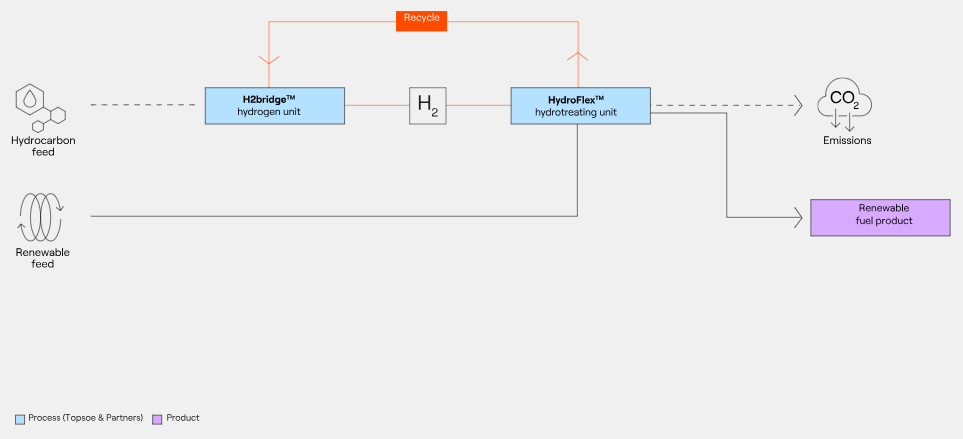
Image Credit: Topsoe A/S
Business Advantages From H2bridge™ and HydroFlex® Integration
The seamless integration of HydroFlex® and H2bridge™ units leverages the efficient recycling of hydrogen recovered from hydrotreating off-gases. This strategic approach enables a reduced footprint for the H2bridge™ unit, resulting in lower CAPEX and OPEX.
Furthermore, the system offers the flexibility to utilize renewable naphtha and LPG as feedstocks for hydrogen production, thereby eliminating the dependency on external fossil fuels. The H2bridge™ unit also features enhanced heat integration and industry-leading minimal water consumption, which also contribute to additional reductions in OPEX costs.
Get in touch now