SynCOR™ Technology is backed by 70 years of proven reliability and secure, uninterrupted operation. Superior to traditional SMR technology for large-scale plants, it contributes to a reduced environmental footprint through lower emissions.
Step Up the Syngas Production
Syngas production using SynCOR™ represents a significant step forward in its production technology. This advanced system has been carefully designed to maximize efficiency in the large-scale production of blue hydrogen and ammonia, addressing the critical need for high carbon capture.
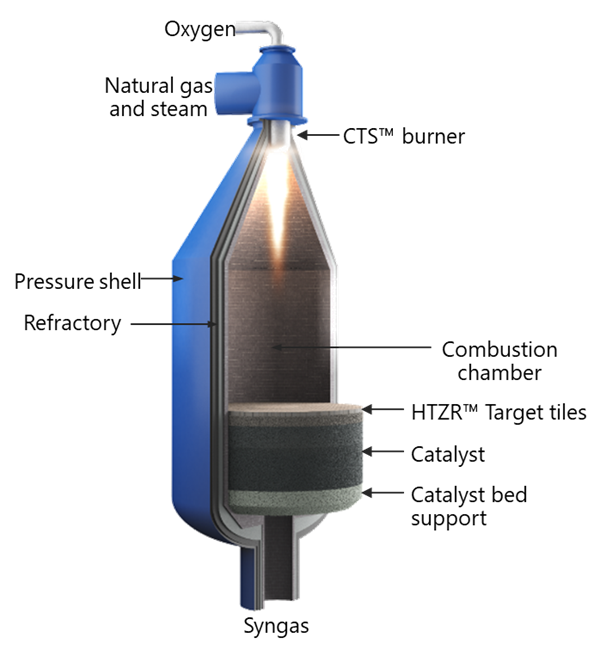
Image Credit: Topsoe A/S
The maturity of any low-carbon technology is a critical factor for its long-term success. In this regard, SynCOR™ is in a class of its own.
Developed in 1958, SynCOR™ has undergone 70 years of rigorous development and real-world application, resulting in a proven track record of unwavering reliability and safe, uninterrupted operation. This extensive legacy of performance is what makes SynCOR™ the most advanced and trusted solution available.
This is SynCORTM
SynCOR™ is a next-gen autothermal reforming (ATR) technology. It is engineered for the efficient, large-scale production of essential low-carbon fuels and chemicals, and is especially well-suited to blue hydrogen and ammonia production.
The core innovation of SynCOR™ lies within its single-reactor design. Here, hydrocarbon feedstocks, such as natural gas, are transformed into syngas through a combined steam reforming and partial oxidation process.
SynCOR™ is distinct in its operations, functioning at a substantially lower steam-to-carbon ratio compared to conventional ATR technologies. This ratio leads to enhanced efficiency and process economics. The syngas produced then serves as the foundation for downstream processing into valuable low-carbon products.
The SynCOR™ concept has been operational in industrial settings since 2002. This technology, a significant advancement in syngas process technology, is favored for numerous large-scale projects globally due to its ability to utilize economies of scale by maximizing single-line capacity. In addition, it substantially reduces capital and operating expenses.
Topsoe's advanced equipment incorporates a process burner engineered for safe operation, extended lifespan, centered flame, soot-free combustion, and uniform mixing. A multi-layered refractory lining ensures safety and reliability, while also maintaining low surface temperatures on the pressure shell. Target tiles offer high wear resistance, serving as a durable top layer.
Autothermal reformer catalysts (RKA-10, RKA-02, RKS-2, and RKS-2-7H) deliver long life, low pressure drop, and high activity, among other characteristics that contribute to the optimal performance and efficiency of the SynCOR™ unit. These catalysts are placed on a bed support.
Want to know more? Get in touch here
The SynCORTM Process
SynCOR™ technology offers a key advantage: the combustion of feed gas produces heat that fuels the reforming reaction, removing the need for external thermal energy input or removal.
Using a SynCOR™ advanced autothermal reformer eliminates the need for tubular reforming. Instead, pre-reformed natural gas, along with oxygen, is directly fed into the autothermal reformer. The removal of tubular reforming enables a substantial reduction in steam addition and corresponds to an improvement in energy efficiency.
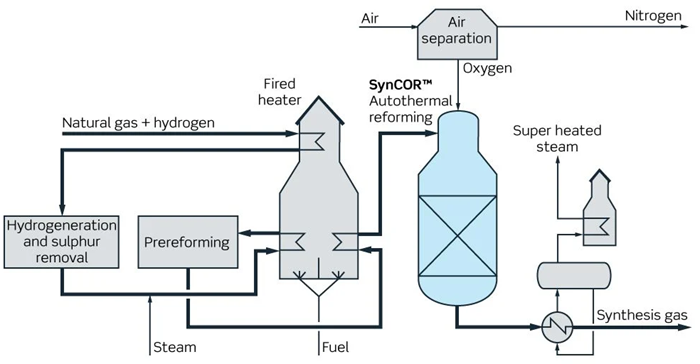
Image Credit: Topsoe A/S
Autothermal reforming environments are generally more demanding than those encountered in a conventional oxygen-fired secondary reformer operating with elevated S/C ratios, a characteristic that mandates the use of exceptionally durable hardware and catalysts.
Syngas Production for Low-Carbon Fuels and Chemicals
Having been implemented in a multitude of large-capacity plants for various applications, such as GTL™ (Gas to Liquid), TIGAS™ (natural gas to gasoline), and syngas, SynCOR™ has now amassed more than 150 years of cumulative operational experience. This history makes it the most mature technology for blue hydrogen and blue ammonia projects.
SynCOR Hydrogen™
The SynCOR™ process further distinguishes itself among low-carbon hydrogen technologies by delivering the lowest OPEX. This efficiency is achieved because its reactor operates at an exceptionally low SMR of 0.6, three to five times less than that of traditional SMR or less developed conventional ATR systems.
Such a design empowers refineries to fully leverage economies of scale, significantly minimizing the levelized cost of hydrogen (LCOH). The reduced steam throughput also offers the practical advantage of smaller equipment and piping dimensions.
This benefit is particularly impactful in large-scale applications, as it allows components to remain within standard size specifications, even when handling very high single-line capacities.
SynCOR™ technology is exceptionally well-suited for blue hydrogen production, primarily due to its remarkably low external fuel consumption. This efficiency enables the attainment of a very high carbon-recovery rate, exceeding 99 %, thereby eliminating the need to capture carbon present in the flue gas.
With its advantageous low steam-to-carbon ratio, SynCOR™ presents a compelling economic case for deployment in mega-scale industrial facilities.
The largest SynCOR™ reactor currently in operation boasts a hydrogen production capacity equivalent to 455 MMSCFD. For context, a single ATR train typically reaches a maximum hydrogen production capacity of 735 MMSCFD.
In metric terms, the largest operational SynCOR™ reactor produces 500 kNm3/hour of hydrogen, with the economical single-train capacity limit extending to 825 kNm3/hour. These favorable economic factors strongly suggest that SynCOR™ will continue to be the leading technology for high-volume hydrogen generation.
SynCOR Ammonia™
SynCOR technology also enables the production of low-carbon-intensity ammonia. Delivering CO2 removal capabilities exceeding 99 %, Topsoe’s solutions stand as pioneers in industrial decarbonization.
Topsoe has established strategic alliances with leading carbon capture technology providers to ensure seamless integration and achieve superior emission reductions.
SynCOR Ammonia is not only an ideal solution for extensive industrial operations but also stands out as the premier ammonia process for directly capturing the highest amount of CO2 from the reforming stage, all without requiring any additional efforts.
It routinely achieves approximately 88 % carbon capture directly from the process gas, a performance metric that substantially exceeds that of any other ammonia technology. This initial capture can be readily elevated to over 99 % within the integrated process unit.
The SynCOR ammonia solution enables large capacities in single trains and is superior to traditional SMR technology for large-scale plants. The largest SynCOR operating references are producing syngas equivalent to more than 6800 tpd of ammonia.
Users can utilize this proven process to scale up their reforming section in an economically viable manner, reducing environmental impacts by lowering water consumption, NOx, and CO2 emissions. At the same time, prioritizing safety through an automated reforming section.
The Main Benefits of SynCORTM
- Straightforward and secure operation
- Superior to traditional SMR technology for large-sized plants
- Large capacities in single trains
- Excellent Economy of Scale
- Exceeding 99 % availability
- Lower OPEX
- Minimal gas consumption
- Low steam to carbon ratio
- Very low water consumption
- Decreased environmental impact through lower emissions
Get in touch now