SNOX™ technology provides complete flue gas cleaning by removing SOx, NOx, and particulates while producing commercial sulfuric acid.
- Presents an economical alternative to conventional Flue Gas Desulfurization (FGD) technologies
- Boosts energy effectiveness by 5 %
- Offers the potential for 5-10 % decreases in specific carbon dioxide emissions
Reduce Flue Gas Emission Compliance Costs in Refineries and Power Plants
SNOX™ technology offers refineries and power plants an advanced solution for the comprehensive removal of sulfur dioxide, nitrogen oxides, and various particulates from their flue gas emissions.
Through this innovative process, sulfur is recovered and transformed into marketable, concentrated sulfuric acid, while harmful nitrogen oxides are efficiently converted into inert, free nitrogen.
Within the SNOX™ unit, combustible particulates like soot are effectively incinerated upon contact with the specialized catalyst. Any remaining particulates are cleanly separated and collected as a dry powder, ensuring the entire operation is free from polluting byproducts.
Taking on the Challenges of FGD
Traditional flue gas desulfurization (FGD) methods are characterized by several inherent disadvantages, including elevated operating costs, substantial limestone consumption, and the generation of contaminated gypsum that requires specialized disposal.
These factors collectively contribute to the increasing expense of operating conventional FGD systems, a challenge that intensifies with higher fuel sulfur content.
The SNOX™ process offers a comprehensive solution to these issues by integrating the removal of SOx, NOx, and particulate matter with the co-production of commercial-grade sulfuric acid. This innovative approach delivers a significant reduction in compliance-related expenditures.
Moreover, it eliminates waste streams and complex material logistics, requires no water or reagents for the desulfurization phase, and establishes itself as a highly cost-effective alternative to conventional FGD technologies.
The exceptional energy efficiency inherent in a SNOX™ unit, facilities such as boilers, combustors, or power plants utilizing SNOX™ technology can anticipate a 5 % enhancement in energy effectiveness, directly translating to a comparable reduction in specific CO2 emissions.
A key differentiator is that the SNOX™ flue gas cleaning process, in contrast to limestone-based methods, inherently avoids generating CO2 emissions.
Interested in how this applies to you? Start here
The SNOX™ Process
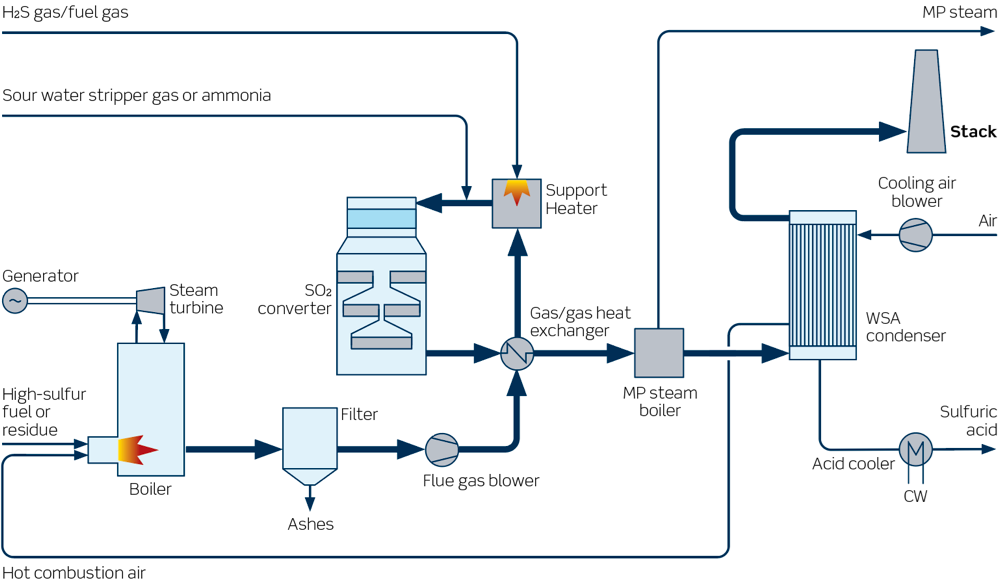
Image Credit: Topsoe A/S
How It Works
The SNOX™ process includes the following steps:
- Primary particulate matter extraction is achieved through the deployment of electrostatic precipitators or bag filters. Any remaining dust will subsequently be captured by the SO2 conversion catalyst, from which it can be extracted at regular intervals. (In scenarios involving combustible dust, such as soot, pre-treatment for dust removal is not necessary, as the dust will combust upon contact with the catalyst within the SO2 converter.)
- To achieve the catalytic reduction of nitrogen oxides (NOx), ammonia (NH3) is introduced into the gas stream before it enters the SCR DeNOx converter.
- The catalytic oxidation of sulfur dioxide (SO2) into sulfur trioxide (SO3) is performed within the dedicated oxidation converter.
- Within the WSA condenser, the gas undergoes cooling to approximately 100 °C. This temperature facilitates the combination of SO3 with water vapor, generating sulfuric acid vapor, which subsequently condenses and is extracted as a concentrated, commercial-grade sulfuric acid product.
- Consequently, the treated gas, now completely devoid of sulfur dioxide, NOx, and particulate matter, is ready for discharge to the stack.
- After cooling within the WSA condenser, the air is directed back to the boiler, combustor, power plant, or any other source generating flue gas, where it is then used as preheated combustion air.
Get in touch now