Thermo Scientific™ Evolution™ UV-Visible Spectrophotometers equipped with Thermo Scientific™ INSIGHT™ Software provide a reliable, user-friendly solution for pharmacopeia compliance.
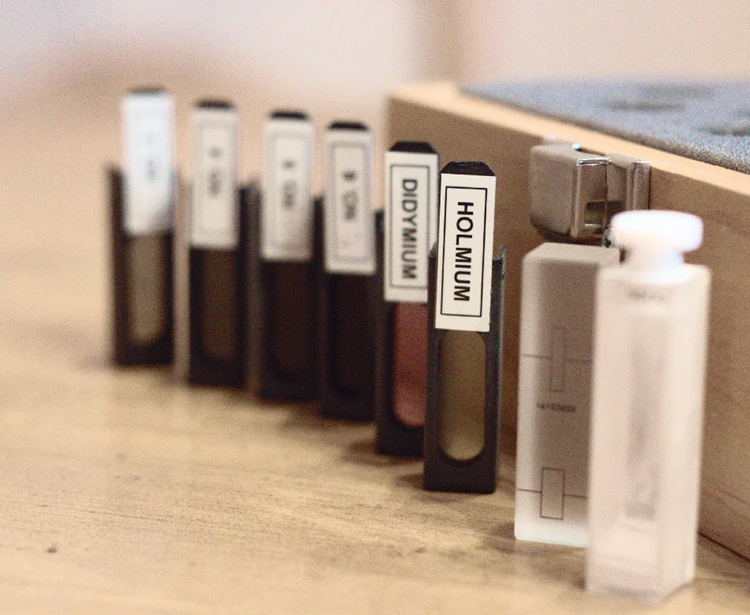
Image Credit: Thermo Fisher Scientific - UV-Vis Spectroscopy
The EP and USP both specify several parameters for performance verification (PV). They evaluate absorbance accuracy, wavelength accuracy, resolution, and stray light.
Thermo Fisher Scientific has developed a summary of the alternatives available for use in PV testing, as selecting standards can be challenging. There are two kits available that incorporate the essential standards for PV testing, making the selection process easier. Standards can be ordered individually.
In this article, the particular requirements for each test will be discussed, and advice on selecting standards to complete the PV testing will be provided.
Table 1. Source: Thermo Fisher Scientific - UV-Vis Spectroscopy
| Part Number |
Standards Kit |
Performance
Verification Test |
Reference
Materials |
| 222-327200 |
USP and EP UV Standards Set |
Wavelength
Accuracy |
Calibrated holmium oxide solution for wavelength accuracy from 241 nm to 641 nm |
| |
|
Photometric
Accuracy |
Calibrated 60 mg/L, 80 mg/L, and 140 mg/L potassium dichromate with blank: UV absorbance accuracy to 2 A |
| |
|
Stray Light |
Certified potassium chloride, sodium iodide, and sodium nitrate for stray light measurements |
| |
|
Resolution |
Certified toluene in hexane solution with hexane blank for resolution (spectral bandwidth) testing |
| 222-327300 |
USP and EP Vis Standards Set |
Wavelength
Accuracy |
Didymium glass filter |
| |
|
Photometric
Accuracy |
Four neutral density filters calibrated for absorbance at 440, 465, 546.1, 590 and 635 nm. Absorbance values approximately 0.5, 1.0, 1.5, and 2.0. |
Photometric (Absorbance) Accuracy
To achieve the requisite wavelength and absorbance ranges, a system's absorbance accuracy must be verified across its intended operational range.
Operational range: the absorbance range in which samples are measured in a lab, measured near the wavelength where the samples are measured.
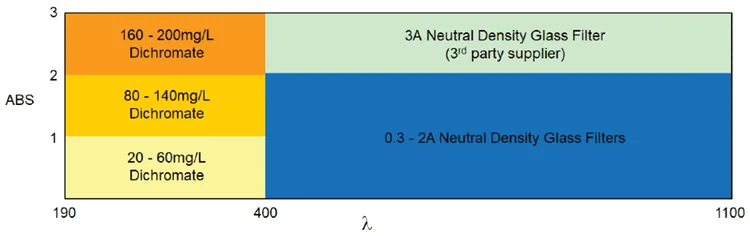
Image Credit: Thermo Fisher Scientific - UV-Vis Spectroscopy
The Requirements
- Select at least three standards with various absorbance levels that cover the operational range.
- For EP, it is recommended not to test > 2 A.
- For USP, one standard must be in the 0–2 A region. If measuring > 2 A, standards evaluating this region must be selected.
Table 2. Source: Thermo Fisher Scientific - UV-Vis Spectroscopy
Potassium Dichromate
solutions (K2Cr2O7) |
Concentration
(mg/L) |
Part Number |
| USP and EP UV Standards Set* |
60 mg/L, 80 mg/L, and 140 mg/L |
222-327200 |
UV Photometric Accuracy Stds
for USP-2015 to 2 A* |
60 mg/L and 140 mg/L |
840-288900 |
| Potassium Dichromate |
100 mg/L |
840-288300 |
| Potassium Dichromate |
120 mg/L |
840-288400 |
| Potassium Dichromate |
160 mg/L |
840-288600 |
| Potassium Dichromate |
180 mg/L |
840-288700 |
| Potassium Dichromate |
200 mg/L |
840-288800 |
Potassium Dichromate 5 Stds kit
(from 0.1 A to 1.5 A) |
20–100 mg/L |
9423UV95200E |
*Recommended
For UV Wavelength Absorbance (< 400 nm)
- Select at least three potassium dichromate standards
- < 1 A 20–60 mg/L K2Cr2O7
- 1–2 A samples: add an 80–140 mg/L K2Cr2O7
- 2–3 A samples: add a 160–200 mg/L K2Cr2O7
For Visible Wavelength Absorbance (> 400 nm)
- Select at least three neutral density glass filters
- One between 0–2 A
- At least two more filters, depending on the operational range
Table 3. Source: Thermo Fisher Scientific - UV-Vis Spectroscopy
| Neutral Density Filters |
Part Number |
| USP and EP Vis Standards Set* |
222-327300 |
| Qualification Filter Kit for UV-Vis |
840-326000 |
Photometric accuracy and linearity test kit
Calibrated ND filters (six filters from 0.3 A to 2 A) |
840-253000 |
*Recommended
Wavelength Accuracy
Wavelength accuracy and precision will be determined across the operational range.
Operation range: the wavelengths where samples are measured in the lab.
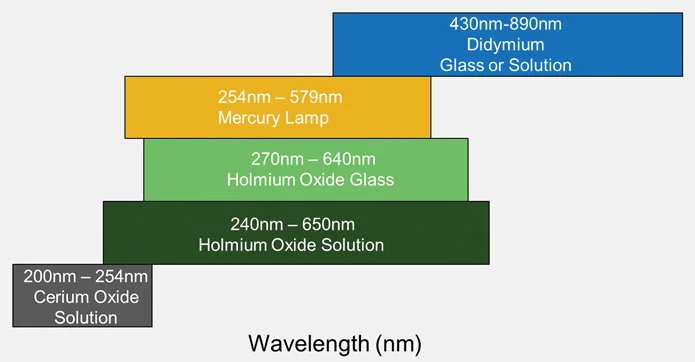
Image Credit: Thermo Fisher Scientific - UV-Vis Spectroscopy
The Requirements
- Use holmium oxide or mercury lamps.
- For measurements above 650 nm, didymium oxide is also necessary.
- Cerium oxide is suitable for monitoring in the far UV.
Table 4. Source: Thermo Fisher Scientific - UV-Vis Spectroscopy
| Products containing Wavelength Standards |
Part Number |
| USP and EP UV Standards Set* (Holmium oxide solution) |
222-327200 |
| USP and EP Vis Standards Set* (Didymium glass filter) |
222-327300 |
Qualification Filter Kit for UV-Vis
(Holmium glass and didymium glass filters) |
840-326000 |
| Wavelength Standard – Didymium Glass |
840-325800 |
| Wavelength Standards, Holmium, and Didymium |
840-325700 |
| Cerium Oxide Standard |
222-327400 |
*Recommended
Mercury Lamp Options for Wavelength Accuracy
Mercury vapor lamps offer various advantages over other standards used in PV testing. These lamps emit stable atomic emission lines and are extremely well described. All low-pressure mercury lamps produce emission lines with the same wavelengths.
Mercury vapor emission spectra are used to calibrate other standards, such as holmium oxide solutions: mercury lamps never need to be recalibrated. The USP recommends atomic line spectra as the primary method for testing wavelength accuracy, stating:
This procedure is described as the primary application because the emission lines produced from a discharge lamp are characteristic of the source element and, as a fundamental physical standard; these wavelengths have been measured with an uncertainty of not more than ± 0.01 nm.
The EP also specifically recommends atomic line spectra for this purpose, “Control the wavelength accuracy of an appropriate number of peaks in the intended spectral range… by measuring the emission from a light source for the verification of emission-line position.”
The Thermo Scientific™ Evolution™ 350 UV-Vis Spectrophotometer offers an optional factory-installed mercury lamp. A mercury lamp attachment is available for the Evolution 200 series instruments as well.
Table 5. Source: Thermo Fisher Scientific - UV-Vis Spectroscopy
| Instrument |
Mercury Lamp Accessory Part Number |
| Evolution 201, 220, 260 |
840-211300 |
| Evolution 350 |
840-310900 |
Resolution
What is required: To calibrate the spectrometer's resolution in the UV band, use a 0.020 % (v/v) solution of toluene in n-hexane as the reference.
Table 6. Source: Thermo Fisher Scientific - UV-Vis Spectroscopy
| Reference Materials |
Standard |
Part Number |
| Certified toluene in hexane solution with hexane blank |
USP and EP UV Standards Set |
222-327200 |
| Certified toluene in hexane solution with hexane blank |
Resolution Standard – Toluene in Hexane |
222-226600 |
Stray Light
Stray light levels must be measured at the relevant wavelength(s) during performance qualification (PQ). Analysts can compare the absorbance of the specified filters to the relevant reference and record the maximum absorbance value.
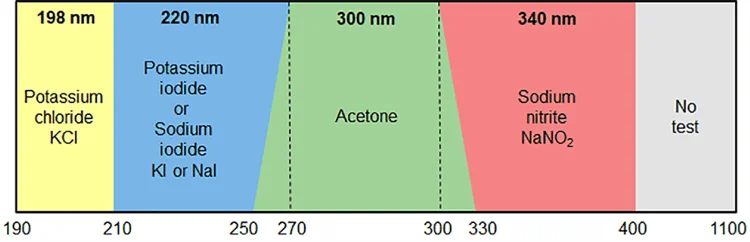
Image Credit: Thermo Fisher Scientific - UV-Vis Spectroscopy
Table 7. Source: Thermo Fisher Scientific - UV-Vis Spectroscopy
| Reference Materials |
Standard |
Part Number |
| KCl, NaI, and NaNO2 |
USP and EP UV Standards Set |
222-327200 |
KCl
190–210 nm
Measure at 198 nm |
Stray light filter, potassium chloride, KCI |
9423UV95520E |
Nal
210–270 nm
Measure at 220 nm |
Stray light filter, sodium iodine, NaI |
9423UV95500E |
Acetone
250–330 nm
Measure at 300 nm |
Acetone stray light standard and blank |
840-284400 |
NaNO2
300–400 nm
Measure at 340 nm |
Stray light standard, sodium nitrate |
222-226500 |
Thermo Scientific Evolution UV-Vis Spectrophotometers
When meeting pharmacopeia requirements is the top priority, selecting a UV-Visible spectrophotometer should be straightforward. Each Evolution UV-Vis Spectrophotometer comes in bundles with many standard kit options:
- Thermo Scientific™ INSIGHT™ Security software ensures 21 CFR Part 11 compliance
- Option for an Evolution UV-Vis spectrophotometer
- Choosing a performance verification standards kit:
- The UV-Vis Qualification Filter Kit includes all necessary standards for general instrument qualification. It contains certain standards used for pharma PV testing, but further standards will be required for overall compliance.
- The USP and EP UV and Vis Standards Sets include all the necessary standards for general EP and USP testing.
- Thermo Scientific™ Validator™ paperwork for first and re-qualification throughout the instrument's lifetime
The flexible Evolution 200 series and Evolution 350 UV-Vis Spectrophotometers offer:
- INSIGHT 2 software with additional compliance features
- Precision monochromator drive ensures accurate and speedy scanning
- Double-beam optics allow for fixed or customizable 1 nm bandwidths
Table 8. Source: Thermo Fisher Scientific - UV-Vis Spectroscopy
| Description |
Part Number |
| Evolution 201 Computer Control UV-Vis |
840-210800 |
| Evolution 220 Computer Control UV-Vis |
840-210600 |
| Evolution 260 Bio Computer Control UV-Vis |
840-211000 |
| Evolution 350 Computer Control UV-Vis |
840-310800 |
| Evolution 350 with Mercury Lamp |
912A0959 |
Selecting the Evolution UV-Vis Model That Meets Your Requirements
The Evolution 201 spectrophotometer's 1.0 nm spectral bandwidth allows for high-resolution data in basic research applications and routine quality control.
The Evolution 220 spectrophotometer improves system versatility by providing a configurable bandwidth choice for a wider range of applications. This type has application-focused beam geometry that is ideal for use with integrating fiber optic probes, sphere accessories (diffuse transmittance/reflectance), and microcells.
The Evolution 260 Bio spectrophotometer enhances the Evolution 220 platform's productivity by adding the simplicity of pre-programmed bio applications.
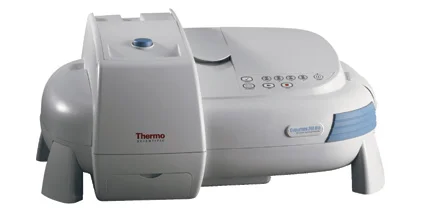
Image Credit: Thermo Fisher Scientific - UV-Vis Spectroscopy
The Evolution 350 spectrophotometer is a high-performance solution with an extra-large sample chamber to accommodate more accessory options and a parallel beam configuration. This device features a mercury lamp option to help with pharmacopeia wavelength and bandwidth accuracy testing.
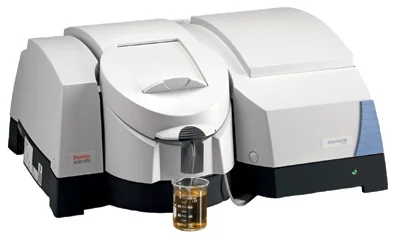
Image Credit: Thermo Fisher Scientific - UV-Vis Spectroscopy
Validated Installation
Thermo Fisher Scientific's unified lab services professionals can handle installation and provide:
- Peace of mind: Users are instructed on equipment use and routine care, and equipment is installed and set according to manufacturer specifications for optimal performance.
- Improved productivity: Accurate installation is scheduled for user convenience, optimizing performance and equipment.
Table 9. Source: Thermo Fisher Scientific - UV-Vis Spectroscopy
| Description |
Part Number |
| Evolution 350 Validated Installation |
701-680300 |
Validated installation includes:
- User orientation and instrument familiarization
- Installation Qualification and Operational Qualification
- On-site installation of instrument
- All engineer travel charges and labor for installation
Does not include instrument Performance Qualification (PQ)
Standards Rental Options
Thermo Fisher Scientific also offers the option of renting standards for performance verification along with the service. Standard rental may be added to the service options listed below.
Table 10. Source: Thermo Fisher Scientific - UV-Vis Spectroscopy
| Description |
Part Number |
| USP Standards Rental with Validated Installation |
701-055587 |
| USP Standards Rental with Recertification Contract |
701-055588 |
| USP Standards Rental with Performance Verification |
701-173000 |
Performance Verification
Table 11. Source: Thermo Fisher Scientific - UV-Vis Spectroscopy
| Description |
Part Number |
Performance verification for Evolution Spectrophotometers
includes Validator qualification materials |
701-023300 |
Annual Recertification
Table 12. Source: Thermo Fisher Scientific - UV-Vis Spectroscopy
| Description |
Part Number |
| Optional annual recertification with a contract for Evolution Spectrophotometers* |
701-509300 |
* Models include Evolution Array, Evolution 60S, Evolution 200, Evolution 300, or Evolution 600 Spectrophotometers

This information has been sourced, reviewed and adapted from materials provided by Thermo Fisher Scientific - UV-Vis Spectroscopy.
For more information on this source, please visit Thermo Fisher Scientific - UV-Vis Spectroscopy.