The Imperative for Change
The Trial: From Laboratory to Commercial Scale
Emission Reduction Potential
Agricultural Waste as an Industrial Resource
Contextualizing Biomass Within India's Decarbonization Mix
Supply Chain Infrastructure and Next Steps
Assessment
References and Further Reading
A world-first Indian trial has found that rice husk pellets from agricultural waste can partially replace coal in steelmaking gasifiers without loss of production performance, opening a practical near-term pathway to lower emissions in one of the fastest-growing steel markets.
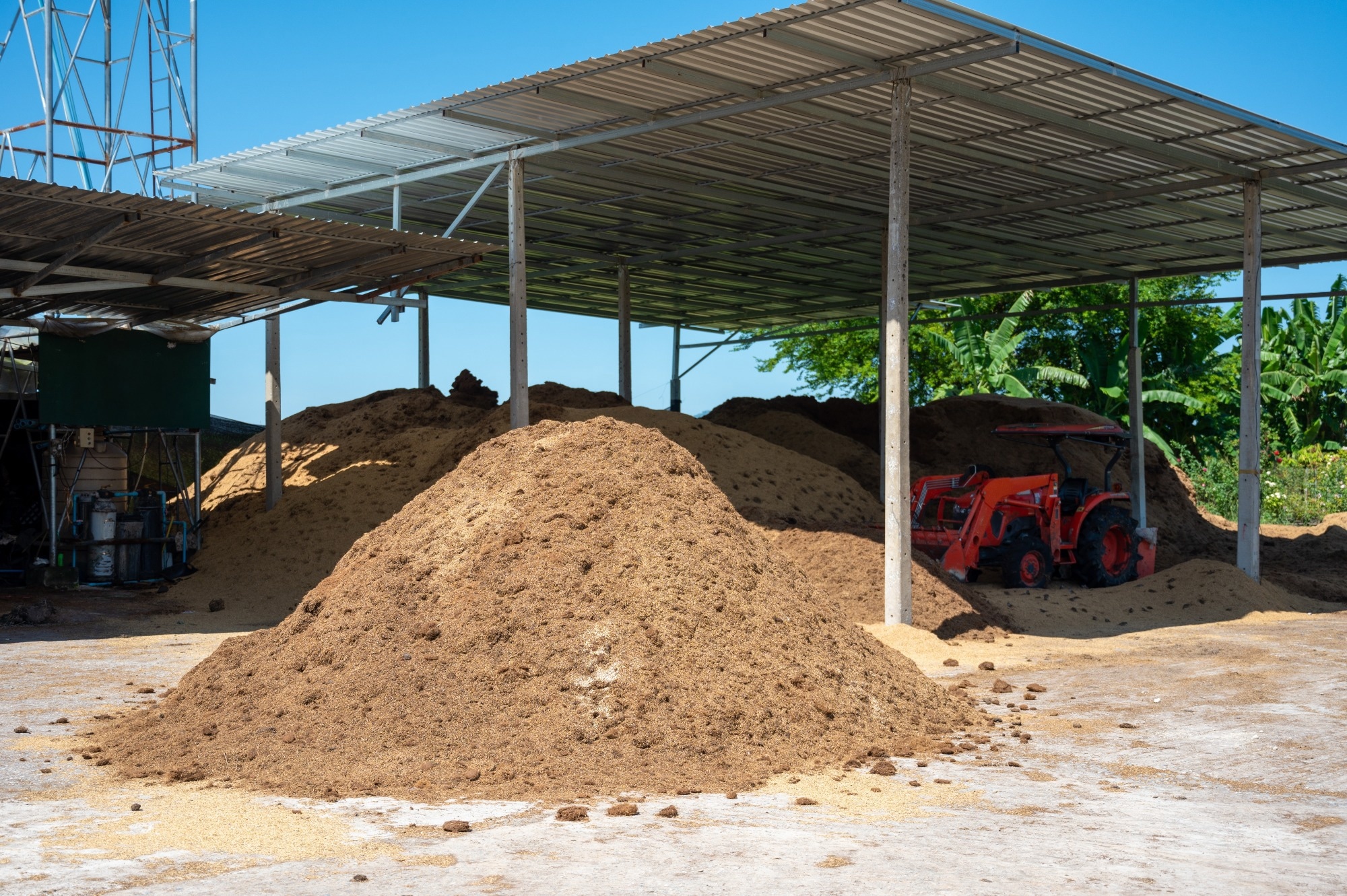
Image Credit: Adcharin Chitthammachuk/Shutterstock.com
The Imperative for Change
Steel is among the most carbon-intensive industries on the planet, responsible for roughly 8-9% of global carbon dioxide (CO2) emissions. In particular, India’s steel sector emits an average of 2.55 tons of CO2 per ton of crude steel. This is much above the global average of 1.85 tons and accounts for approximately 12% of the country's total emissions.1,2
With capacity projected to reach 300 million tons annually by 2030 and 500 million tons by 2047, those figures are on a trajectory to worsen unless abatement measures are adopted at scale.1
India's heavy reliance on coal-based direct reduced iron (DRI) processes, combined with a fleet of predominantly small-scale rotary kilns, creates particular structural challenges. Various long-term pathways are under active research:
- Green hydrogen direct reduced iron (DRI)
- Carbon capture and storage
- Expanded scrap-electric arc furnace capacity
Each, however, carries meaningful cost and infrastructure barriers in the near term.3,4 The practical question for policymakers and operators is whether emissions reductions can begin now, using equipment already in place.
The Trial: From Laboratory to Commercial Scale
In March 2026, CSIRO (Australia's national science agency) and the Indian Institute of Science (IISc), together with RESCONS Solutions Pvt. Ltd. and Jindal Steel and Power Limited (JSPL), announced results from what they describe as a world-first commercial-scale demonstration of agricultural biomass in steelmaking gasifiers.1 The trial was conducted at JSPL's facility in Odisha and funded in part through the Australian Government's India-Australia Green Steel Research Partnership.
The approach centered on pelletizing locally sourced rice husks, a widely generated agricultural residue in India, and blending them with the coal feed entering commercial gasifiers used to produce syngas (synthesis gas) for iron ore reduction. Blends of 5% and 10% rice husk pellets by weight were tested. At both blend levels, sustained syngas production was maintained with no reported loss of gasifier performance.1
The technical viability of rice husk as a gasification feedstock has a prior research base: fixed-bed gasification studies have shown it can produce syngas with CO content in the range of 24%, with cold gas efficiency peaking around 50% under optimized equivalence ratios.5
A separate open-access LCA study published in Journal of Cleaner Production found that biosyngas-based DRI-EAF routes produce approximately 251 kg CO2eq. per ton of crude steel at the cradle-to-gate boundary, 75-85% lower than conventional fossil-based routes, with compatibility for existing furnace infrastructure cited as a key advantage.6 What the Odisha trial added was operational confirmation that pelletized rice husk can function as a partial drop-in replacement within large-scale rotary kiln gasifiers common across India's DRI sector.
Click here to download a free PDF copy of this page
Emission Reduction Potential
CSIRO estimates that nationwide adoption in India could reduce steel-sector emissions by up to 50%, equivalent to approximately 357 million tons of CO2 per year.1 The agency also notes that biomass use in steelmaking could reduce net emissions by up to approximately 1.19 tons of CO2 per ton of crude steel.1
A 2025 life cycle assessment by Saha and Mandal, published in the Journal of the Institution of Engineers (India): Series D), compared three routes, conventional BF-BOF, conventional DRI-EAF, and biomass-integrated DRI-EAF. They found that the biomass-integrated route achieves approximately 67% lower CO2 emissions relative to BF-BOF, attributing the reduction primarily to coke substitution with sustainably sourced biomass.4
A companion TMS conference paper placed the biomass-integrated DRI-EAF route at around 0.67 tons of CO2e per ton of crude steel, against 2.04 tons for the conventional BF-BOF route.7
These projections are scenario-dependent and contingent on responsible biomass sourcing. For a country where steel-sector emissions currently stand at around 240 million tons annually and are projected to roughly triple by 2050 absent intervention, even partial coal displacement through available biomass represents a material near-term contribution.2
Read More: What is Vertical Farming?
Agricultural Waste as an Industrial Resource
India generates approximately 228.52 million tons of surplus crop residue biomass annually.1 A large proportion is rice straw and husk, concentrated in Punjab, Haryana, and Uttar Pradesh. Absent productive commercial uses, a significant share is disposed of through open field burning, a practice that, despite government bans, has proven difficult to eliminate at scale.
The public health consequences are substantial. A peer-reviewed analysis published in Nature Communications estimated that agricultural residue burning caused between 44,000 and 98,000 PM2.5-related premature deaths annually in India from 2003 to 2019, with Punjab, Haryana, and Uttar Pradesh accounting for 67-90% of the national total.8
The Indo-Gangetic Plain, which overlaps substantially with India's agricultural and steelmaking regions, experiences some of the most severe seasonal air-quality degradation due to residue burning. Redirecting rice husk into pellet supply chains for industrial use would directly reduce the volume available for open combustion.
India has already mandated 5% biomass co-firing in thermal power plants from 2024-25, establishing a partial precedent for biomass aggregation policy. No equivalent mandate exists for the steel sector yet, but the CSIRO-IISc trial now provides a technical evidence base on which such a measure could be built.1
Contextualizing Biomass Within India's Decarbonization Mix
Biomass co-processing is not positioned as a comprehensive solution. India's Ministry of Steel roadmap to net-zero by 2070 identifies a portfolio of interventions: green hydrogen DRI, electric arc furnace expansion, scrap utilization, and CCUS.
Analysis from the Council on Energy, Environment and Water (CEEW) suggests CCUS could abate up to 56% of emissions from existing technologies, with aggregate capital requirements for the sector exceeding USD 283 billion.3 These are long-horizon investments.
Biomass occupies a different position in the decarbonization timeline. It requires no new furnace infrastructure, operates within existing gasifier systems, and draws on a domestically abundant feedstock that is otherwise problematic to dispose of.
The CEEW analysis points out that alternative fuels, including biomass pellets, have a relatively limited effect in isolation, around 6% of total emissions reduction, but in the context of India's DRI-heavy production profile, and particularly at regional facilities where coal DRI plants and rice production co-exist geographically, the localized opportunity may be considerably more concentrated.3 CSIRO research group leader Keith Vining has specifically highlighted this geographic alignment as a target for early-phase adoption.1
Supply Chain Infrastructure and Next Steps
To support practical scaling, the CSIRO-RESCONS team has published an interactive map overlaying India's steelmaking infrastructure with regional biomass availability data, allowing producers and policymakers to identify facilities where feedstock supply and plant operations align most closely.1 This addresses one of the more concrete near-term barriers: even where the technology is proven, biomass supply chains are diffuse and geographically variable, and pellet logistics require up-front coordination.
Subsequent work will expand beyond Jindal Steel to smaller-scale regional DRI facilities and will test a wider range of biomass sources. Increasing the biomass replacement rate beyond 10% and assessing downstream impacts on the direct reduction process are noted priorities.1
The India–Australia collaboration behind this trial forms part of a wider bilateral research program on green steel. The initiative reflects shared strategic interests: Australia is exploring ways to add value to its iron ore exports in a lower-carbon economy, while India is seeking to balance rapid industrial growth with its climate commitments.
Assessment
The Odisha trial does not resolve the structural challenges facing Indian steel decarbonization. Coal will remain the dominant reducing agent for years, and sector emissions are likely to grow in absolute terms as capacity expands toward government targets.
What the trial establishes at commercial scale and without production penalty is that agricultural biomass can enter the gasifier feed using current equipment, removing one category of technical uncertainty that previously stood between research findings and adoption.
For regions where rice production, steel production, and air quality pressures overlap, the case for biomass co-processing as a transition measure is now grounded in direct operational evidence rather than modeling alone. Whether it scales depends on the development of pellet supply chains, price support mechanisms, and policy mandates analogous to those already in place for thermal power. Those elements remain to be built. The technical proof of concept is now established.
References and Further Reading
- CSIRO (2026). Australia-India partnership takes step closer to green steel through world-first use of ag waste in steelmaking. CSIRO News Release, https://www.csiro.au/en/news/All/News/2026/March/World-first-use-of-ag-waste-in-steelmaking
- IEEFA & JMK Research (2023). Steel Decarbonisation in India. Institute for Energy Economics and Financial Analysis. https://ieefa.org/resources/steel-decarbonisation-india
- CEEW (2025). How Can India Decarbonise for Net Zero Steel Industry? Council on Energy, Environment and Water. https://www.ceew.in/publications/how-can-india-decarbonise-for-net-zero-steel-industry
- Saha AK, Mandal AK (2025). Towards a Low-Carbon Steel Industry in India: Decarbonization Strategies and Environmental Impact Assessment. Journal of the Institution of Engineers (India): Series D. https://link.springer.com/article/10.1007/s40033-025-00923-9
- Ma Z, Ye J, Zhao C, Zhang Q (2015). Gasification of rice husk in a downdraft gasifier: the effect of equivalence ratio on gasification performance, properties, and utilization analysis of byproducts of char and tar. BioResources 10(2), 2888–2902. https://bioresources.cnr.ncsu.edu/resources/gasification-of-rice-husk-in-a-downdraft-gasifier-the-effect-of-equivalence-ratio-on-the-gasification-performance-properties-and-utilization-analysis-of-byproducts-of-char-and-tar/
- Nurdiawati A et al. (2023). Towards fossil-free steel: Life cycle assessment of biosyngas-based direct reduced iron (DRI) production process. Journal of Cleaner Production 393, 136262. https://www.sciencedirect.com/science/article/pii/S0959652623004201
- Saha, A.K. et al. (2025). Greenhouse Gas Life Cycle Assessment of Traditional and Biomass-Integrated Steelmaking Routes. TMS Annual Meeting & Exhibition. Springer, Cham. https://link.springer.com/chapter/10.1007/978-3-031-80688-9_5
- Lan R, Eastham SD, Liu T, Norford LK, Barrett SRH (2022). Air quality impacts of crop residue burning in India and mitigation alternatives. Nature Communications 13, 6537. https://www.nature.com/articles/s41467-022-34093-z
Disclaimer: The views expressed here are those of the author expressed in their private capacity and do not necessarily represent the views of AZoM.com Limited T/A AZoNetwork the owner and operator of this website. This disclaimer forms part of the Terms and conditions of use of this website.