A recent study published in Nature Communications explores a polymeric carbon nitride-based system designed to direct seawater splitting for hydrogen production under ambient pressure. The researchers analyzed how the material operates in chemically complex seawater and assessed its ability to function without a vacuum. They demonstrate sunlight-driven conversion of seawater into hydrogen fuel while overcoming key limitations of freshwater electrolysis. The work advances scalable, decentralized hydrogen production for sustainable, resource-efficient energy systems.
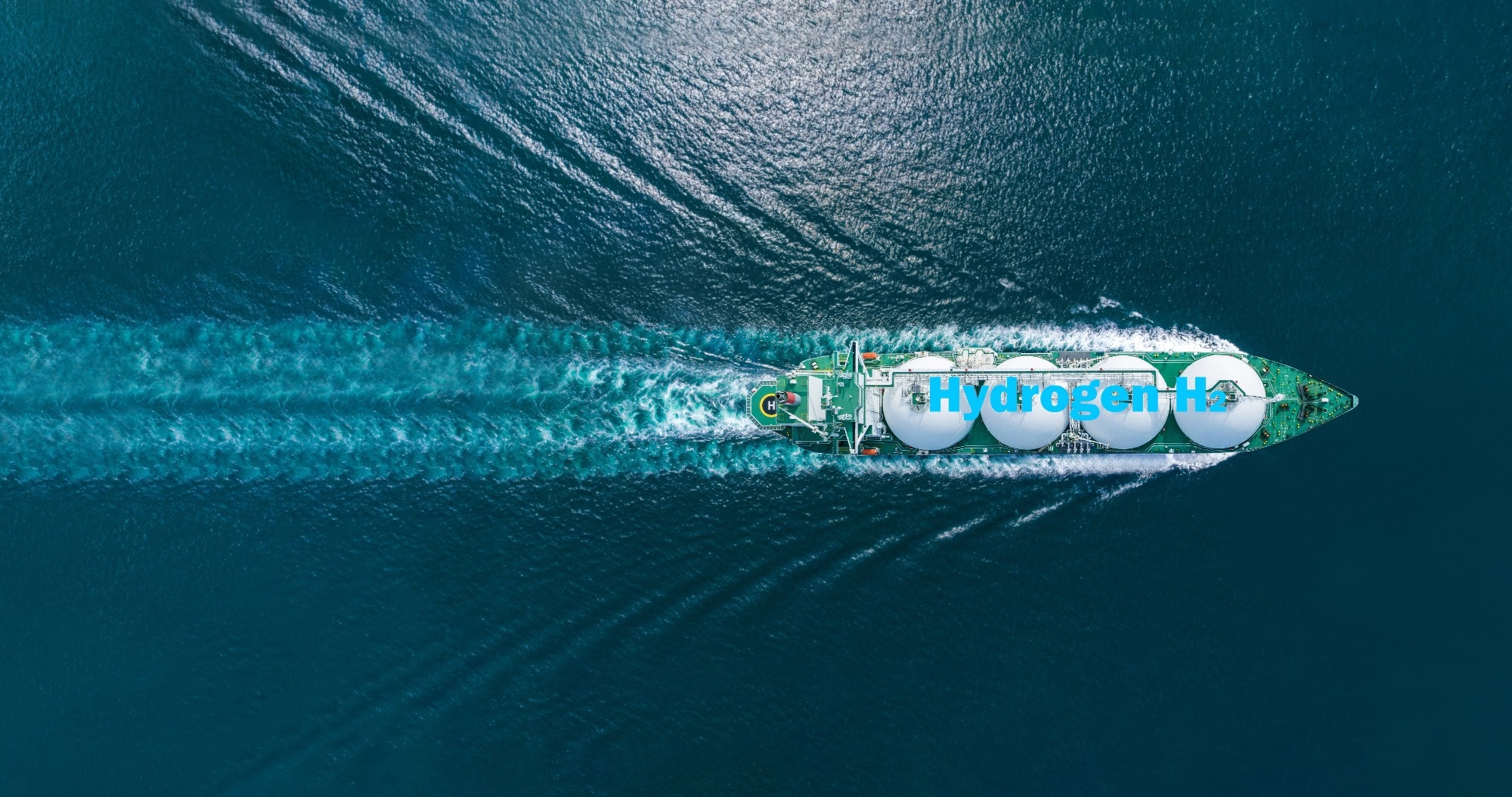
Image Credit: GreenOak/Shutterstock.com
Conventional photocatalysts, such as standard graphitic carbon nitride (CN), face a scalability bottleneck in solar-driven hydrogen evolution because their high exciton binding energies lead to rapid electron-hole recombination.
Many high-efficiency systems depend on negative pressure to suppress back reactions, which restricts their practicality for large-scale outdoor use. Addressing these limitations requires materials that enhance charge separation while maintaining efficient operation under ambient atmospheric conditions.
In this work, the researchers engineer a Donor–π–Acceptor framework by covalently linking ultrathin carbon nitride nanosheets with pyrene units through tailored π-bridges. The designed UPy2 catalyst is a promising system for efficient sunlight-driven hydrogen production in natural seawater, with its performance in part attributed to seawater metal cations that facilitate hole consumption. These results demonstrate a shift toward ambient-pressure seawater photocatalysis for scalable solar hydrogen production.
Methodology and Approach
The team synthesized three molecular frameworks - UPy1, UPy2, and UPy3 - using a stepwise engineering strategy. They first produced ultrathin carbon nitride (UCN) via thermal oxidation of urea, then fragmented the nanosheets through ultrasonication and reassembled them through a Schiff-base reaction with π-pyrene-π linkers. Each framework featured a different π-bridge, such as benzene, biphenyl, or benzene–acetylene to systematically control electronic delocalization across the structures.
Want to save for later? Click here.
Researchers characterized covalent integration using synchrotron-based X-ray absorption (NEXAFS), carbon-13 nuclear magnetic resonance spectroscopy (13C NMR), and X-ray photoelectron spectroscopy (XPS). They also evaluated charge-transfer behavior through femtosecond transient absorption spectroscopy and temperature-dependent photoluminescence, which helped quantify reductions in exciton binding constraints. To assess scalability, the team tested the materials in a custom 20-cm-diameter disk reactor under natural sunlight.
Results and Discussion
Among the three molecules, UPy2, which incorporates a biphenyl π-bridge, is the most effective. It exhibits an exciton binding energy of 28 meV, lower than that of pure UCN, enabling spontaneous charge separation at room temperature, while femtosecond transient absorption measurements reveal a charge-separated lifetime exceeding 1600 ps. This extended lifetime provides photogenerated carriers sufficient time to participate in surface redox reactions before recombination. Under ambient pressure, pure UCN produces no detectable hydrogen, whereas UPy2 achieves 82 mmol h-¹ g-¹ in simulated seawater. These findings demonstrate substantial performance gains from molecular-level structural tuning and optimized donor–acceptor interactions.
Ion-interaction analysis reveals an unexpected seawater effect that significantly enhances catalytic performance. The high electron density of the carbon nitride framework suppresses chloride adsorption and prevents parasitic side reactions that typically hinder seawater photocatalysis. In contrast, Na+ and Mg²+ cations coordinate to the sacrificial reagent triethanolamine (TEOA) to form complexes that strongly bind to heptazine units. This coordination lowers the activation barrier for hole consumption and accelerates oxidation kinetics, as supported by density functional theory calculations. The results indicate that dissolved ions function as cooperative catalytic contributors rather than inhibitory species.
In situ characterization further confirms the formation of Mg(OH)2 nanosheets on the catalyst surface during operation. These structures enhance interfacial electron transfer and stabilize charge-transport pathways without impeding activity. Measurements show that the internal electric field of UPy2 is 8.2 times stronger than that of unmodified UCN, owing to the donor–acceptor push–pull interaction between pyrene donor units and heptazine acceptor units. This polarization directs electrons toward reduction sites and holes toward oxidation centers, suppresses recombination, and sustains continuous photocatalytic turnover. Consequently, the framework maintains high efficiency, structural stability, and operational robustness under realistic reaction conditions.
Conclusion
This work demonstrates that π-bridge engineering effectively overcomes excitonic limitations in polymeric carbon nitride, enabling solar-to-hydrogen production under ambient pressure in natural seawater. The results show that eliminating vacuum requirements and freshwater dependence substantially lowers capital and operational barriers for large-scale hydrogen generation. Real-time evaluation in real seawater confirms that molecular-level structural design can simultaneously improve efficiency and practicality, establishing a viable pathway toward cost-effective green hydrogen infrastructure.
Deployment of a large-area disk reactor under natural sunlight further validates the scalability of this approach. The findings indicate that seawater cations enhance catalytic performance through cooperative interactions rather than acting solely as contaminants, highlighting a new direction for catalyst design. Although additional optimization is required for industrial integration, the framework provides a practical foundation for decentralized hydrogen production.
Future work should focus on extending this strategy to broader catalyst systems and reactor geometries, as well as on long-term stability testing under variable environmental conditions. Overall, the study shows that precise molecular engineering, combined with abundant natural resources, can convert seawater and sunlight into scalable fuel. It provides quantitative design guidance to advance sustainable hydrogen technologies toward global net-zero targets.
Journal Reference
Li, K., Xiao, T., et al. (2026). Solar hydrogen production through ambient-pressure seawater splitting. Nature Communications. DOI:10.1038/s41467-026-69583-x, https://www.nature.com/articles/s41467-026-69583-x
Disclaimer: The views expressed here are those of the author expressed in their private capacity and do not necessarily represent the views of AZoM.com Limited T/A AZoNetwork the owner and operator of this website. This disclaimer forms part of the Terms and conditions of use of this website.