A new study from The James Hutton Institute and the University of Graz analyzing roe deer livers over a 25-year timespan found that concentrations of legislated PFAS declined significantly, while concentrations of other PFAS showed upward trends.
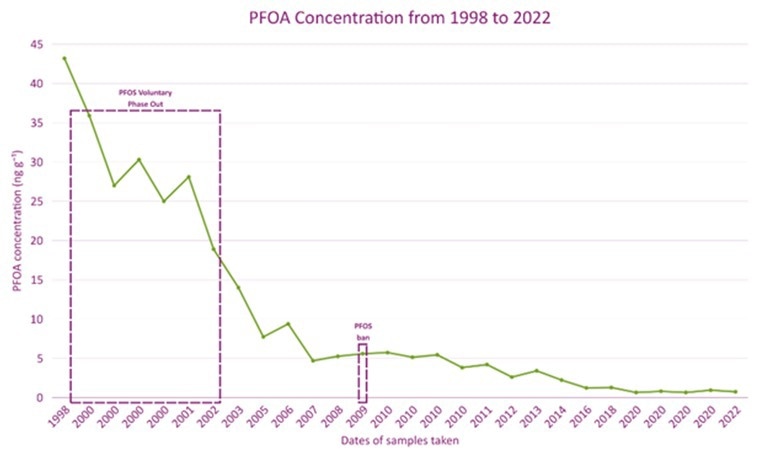 Image Credit: The James Hutton Institute
PFAS, or per- and polyfluoroalkyl substances, are a group of more than 12,000 synthetic chemicals used in everyday items such as frying pans, waterproof jackets, food packaging and cleaning products. Often referred to as “forever chemicals”, these compounds are recognized for their ability to persist long-term in the environment and have been detected on plants, nectar, pollen and the atmosphere.
In addition to their longevity, PFAS are known to have a negative impact on human health, with links to cancer, fertility issues and liver damage. As a result of this, their use has been regulated in the UK, the United States and the EU.
To test the impact of EU regulations, scientists at The James Hutton Institute and the University of Graz analyzed concentrations of PFAS found in one-year-old roe deer livers collected from Bavarian Forest National Park between 1998 to 2022.
Using samples from the German Environmental Specimen Bank, they tested for a range of PFAS, including both regulated and unregulated compounds.
They found that the total concentration of PFAS found in the livers decreased by more than 87 % between 1998 and 2022, dropping from 64 nanograms per gram to 8 nanograms per gram. PFOS (a type of PFAS that was once widely used in products like stain-resistant coatings and firefighting foams but is now heavily restricted in the EU) showed the biggest decline. Its levels fell by over 98 % and have stayed low since 2018. Between 1998 and 2003 alone, PFOS concentrations declined by 67 %, reflecting the impact of voluntary industry-phase outs in the early 2000s.
Although overall PFAS levels fell sharply from 1998 to 2022, some of the newer replacement chemicals increased over the same period. One example is PFNA – a type of PFAS used in the production of non-stick coatings and water-repellent treatments for fabrics which has faced fewer restrictions than older compounds like PFOS. Its concentration doubled during the study period, rising from 3 nanograms per gram to 6 nanograms per gram.
Although PFNA is currently regulated in the EU, its rise illustrates a pattern of “regrettable substitution” identified by the researchers, where industry shifts toward alternative PFAS as other chemicals are phased out.
Dr Viktoria Mueller, a researcher at the Hutton and one of the study’s lead authors, said, “Our findings suggest that focusing on just a few PFAS doesn’t solve the problem. When some are restricted, they are replaced by others, leading to ongoing contamination.”
Professor Joerg Feldmann, from the University of Graz, added, “These biomonitoring studies on animals from remote places show that PFAS are transported over vast distance through the atmosphere. Possible sources of atmospheric PFAS are PFAS production sites, hence we would urge the European and the UK policymakers to include polymers in a PFAS ban.”