Ponda, the Bristol-based biomaterials company behind BioPuff®, is building a model in which restored wetlands become viable material supply chains for fashion. Wetlands store more than twice the carbon of all the world's trees combined, but once drained, they release 1.9 gigatons of CO2 a year, around twice fashion's total emissions. Ponda's approach keeps them wet, puts them to work, and has now opened a crowdfunding campaign to scale the impact and influence of their regenerative projects.
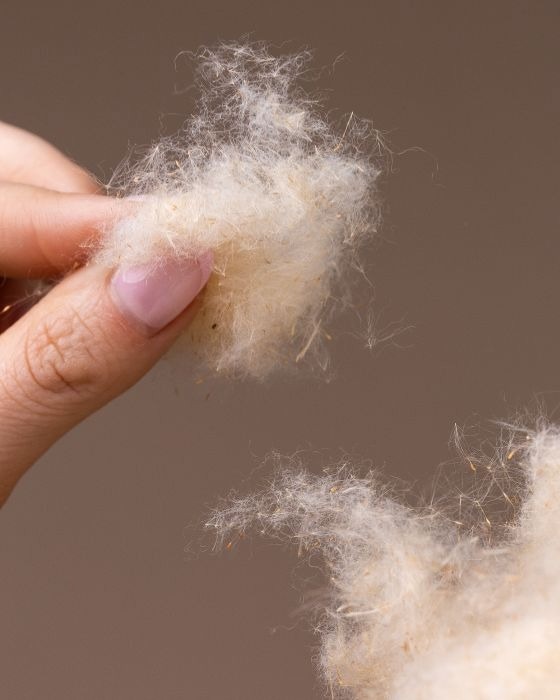 Image Credit: Ponda
The raise will support the next stage of manufacturing, operational capacity and market readiness needed to expand Ponda's paludiculture system: the model that links wetland restoration with fiber production, regional jobs and next-generation insulation for fashion.
Through Palus Demos, the four-year, €10 million Horizon Europe program investigating paludiculture across large demonstrator sites in the UK, Ireland and the Netherlands; PaluWise, focused on scaling practical wet farming systems; and the Paludiculture Exploration Fund, the UK government-backed program delivered by Natural England, Ponda has developed the capability to sow, grow, harvest and process wetland biomass into fiber. Its work spans drone-sown seed pellets, low-impact harvesting, pilot manufacturing in Bristol and a growing network of harvest sites, helping build the supply chain needed to take paludiculture from concept to commercial delivery.
Across these programs, Ponda has worked with organizations including Lancashire Wildlife Trust, Manchester Metropolitan University, Liverpool John Moores University, landowners, farming operators and other delivery partners. Together, the work is helping answer a pressing question for climate-exposed and ecologically fragile landscapes: what forms of production still make sense on wetter land?
BioPuff® has already been used by brands including Stella McCartney, Berghaus, Ahluwalia and Sheep Inc., showing how wetland-grown fibers can move beyond demonstration and into real product development.
For Ponda, the significance goes well beyond one material. Making restored wetlands commercially viable requires new infrastructure across seed development, land management, harvesting, transport, fiber processing and manufacturing. As that system grows, it has the potential to create skilled rural and regional jobs rooted in landscape restoration rather than depletion.
Julian Ellis-Brown, Co-founder and CEO of Ponda, said: "For too long, wetlands have been treated as land that only becomes valuable once it is drained, controlled or converted to something else. That thinking has done enormous damage. What we are showing instead is that these landscapes can stay wet, recover ecological function and still support meaningful forms of production."
He added: "This is no longer a theoretical proposition. Across multiple large-scale programs, we have helped demonstrate the supply chain needed to make paludiculture work in practice, from crop establishment and harvesting through to fiber processing and end use. This raise is about scaling that model so restored wetlands can become economically viable working landscapes again."
By opening its crowdfunding campaign, Ponda is inviting innovators, industry and the wider community to support the next phase of a model that connects climate action, biodiversity recovery, regional employment and material innovation. The goal is not simply to grow BioPuff®, but to scale the infrastructure needed to make restored wetlands relevant to the future of fashion and land use alike.