Battery Architecture and Materials
Resource Availability and Environmental Considerations
Technical Limitations of Sodium-Ion Batteries
Recent Advances in Sustainable Sodium-Ion Batteries
What are the Market Prospects of Sodium-Ion Batteries?
References and Further Reading
Sodium-ion batteries (SIBs) offer a compelling alternative to lithium-based cells. They use the same basic rechargeable architecture, but swap lithium for abundant, lower-cost sodium - which means rethinking electrode materials and electrolytes to make the chemistry work. From 2023 to 2025, progress has been rapid. Researchers have improved electrode performance, refined electrolyte formulations, and begun scaling up pilot manufacturing. Energy density still trails lithium-ion, and large-scale production remains a hurdle - but sodium-ion is quickly moving from promising research to practical reality.
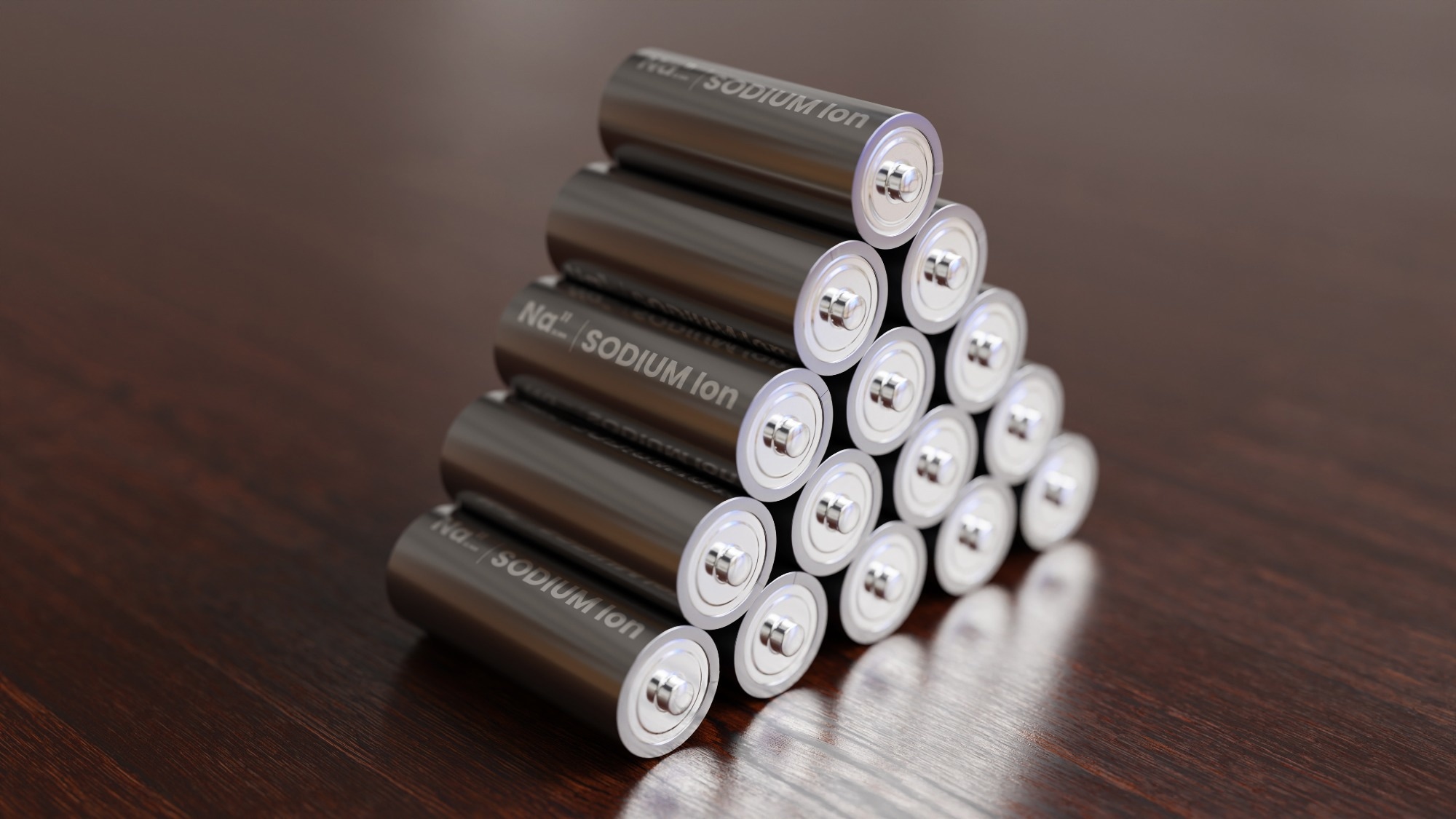
Image Credit: Mahir Asadli/Shutterstock.com
Battery Architecture and Materials
Sodium-ion batteries adapt lithium-ion cell designs to accommodate sodium-specific electrochemistry. The technology employs three main cathode classes: layered NaxMO2 oxides, polyanion phosphates such as Na3V2(PO4)3, and Prussian-blue analogues. Anodes typically use hard carbon, alloying materials, intermetallics, or conversion compounds. Electrolytes contain sodium salts formulated for sodium solvation chemistry.1
Layered oxides based on NaxMO2 (where M represents a transition metal) serve as high-capacity intercalation hosts. Polyanion phosphates, particularly NASICON-type frameworks, provide structural stability and rate capability. Prussian-blue analogues, such as Na2Fe[Fe(CN)6] and its derivatives, offer low-cost, iron-based cathode options.1
Hard carbon dominates as the primary anode material for reversible sodium storage. Researchers continue investigating alloys, intermetallics, and conversion oxides and sulfides for higher capacity, though these alternatives face challenges with cycling stability and volume changes during charge-discharge cycles.1
Industrial pilot cells have adopted fluorine-free salts, such as sodium bis(oxalate)borate (NaBOB), in alkyl phosphate solvents (triethyl or trimethyl phosphate). This approach addresses safety concerns and provides moisture tolerance in commercial applications.2
Manufacturing processes adapt lithium-ion production methods, including electrode coating, calendaring, and cell assembly. However, sodium-specific requirements exist for electrode balancing and moisture control, as some sodium cathode materials show sensitivity to environmental conditions.3,4
One industrial example targets annual production of 2,000 tons of Prussian white material, sufficient to enable approximately 1 GWh of sodium-ion cells, demonstrating that industrial synthesis and scaling of key active materials is progressing.2
Resource Availability and Environmental Considerations
Sodium-ion batteries are considered more sustainable because sodium is abundant and geographically widespread. This reduces raw-material criticality compared with lithium and cathodes containing nickel or cobalt. The technology potentially lowers supply-chain risk for large-scale stationary storage applications.1,5
Sodium occurs widely in Earth's crust and seawater, avoiding the concentrated-resource supply risks associated with lithium or certain transition metals. This advantage appears consistently in 2023-2024 reviews.1,5
Industrial and research efforts prioritize recyclable cell designs and fluorine-free electrolytes to reduce end-of-life environmental impacts. Pilot schemes emphasize closed-loop recovery of active materials as a design objective.2,4
Want to save for later? Click here.
Techno-economic modeling identifies multiple development pathways where sodium-ion battery pack costs could become competitive with low-cost lithium-ion variants by the early 2030s. This outcome depends on rapid technology learning and improvements in energy density and manufacturing scale.6
The literature from 2023-2025 does not provide sufficient evidence for precise lifecycle or unit-cost comparisons. Available studies focus on scenario modeling and relative risk advantages rather than universally applicable cost or carbon-footprint figures.5,6
Technical Limitations of Sodium-Ion Batteries
Recent literature identifies several interrelated barriers limiting sodium-ion battery adoption: lower energy density compared with lithium-ion cells, host-structure instability due to larger sodium ions, differences in electrolyte and solid-electrolyte interphase (SEI) chemistry, and full-cell engineering challenges. These constraints affect gravimetric and volumetric energy, cycle life, rate capability, and manufacturability.1,3,7
Sodium-ion batteries typically lag state-of-the-art lithium-ion technology in energy density. This gap results from higher sodium mass and ionic radius, as well as fewer high-voltage, high-capacity cathode options. Exact energy density ranges are not consistently reported in 2023-2025 reviews.1,3
Layered oxide cathodes undergo phase transitions and layer gliding during intercalation and deintercalation cycles, leading to capacity fading in some NaxMO2 systems.7 Sodium solvation and desolvation processes, along with different inorganic SEI components, alter interfacial stability compared with lithium systems. This complicates electrolyte selection and additive strategies.1,3
Higher-capacity anode chemistries based on alloys or conversion reactions suffer from large volume changes and poor long-term cycling stability. Hard carbon offers the best current compromise but limits final cell energy.1
Full-cell engineering presents challenges in electrode balancing, sodium inventory management, and moisture sensitivity of some sodium cathodes. Scaling production of optimized active materials remains a nontrivial obstacle to rapid commercialization.3,5
The supplied reviews do not provide universally applicable quantitative performance limits, such as specific energy (Wh/kg), cycle counts under standardized conditions, or cost per kWh.
Recent Advances in Sustainable Sodium-Ion Batteries
Work between 2023 and 2025 has advanced materials, cell chemistries, and early commercial scaling. Key developments include improved cathode chemistries, electrolyte strategies, high-entropy electrode concepts, and pilot manufacturing demonstrations.1,2,4,8
Polyanion and Prussian-blue derivative cathodes have been refined for better cycling stability and lower cost.1,4 Hard carbon optimizations and surface and interface tuning remain the primary route to reliable anodes for commercial full cells.
Development of fluorine-free salts and non-flammable phosphate solvents addresses both safety and environmental concerns in industrial pilot cells.2
High-entropy and multi-component electrode strategies are being explored to tune electrochemistry and improve cycle life and rate capability, with active research reported in 2023 reviews.1,4
Progress on all-solid-state sodium batteries and solid electrolytes has been reported as a direction for higher stability and safety, though this remains at earlier stages than liquid-electrolyte systems.8
Industrial translation includes commercial efforts targeting the manufacture of Prussian-white active material at approximately 2,000 tons per year to support roughly 1 GWh of cells, demonstrating concrete scale-up of a sodium-ion battery component.2
Many reported laboratory performance gains, life-cycle improvements, rate increases, or cell energy enhancements are summarized in recent reviews, but standardized cross-study numerical benchmarks are not universally reported. Quantitative comparisons across studies require inspection of original experimental papers referenced within the reviews.1,4
What are the Market Prospects of Sodium-Ion Batteries?
Recent techno-economic and industrial reports position sodium-ion batteries as candidates for low-cost stationary storage and certain vehicle applications. Commercialization pathways are active, with techno-economic models indicating potential competitiveness under accelerated development. Timelines and market roles depend heavily on continued advances in energy density and scale-up.2,5
Active commercialization includes industrial synthesis scale-up of Prussian-white cathode material, with a 2,000-ton-per-year target to enable approximately 1 GWh of cells. This indicates near-term supply-chain establishment for specific sodium-ion battery chemistries.2
Analysts and recent reviews identify stationary grid storage, low-cost electrified two- and three-wheelers, low-range vehicles, and safer, lower-cost consumer applications as the most likely early markets. These applications favor cost and resource advantages over high-energy-density requirements.1,5
Techno-economic scenario modeling suggests many sodium-ion battery development pathways could reach price competitiveness with low-cost lithium-ion variants in the early 2030s. This outcome is contingent on sustained research and development, learning-curve improvements, and sensitivity to lithium, graphite, and nickel supply dynamics.6
Raising sodium-ion battery energy density to reduce material intensity, improving cycle life and fast-charge capability, and successfully industrializing low-cost, stable active materials are repeatedly identified as critical factors in determining whether sodium-ion batteries capture significant market share.6,7
References and Further Reading
- J. Y. Hwang, S.-T. Myung, and Y.-K. Sun, "Sodium-ion batteries: present and future," Chemical Society Reviews, vol. 46, no. 12, pp. 3529–3614, June 2017. https://doi.org/10.1039/C6CS00776G
- K. C. Bhowmik, Md. A. Rahman, M. M. Billah, and A. Paul, "From Lithium-Ion to Sodium-Ion Batteries for Sustainable Energy Storage: A Comprehensive Review on Recent Research Advancements and Perspectives," Chemical Record, Nov. 2024. https://doi.org/10.1002/tcr.202400176
- A. Singh et al., "Unleashing the Potential of Sodium-Ion Batteries: Current State and Future Directions for Sustainable Energy Storage," Advanced Functional Materials, July 2023. https://doi.org/10.1002/adfm.202304617
- H. Hirsh, Y. Li, D. H. S. Tan, M. Zhang, E. Zhao, and Y. S. Meng, "Sodium-Ion Batteries Paving the Way for Grid Energy Storage," Advanced Energy Materials, vol. 10, no. 32, pp. 2001274–2001274, Aug. 2020. https://doi.org/10.1002/AENM.202001274
- A. N. Singh et al., "Unleashing the Potential of Sodium-Ion Batteries: Current State and Future Directions for Sustainable Energy Storage (Adv. Funct. Mater. 46/2023)," Advanced Functional Materials, Nov. 2023. https://doi.org/10.1002/adfm.202370270
- N. Tapia-Ruiz et al., "2021 roadmap for sodium-ion batteries," vol. 3, no. 3, p. 031503, July 2021. https://doi.org/10.1088/2515-7655/AC01EF
- L. Zhao et al., "Engineering of sodium-ion batteries: Opportunities and challenges," Engineering, May 2022. https://doi.org/10.1016/j.eng.2021.08.032
- H. Hirsh, Y. Li, D. H. S. Tan, M. Zhang, E. Zhao, and Y. S. Meng, "Na-Ion Batteries: Sodium-Ion Batteries Paving the Way for Grid Energy Storage (Adv. Energy Mater. 32/2020)," Advanced Energy Materials, vol. 10, no. 32, pp. 2070134–2070134, Aug. 2020. https://doi.org/10.1002/AENM.202070134
Disclaimer: The views expressed here are those of the author expressed in their private capacity and do not necessarily represent the views of AZoM.com Limited T/A AZoNetwork the owner and operator of this website. This disclaimer forms part of the Terms and conditions of use of this website.