The Aromatic Bottleneck and the Regulatory Pathway
How Flexiforming Works
Pilot Results and Qualification Progress
Commercial Model and Remaining Steps
Conclusion
References and Further Reading
Aviation accounts for approximately 2-3 % of global CO2 emissions and has no near-term electrification pathway at the commercial scale.1 Sustainable aviation fuel (SAF) is the central plank of the industry's decarbonization strategy, with IATA estimating that SAF could deliver up to 65 % of the emission reductions needed to reach net zero by 2050.2 Yet, the supply build-out remains in its early stages: IATA data shows that 2024 production reached approximately 1 million tons, just 0.3 % of global jet fuel consumption.3
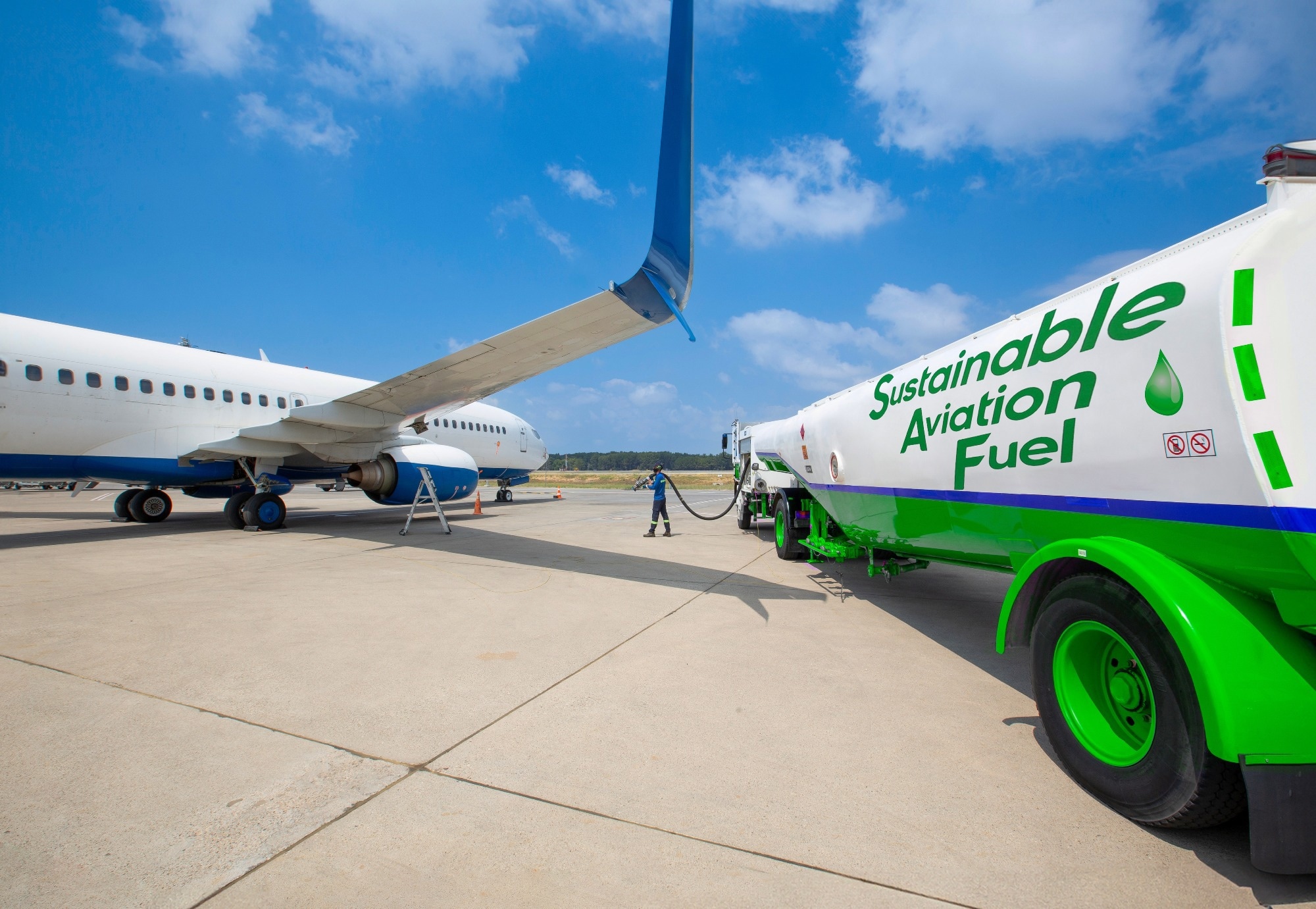
Image Credit: Bulent camci/Shutterstock.com
Under current ASTM D7566 certification standards, almost all approved SAF pathways must be blended with conventional petroleum-based jet fuel before use in commercial aircraft.
For the dominant Hydroprocessed Esters and Fatty Acids (HEFA) pathway, which accounted for around 99.6 % of SAF production in 2024, the blending cap is 50 %.4, 5 The reason is chemical: HEFA and most other approved pathways produce entirely paraffinic fuels, while conventional jet fuel contains 8–25 % aromatic molecules essential for swelling the elastomeric seals in aircraft fuel systems.6 Those aromatics are currently supplied by the fossil jet used in blending.
A fuel that is 50 % renewable and 50 % fossil cannot achieve full lifecycle decarbonization. California-based Universal Fuel Technologies (Unifuel) has developed a technology called Flexiforming, which it argues provides a commercially viable route to eliminating fossil blendstock from the equation.
The Aromatic Bottleneck and the Regulatory Pathway
The blending requirement is codified in ASTM D7566, which governs synthesized aviation turbine fuels. SAF blending components can only be redesignated as conventional Jet A (ASTM D1655) after meeting all performance specifications once blended with petroleum jet, specifications that include aromatic content.5
Dedicated task groups are evaluating standards to enable 100 % SAF use, with a target timeline of no earlier than 2030.7 Meanwhile, SkyNRG's 2025 SAF Market Outlook reports that nearly 82 % of current SAF capacity relies on HEFA and that demand is set to outpace HEFA's production potential after 2030, creating a projected 26 Mt gap between supply and demand by 2035.8
Even at full HEFA scale, the blending requirement means fuel delivered to aircraft retains a fossil carbon fraction. ASTM's own community has acknowledged this: CAAFI's executive director noted that blending adds time, cost, and carbon footprint, and that work toward a 100 % synthetic specification has been active.9
Want to save for later? Click here.
Unifuel's Flexiforming technology is a zeolite-based catalytic process that converts naphtha, alcohols, light olefins, or blends of these into high-octane gasoline, kerosene, or BTX aromatics, with the product slate adjusted by varying temperature, pressure, and space velocity.10 The proprietary HZSM-5 zeolite catalyst has a reported service life of three to five years. The technology is protected by 33 patents across 12 countries and has been operating in four commercial plants since 2015.
For HEFA operators, the application addresses the aromatic bottleneck directly. HEFA plants operating in maximum-SAF mode produce renewable naphtha as a byproduct, typically 5–25 % of output, that is paraffinic, aromatic-free, and sells at a fraction of SAF value. Flexiforming converts this naphtha into Synthetic Aromatic Kerosene (SAK), which, when blended with the plant's own HEFA Synthetic Paraffinic Kerosene (SPK), produces a fully synthetic jet fuel with both paraffinic and aromatic components from renewable sources. The fossil blendstock is not reduced; it is removed. 10
Pilot Results and Qualification Progress
Unifuel completed a five-month pilot at RPD Technologies' facility in Crosby, Texas (August–December 2024), producing approximately 100 liters of SAF sample material across four pathways: methanol-to-jet, ethanol-to-jet (ETJ), and naphtha-with-ethanol-to-jet. Samples were submitted to Washington State University's Bioproducts, Sciences and Engineering Laboratory (BSEL) for Tier 0 screening under the ASTM D4054 qualification framework. Results were announced in March 2025.11
The most significant result was reported on 17 March 2026. Independent testing by Washington State University validated a blend of 16 % Flexiforming-derived aromatic SAF and 84 % HEFA-derived paraffinic SAF against conventional jet fuel reference points. The blend met all critical performance parameters, including density, viscosity, freeze point (−43.5 °C), flash point, and heating value.12 These results confirm that aromatic molecules produced from renewable HEFA naphtha can, when combined with paraffinic SAF, meet the performance parameters required at the screening stage of the ASTM certification process.
In August 2025, Unifuel's ETJ pathway was accepted into the ASTM D4054 Clearinghouse - a formal gate requiring independent evidence of technical credibility, production at meaningful scale, and compliance with quality and safety criteria. The company is targeting completion of Tier 1 and Tier 2 testing required for D7566 qualification by the end of 2026.13
Commercial Model and Remaining Steps
Unifuel's commercial proposition rests on integrating Flexiforming into existing plant equipment, such as idle naphtha hydrotreaters or catalytic reformers, via a modular bolt-on unit requiring limited additional capital investment.10 A phased approach allows HEFA operators to begin with naphtha-to-gasoline conversion for near-term revenue, then repurpose the same core equipment to produce SAK once regulatory approval is obtained, at which point the SAK is blended with the plant's own HEFA SPK to create fully formulated, fossil-free SAF.
Full ASTM qualification as a D7566 annex pathway, the step required before commercial sale to airlines, requires Tier 1 through Tier 4 testing, OEM review, and ASTM ballot approval.5, 9 For the HEFA naphtha-to-SAK pathway specifically, the broader regulatory framework for neat SAF is still being developed, with standards not expected before 2030.7 What the pilot results confirm is that the chemistry is technically plausible at screening level. Whether it will satisfy the full D4054 test battery, including Tier 3 engine operability testing, remains to be demonstrated.
Conclusion
Today’s fossil blending requirement is the reason SAF still contains carbon levels that long-term full decarbonization targets cannot support.
Producing aromatics from renewable feedstocks and combining them with paraffinic SAF is a technically coherent route toward a genuinely fossil-free aviation fuel, though full ASTM D7566 qualification for this pathway, and the broader neat SAF standards that would enable its commercial deployment, remain years away, with a target horizon of no earlier than 2030.
Flexiforming's validated pilot results and entry into the ASTM qualification process represent a meaningful step toward that outcome. The economics will need to hold up at commercial scale, and the certification process has yet to run its full course. For producers, investors, and fuel purchasers planning for the post-2030 SAF landscape, this technology is worth close attention.
References and Further Reading
- EASA. What are Sustainable Aviation Fuels? European Union Aviation Safety Agency, 2024. https://www.easa.europa.eu/en/domains/environment/eaer/sustainable-aviation-fuels/what-are-sustainable-aviation-fuels
- IATA. Global Feedstock Assessment for SAF Production: Outlook to 2050. International Air Transport Association, 2025. https://www.iata.org/globalassets/iata/publications/sustainability/global-feedstock-assessment-for-saf-production-outlook-to-2050.pdf
- IATA. Disappointingly Slow Growth in SAF Production. Press release, December 2024. https://www.iata.org/en/pressroom/2024-releases/2024-12-10-03/
- Market.us. Sustainable Aviation Fuel Market Size, Share | CAGR of 54.5%. 2025. https://market.us/report/sustainable-aviation-fuel-market/
- Congressional Research Service. Sustainable Aviation Fuel (SAF): Production Pathways. IF12847, March 2025. https://www.congress.gov/crs-product/IF12847
- Advanced BioFuels USA. Flying with 100% Sustainable Aviation Fuels (SAF). https://advancedbiofuelsusa.info/flying-with-100-sustainable-aviation-fuels-saf
- EASA. SAF Market. European Union Aviation Safety Agency, 2024. https://www.easa.europa.eu/en/domains/environment/eaer/sustainable-aviation-fuels/saf-market
- SkyNRG & ICF. Sustainable Aviation Fuel Market Outlook 2025. January 2026. https://skynrg.com/safmo25/
- ASTM International. Fueling the Future of Aviation. ASTM Standardization News, July 2023. https://www.astm.org/news/fueling-future-aviation-ja23
- Universal Fuel Technologies. For HEFA Operators. unifuel.tech, 2025. https://unifuel.tech/for-hefa-operators
- Universal Fuel Technologies / BusinessWire. Pilot Demonstrates New Sustainable Aviation Fuel Production Pathways. March 25, 2025. https://www.businesswire.com/news/home/20250325181619/en/Universal-Fuel-Technologies-Pilot-Demonstrates-New-Sustainable-Aviation-Fuel-Production-Pathways
- Universal Fuel Technologies / BusinessWire. Universal Fuel Technologies Demonstrates Fully Drop-In Synthetic Aviation Fuel Using HEFA Byproducts. March 17, 2026. https://www.businesswire.com/news/home/20260317135795/en/Universal-Fuel-Technologies-Demonstrates-Fully-Drop-In-Synthetic-Aviation-Fuel-Using-HEFA-Byproducts
- Green Air News. Unifuel's 100% Drop-In SAF Production Technology Passes First Test in ASTM Qualification Process. October 2025. https://www.greenairnews.com/?p=7903
Disclaimer: The views expressed here are those of the author expressed in their private capacity and do not necessarily represent the views of AZoM.com Limited T/A AZoNetwork the owner and operator of this website. This disclaimer forms part of the Terms and conditions of use of this website.