The Ocean Cleanup is a Netherlands-based non-profit organization focused on developing and scaling technologies to remove plastic pollution from the oceans, with a goal of reducing it by 90 % by 2040.
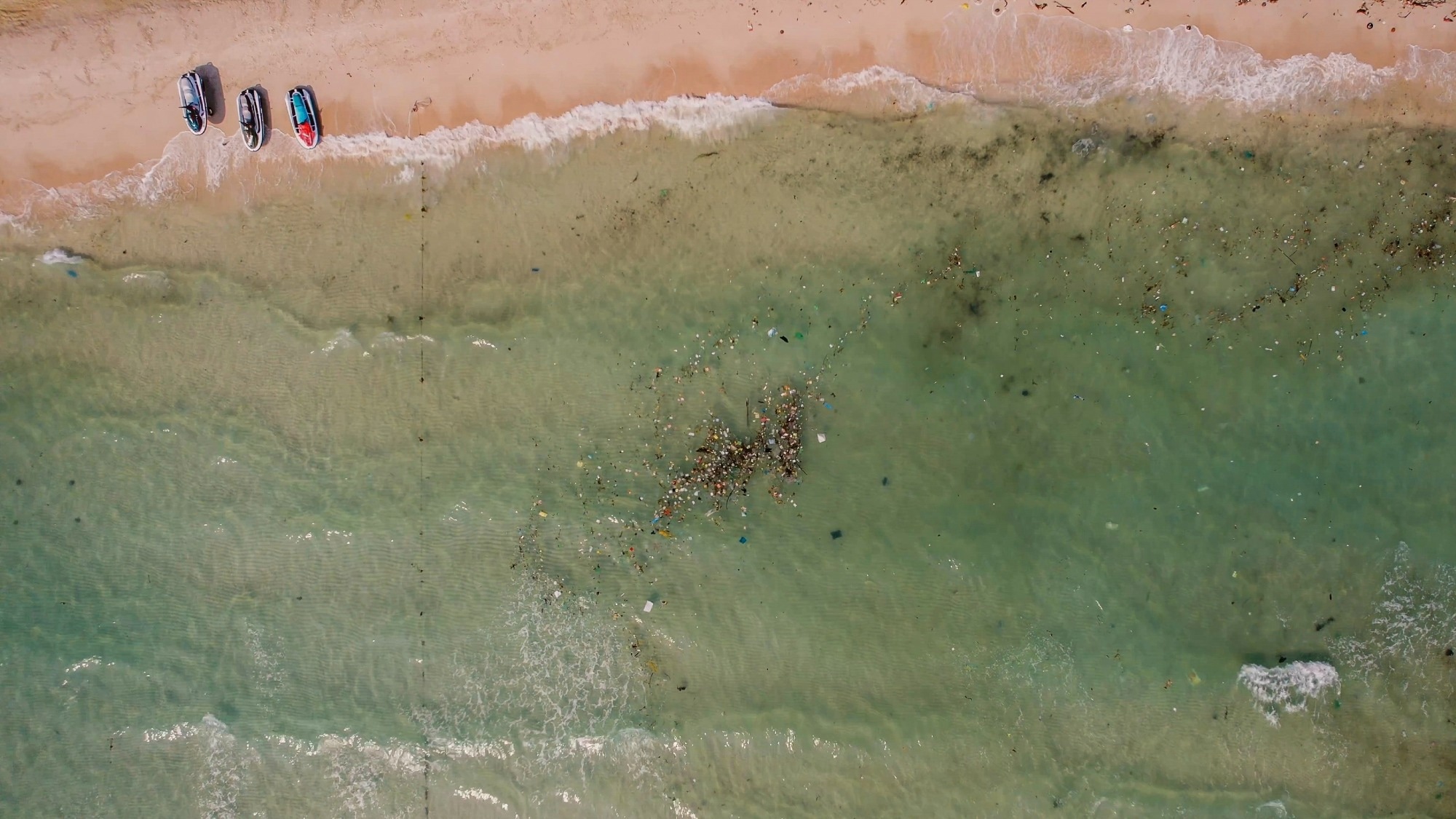
Image Credit: fotogurmespb/Shutterstock.com
Founded in 2013 by Dutch inventor Boyan Slat, The Ocean Cleanup became the first and only organization to deploy large-scale passive systems for removing plastic from the Great Pacific Garbage Patch (GPGP). It has now become the largest ocean cleanup in history, having removed over 53 million kg of plastic globally.
The Scale of Ocean Plastic Pollution
An estimated five trillion pieces of plastic have accumulated in the world’s oceans, distributed across surface waters, the water column, and the seafloor. This material originates mainly from land-based sources and is transported via rivers, stormwater systems, and coastal runoff.
Ocean circulation concentrates this debris into five major gyre-based accumulation zones, with the largest being the Great Pacific Garbage Patch between Hawaii and California, spanning approximately 1.6 million square kilometers. It is dominated by ghost gear, which accounts for roughly 75 % of its mass and drives entanglement and ingestion risks across marine ecosystems.
These plastics do not undergo meaningful chemical degradation but fragment into persistent microplastics below 5 mm that are effectively unrecoverable at scale. They disrupt oceanic carbon sequestration and are associated with annual carbon export losses of 15 to 30 million metric tons, while also degrading coastal ecosystems, such as mangroves, by altering hydrology and root structure.
These impacts extend to fisheries, tourism, and coastal food security, and continued accumulation is expected to intensify environmental and economic pressures over time.1,2
The Ocean Cleanup Approach: A Dual-Domain Plastic Intervention Strategy
The Ocean Cleanup project addresses ocean plastic pollution using a dual strategy that focuses on removing existing debris from ocean gyres while simultaneously preventing new inputs from entering through river systems.
Their data indicates that approximately 1,000 of the world’s 3 million rivers account for 80 % of riverine plastic discharge, highlighting a highly uneven distribution of pollution sources. This concentration enables targeted intervention in key waterways, improving the efficiency and scalability of plastic interception efforts by prioritizing the most significant entry points into marine environments.3
Detection and Mapping Technology
Mapping plastic distribution is essential due to the vast scale and dynamic nature of ocean environments. To address this, The Ocean Cleanup has developed an integrated detection infrastructure to characterize plastic across riverine systems, coastal waters, and the open ocean.
The river monitoring system (RMS) uses bridge-mounted camera arrays to capture debris in target waterways, with the resulting imagery used to train AI models for the identification and quantification of plastic types.
The automated debris imaging system (ADIS) extends monitoring to the open ocean through vessel-mounted, AI-enabled cameras that detect and geolocate floating debris, feeding data into a continuously updated global plastic density map.
Satellite remote sensing is primarily used in coastal regions to validate the impact of river interception efforts, while drones equipped with infrared sensors are being developed for large-scale monitoring of the Great Pacific Garbage Patch.
Click here to download a free PDF copy of this page
Their proprietary computer vision segmentation model further classifies plastic into morphological categories and extracts multiple quantitative parameters from low-resolution imagery, enabling scalable and automated plastic characterization.4,5,6
Table 1. Detection and mapping technologies deployed by The Ocean Cleanup
| Technology |
Platform |
Function |
Key Feature |
| River Monitoring System (RMS) |
Bridge-mounted cameras |
Detection and quantification of riverine plastic |
AI training dataset generation for plastic classification |
| Automated Debris Imaging System (ADIS) |
Vessel-mounted AI cameras |
Real-time surface
imaging and plastic
density mapping |
Creation of global, GPS-tagged plastic density maps |
| Satellite Remote Sensing |
Orbital imaging |
Maps plastic hotspots in coastal waters and remote river systems |
Validation of river interception effectiveness |
| Aerial Drones |
AI-equipped UAVs |
Monitoring of open-
ocean accumulation zones |
Infrared sensors enable 24/7 detection capability |
| Computer Vision Segmentation Model |
In-house image analysis system |
Quantifies and classifies plastic particles by shape, size, and color |
Outputs 16+ parameters per sample; freely accessible for non-commercial use |
Ocean Surface Cleanup: System 03
System 03 is the Ocean Cleanup’s primary ocean plastic recovery platform deployed in the North Pacific Garbage Patch (NPGP).
The system uses a floating barrier approximately 2.2 km in length and supports a 16 mm mesh screen extending to 4 m below the waterline, corresponding to the depth range where most buoyant plastic accumulates. The barrier is towed by two vessels at below 2.5 knots, with a 70 m retention zone that funnels captured material into a 5.5 m collection section.
The system operates passively using the relative motion between the gyre-driven plastic and the vessels, with barrier wings guiding floating debris into the retention zone rather than actively pursuing it. Plastic is then collected continuously under dynamic ocean conditions, minimizing energy use and allowing natural accumulation within the system.
The vessels are directed toward regions of elevated plastic concentration using computational modeling of plastic dispersal combined with real-time ADIS data. This targeting is refined through iterative feedback from system performance data, enabling dynamic adjustment of deployment routes to remain within high-concentration zones.
The retention zone is typically emptied every four days, lifted onboard, sealed, and offloaded on deck for sorting and packaging, with more than 97 % of recovered material directed into recycling streams.7
How System 03 Cleans the Great Pacific Garbage Patch
Video Credit: The Ocean Cleanup/Youtube.com
River Interception: The Interceptor Family
The Ocean Cleanup removes plastic from rivers using its Interceptor family of systems, which combine floating barriers and autonomous vessels to capture debris before it reaches the ocean.
Interceptor barriers guide waste toward collection points, where conveyor-equipped Interceptor units extract and store the material. The collected plastic is then transported for sorting, recycling, or disposal, with system deployment guided by monitoring data to target high-debris river sections.2,8
Table 2. The Ocean Cleanup Interceptor family: configurations and operational characteristics
| Model |
Function |
Mechanism |
Notable Feature |
Active Deployment |
| Interceptor Original |
Primary river plastic extraction system |
Floating barriers guide waste into a catamaran unit, where water flow drives it onto a conveyor. A shuttle distributes it to six dumpsters, with load balancing. |
Solar-powered system, smart monitoring, up to 50 m3 storage, automated SMS
alerts when full |
Indonesia, India, Colombia, Philippines, Caribbean |
| Interceptor Barrier |
Small river mouths and coastal inlets |
Permeable floating barrier anchored in a U-shape slows and concentrates debris until manual extraction, typically supported by a Tender system. |
Low-maintenance, energy-efficient, designed for integration with external extraction units |
Multiple coastal sites globally |
| Interceptor Barricade |
High-volume seasonal rivers |
Dual-boom system with an upstream boom capturing the primary debris load and a downstream boom capturing overflow and missed plastic. |
Engineered for extreme rainy-
season flow events |
Rio Las Vacas, Guatemala |
| Interceptor Guard |
Shallow gullies and coastal channels |
Flexible barrier that can beach without structural damage and prevents debris reflux; functions
as a no-return boom with Barrier systems. |
Prevents re-entry of captured plastic
under wind and wave influence |
Kingston Harbour, Jamaica |
| Interceptor Tender |
Multi-site barrier networks |
Motorized barge equipped with a conveyor belt that collects debris from barriers and offloads it onshore |
Shared infrastructure across deployments reduces per-site equipment cost and enables scalable operations. |
Deployed in combination with Barrier systems |
Recycling Plastic into Commercial Products
The Ocean Cleanup recovery pipeline converts plastic from ocean and river systems into recycled materials and consumer products. This closed-loop approach generates revenue for reinvestment while demonstrating the viability of ocean plastic as a commercial resource.
The Ocean Cleanup’s first commercial product, The Ocean Cleanup Sunglasses, launched in 2020 using plastic recovered from the Great Pacific Garbage Patch, serving as a proof of concept for its recycling pipeline.9
A subsequent partnership with Kia resulted in the development of a limited-edition EV3 trunk liner, incorporating 40 % recycled ocean plastic and manufactured using extrusion and vacuum forming.10
These products provide a tangible, consumer-facing demonstration of the recycling process.
Comparison with Similar Projects
Most plastic removal initiatives are concentrated on coastal and nearshore cleanup or localized waste collection efforts, whereas The Ocean Cleanup’s dual-domain strategy, coupled with its emphasis on scalable deployment and automated detection infrastructure, sets it apart as a systems-level intervention in marine plastic mitigation.
Table 3. Comparison of Ocean Plastic Intervention Approaches
| Organization |
Operational Focus |
Methodology |
Deployment Environment |
Distinguishing Feature |
| The Ocean Cleanup |
Large-scale plastic removal and interception |
Passive barrier systems, river Interceptors, AI-driven monitoring |
Open-ocean gyres and major rivers |
Kilometer-scale gyre cleanup combined with a global river interception network |
| 4ocean |
Coastal and nearshore cleanup |
Vessel-based mechanical and manual collection |
Coastal waters and nearshore zones |
Commercial funding model via recycled plastic products |
| SEABIN |
Localized surface debris capture |
Fixed floating collection devices |
Marinas, harbors, sheltered waters |
Stationary point-source filtration of surface plastics |
| Plastic Oceans International |
Awareness, research, and education |
Advocacy, community programs, research initiatives |
Global (non-operational cleanup focus) |
Non-intervention model focused on behavioral and policy change |
Environmental Implications of the Ocean Cleanup Project
The Ocean Cleanup’s interventions are expected to deliver measurable reductions in marine plastic pollution by removing legacy debris from ocean gyres and intercepting plastic in river systems before it enters the ocean.
These efforts will reduce direct ecological harm to marine organisms, limit the long-term formation of secondary microplastics, and mitigate broader disruptions to marine food webs and ecosystem processes.
Lower surface plastic concentrations will also reduce deposition on coastal and island environments, lowering cleanup burdens and mitigating economic impacts associated with marine debris in tourism and fisheries sectors.
Large-scale removal operations will also enable systematic scientific observation in remote marine regions, improving understanding of plastic transport, accumulation dynamics, and ecosystem interactions.7
However, the effectiveness of these interventions in reversing ocean plastic accumulation will depend on whether deployment capacity can scale faster than ongoing land-based plastic inputs.
References and Further Reading
- The Ocean Cleanup. (2026). Oceans. https://theoceancleanup.com/oceans/
- Zhu, X., Rochman, C. M., Hardesty, B. D., & Wilcox, C. (2024). Plastics in the deep sea – A global estimate of the ocean floor reservoir. Deep Sea Research Part I: Oceanographic Research Papers, 206, 104266. https://doi.org/10.1016/j.dsr.2024.104266
- The Ocean Cleanup. (2026). How It Works - Interceptor™ Original. https://theoceancleanup.com/rivers/interceptor-original/
- Mani, T. (2023). A Tale of 3 Rivers: Intercontinental River Research Collaboration. https://theoceancleanup.com/updates/a-tale-of-3-rivers-intercontinental-river-research-collaboration/
- The Ocean Cleanup. (2026). Understanding plastic pollution - Research. https://theoceancleanup.com/research/
- Liese, N., Puskic, P., Royer, S., & Kooi, M. (2026). A comparative analysis of 2D, visible light imaging technologies for describing the physical properties of micro- and mesoplastics (0.5 to 50 mm). Marine Pollution Bulletin, 228, 119580. https://doi.org/10.1016/j.marpolbul.2026.119580
- Egger, M., Booth, A. M., Bosker, T., Everaert, G., Garrard, S. L., Havas, V., Huntley, H. S., Koelmans, A. A., Kvale, K., Lebreton, L., Niemann, H., Pang, Q., Proietti, M., Puskic, P., Richon, C., Royer, S. J., Savoca, M. S., Tjallema, A., Van Vulpen, M., . . . Mitrano, D. M. (2025). Evaluating the environmental impact of cleaning the North Pacific Garbage Patch. Scientific Reports, 15(1), 16736. https://doi.org/10.1038/s41598-025-00619-w
- The Ocean Cleanup. (2026). Intercepting Trash in Rivers. https://theoceancleanup.com/rivers/
- The Ocean Cleanup. (2026). The Ocean Cleanup Sunglasses. https://theoceancleanup.com/sunglasses/
- Kia. (2026). Trunk Liner - A Small Step Towards a Brighter Future. https://worldwide.kia.com/en/sustainability/ev3-trunkliner
Disclaimer: The views expressed here are those of the author expressed in their private capacity and do not necessarily represent the views of AZoM.com Limited T/A AZoNetwork the owner and operator of this website. This disclaimer forms part of the Terms and conditions of use of this website.