New research shows pre-treatment in lithium-ion battery recycling drives environmental impact and recovery of valuable metals – yet it is often overlooked in recycling strategies.
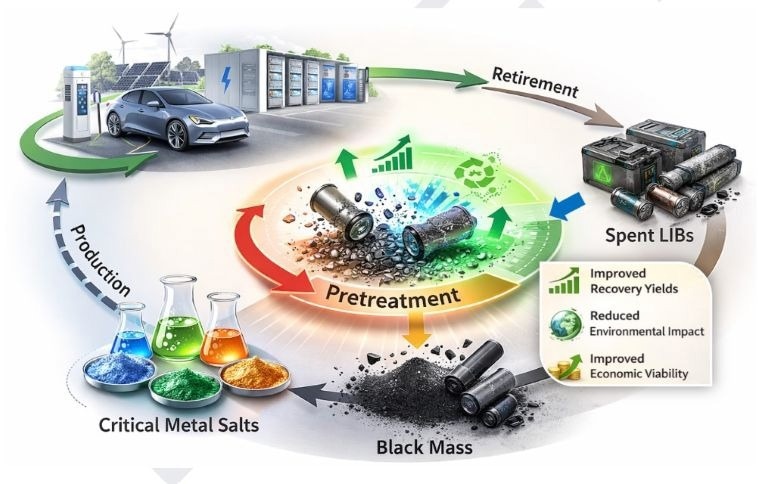 Illustration outlining the pretreatment process of lithium-ion batteries. Image generated with AI assistance. Image Credit: Monash University
Published in Nature Sustainability, the Monash study found the pre-treatment stage can account for up to 38 percent of the environmental impact of recycling and significantly affects material losses, depending on battery type and processing method.
Pre-treatment is the first processing step, turning spent batteries into “black mass,” before valuable metals such as lithium, nickel, and cobalt can be extracted, yet it is often ignored in recycling strategies, according to the study.
As countries around the world build new battery recycling systems, the insights provide critical guidance for policymakers and industry, helping ensure recycling systems are efficient, effective and sustainable.
The study, by the Department of Civil and Environmental Engineering, compared three main industrial approaches – mechanical, thermal and chemical pre-treatments - identifying clear trade-offs between environmental performance, recovery efficiency and operational complexity.
Professor Victor Chang, Deputy Head, Department of Civil and Environmental Engineering, said the findings show that choices made at the start of recycling can affect how well the system works and how much waste or metals are lost over time.
“While many countries are planning to invest in and scale up battery recycling industries, our work highlights an important aspect of the process – the pre-treatment stage. This step is often overlooked, but it can be critical in determining the efficiency, safety, and overall effectiveness of downstream recycling processes,” Professor Chang said.
“Lithium-ion battery recycling is not just a technical challenge – it’s a system design challenge. Pre-treatment shapes both recovery efficiency and environmental outcomes. Decisions made at this stage will affect system performance for decades, so it’s vital that they are guided by robust evidence.”