Four main types of electrolyzers are used for converting water and electricity into hydrogen gas: Alkaline, PEM, AEM, and SOEC.
Each type of electrolyzer features its own range of advantages, disadvantages, and optimal applications, and factors such as usage patterns, energy profiles, siting limitations, and scalability plans influence the correct choice for a given application.
Understanding Electrolyzers
An electrolyzer uses electricity to split water (H2O) into hydrogen (H2) and oxygen (O2). This process is known as electrolysis and is a zero-emission method for generating hydrogen gas when powered by renewable energy.
The same fundamental principle applies to all types of hydrogen electrolyzers, but there are differences in operating costs, employed electrolytes, membrane materials, system architectures, and temperature and pressure flexibility.
These differences determine how each technology performs under real-world conditions. This means that the type of electrolyzer used can determine the success of a project, whether it is deployed in industrial energy systems, microgrid, or long-duration energy storage applications.
This article looks at the differences and use cases of the four most popular electrolyzer types in the hydrogen sector.
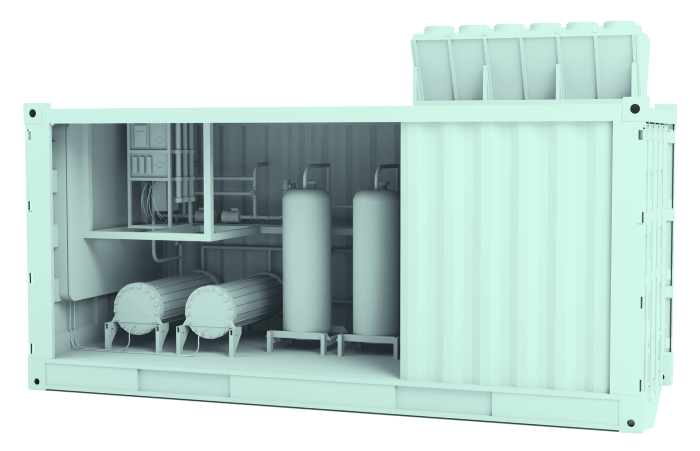
Image Credit: Power to Hydrogen
The Four Primary Types of Electrolyzers
Alkaline Electrolyzers
Alkaline electrolyzers have seen decades of use in commercial applications. These electrolyzers employ a liquid alkaline solution as the electrolyte, typically sodium hydroxide (NaOH) or potassium hydroxide (KOH).
A diaphragm separates the oxygen and hydrogen gases, facilitating ion flow between the electrodes while preventing gas mixing. This method minimizes system costs, employs durable components, and offers long operational lifespans.
However, alkaline electrolyzers have a slower dynamic response, making them less suitable for use with variable renewable energy sources. These electrolyzers are often bulkier and tend to operate at lower current densities than their counterparts.
These systems are well-suited fo large-scale hydrogen production, most notably in applications where space is not a limiting factor and in industrial facilities with consistent power input.
Proton Exchange Membrane (PEM) Electrolyzers
PEM electrolyzers use a solid polymer membrane as the electrolyte, which conducts protons while blocking gases, ensuring high-purity hydrogen output. These systems operate at relatively low temperatures and are recognized for their rapid response times and their capacity to accommodate power fluctuations.
Their compact design makes them ideally suited to settings with space constraints. They can also produce hydrogen at high pressures, lowering additional compression requirements.
These electrolyzers rely on costly noble metal catalysts, such as iridium (Ir) and platinum (Pt), however, leading to increased operating costs on top of the high upfront costs. The membranes also suffer from limited durability under certain conditions.
PEM systems are useful in high-purity applications, including transportation and fuel cells. They are also well-suited to integration with renewable energy for on-site hydrogen production.
Anion Exchange Membrane (AEM) Electrolyzers
AEM electrolyzers benefit from the best features of both alkaline and PEM technologies. These electrolyzers leverage a solid anion-exchange membrane and achieve PEM-like efficiency while relying on cost-effective, non-noble-metal catalysts to reduce system costs.
Key benefits of AEM electrolyzers include flexibility with intermittent power, the elimination of expensive noble metals, and suitability for compact systems. They also operate at relatively low temperatures and seek to offer a balance between affordability and performance.
They are also a good fit for cost-sensitive projects, decentralized hydrogen production, emerging markets, and pilot programs. Power to Hydrogen specializes in AEM electrolyzer technology, working to further develop AEM systems as a practical solution for distributed hydrogen generation.
AEM systems are an excellent choice for small- to medium-sized projects, modular hydrogen systems, on-site production with limited maintenance personnel, and microgrid applications.
Solid Oxide Electrolyzers (SOEC)
Solid Oxide Electrolysis Cells (SOECs) use a solid ceramic electrolyte and function at extremely high temperatures, generally between 600 °C and 1000 °C. These high temperatures allow them to use heat to reduce electricity requirements, making them highly electrically efficient.
Industrial facilities that produce significant heat, such as steel mills, benefit from the use of SOECs.
These electrolyzers are able to generate hydrogen by using waste heat from manufacturing processes. These high operating temperatures also present challenges, however, slowing down start-up and shutdown processes, straining materials, and currently limiting widespread commercial deployment.
SOECs are almost exclusively employed for large-scale hydrogen production, most notably in industrial settings where waste heat is available.
Image Credit: Power to Hydrogen
Comparing Electrolyzer Types
Source: Power to Hydrogen
| Factor |
Alkaline (ALK) |
PEM |
AEM |
SOEC |
| Electrolyte |
Liquid (KOH/NaOH) |
Solid polymer |
Solid anion membrane |
Solid ceramic |
| Operating Temperature |
60–90 °C |
70–90 °C |
40–70 °C |
600–1000 °C |
| Response Time |
Slow |
Fast |
Moderate |
Slow |
| Efficiency |
Moderate |
High |
High |
Very High |
| Maturity |
Highly mature |
Commercialized |
Emerging |
Pre-commercial |
| Cost |
Low |
High |
Low to medium |
High |
Ideal Use
Case |
Base-load hydrogen
production |
Renewable energy
integration |
Distributed and renewable
applications |
Industrial scale with
waste heat |
Selecting the Right Electrolyzer for Specific Applications
Multiple technologies are available, meaning that several factors must be balanced to select the right electrolyzer.
Space Constraints
The compact designs of PEM or AEM electrolyzers make them the ideal choice for applications with only limited footprints.
Hydrogen Purity
PEM and AEM electrolyzers generate very high-purity hydrogen, requiring only minimal post-processing prior to use.
Budget
Alkaline systems are typically the most affordable in terms of upfront costs, while PEM and SOEC systems have higher initial costs but lower operational expenses. AEM offers the most optimal balance of CAPEX and OPEX, with increased savings potential as the technology continues to mature and scale.
Hydrogen Storage
AEM and PEM systems are the ideal options when working with pressurized hydrogen. Both of these electrolyzer types operate efficiently up to 30 bar, reducing the need for post-compression.
Alkaline systems generally produce gas at low pressures, while SOECs necessitate the use of external compression systems.
Energy Source Compatibility
PEM electrolyzers are highly suited for use with intermittent and renewable energy sources due to their rapid start-up and dynamic response capabilities. SOEC and alkaline systems perform best with consistent energy input.
Selecting the wrong electrolyzer type could lead to underperformance, energy waste, or excessive maintenance. Power to Hydrogen guides its clients through these considerations, ensuring the selected electrolyzer type best matches their specific project needs.
The Role of Electrolyzers in Hydrogen's Future
Industries and countries continue to move toward decarbonization, prompting increased investments in continually evolving electrolyzer technology.
Governments are increasingly supporting hydrogen production to help meet emissions targets, seeking to bring hydrogen costs below $1 per kilogram.
AEM electrolyzer technology has the best potential to help meet these goals; though PEM and alkaline systems are already established, they must make compromises in terms of either cost or flexibility.
SOEC has value in niche high-heat use cases, but AEM is built for cost-effective, reliable, and flexible hydrogen generation.
Power to Hydrogen’s Hybrid AEM Electrolyzers
Power to Hydrogen’s hybrid AEM electrolyzers are the solution for applications requiring PEM’s agility without its cost profile, or alkaline’s economics without its operational drag.
The company’s AEM systems are engineered for real sites, grids, and budgets, and engineers are opting to work with Power to Hydrogen for a number of reasons:
- Rapid, stable dynamics, tracking intermittent wind and solar profiles with quick start and stop capabilities
- Lower critical materials risk, de-risking both cost and the supply chain, as there is no heavy reliance on scarce PGM catalysts
- Simpler operations, with no concentrated KOH loops like conventional alkaline
- Compact footprint, with modular skids sized for microgrids, space-constrained sites, and behind-the-meter projects
Power to Hydrogen’s hybrid AEM system gives users room to engineer, rather than simply accommodate trade-offs. Customers planning a pilot, repower, or multi-MW build can provide their water specs, load profile, and target purity, and receive a stack-and-skid package tailored to the specific site constraints and cost model.
Summary
Every hydrogen project is different. Selecting the optimal electrolyzer is a crucial decision that impacts cost, efficiency, and scalability, whether planning a utility-scale deployment or building a small-scale renewable energy system.

This information has been sourced, reviewed, and adapted from materials provided by Power to Hydrogen.
For more information on this source, please visit Power to Hydrogen.