What Are Aqueous Zinc-Ion Batteries?
How Do Aqueous Zinc-Ion Batteries Differ From Lithium-Ion Batteries?
Are Zinc-Ion Batteries Sustainable?
What Materials Are Needed for Aqueous Zinc-Ion Batteries?
Challenges and Recent Research
Could Zinc-Ion Batteries Replace Traditional Batteries?
References and Further Reading
Lithium-ion batteries power most of the world's phones, laptops, and electric vehicles, and they also anchor grid-scale energy storage. However, concerns over cost, fire risk, and the geographic concentration of lithium supply chains have intensified the search for alternatives. Aqueous zinc-ion batteries (AZIB) are a leading candidate that stores energy using zinc metal and a water-based electrolyte. But how do these batteries work, how do they compare with lithium-ion cells, and could they realistically reduce our dependence on lithium?
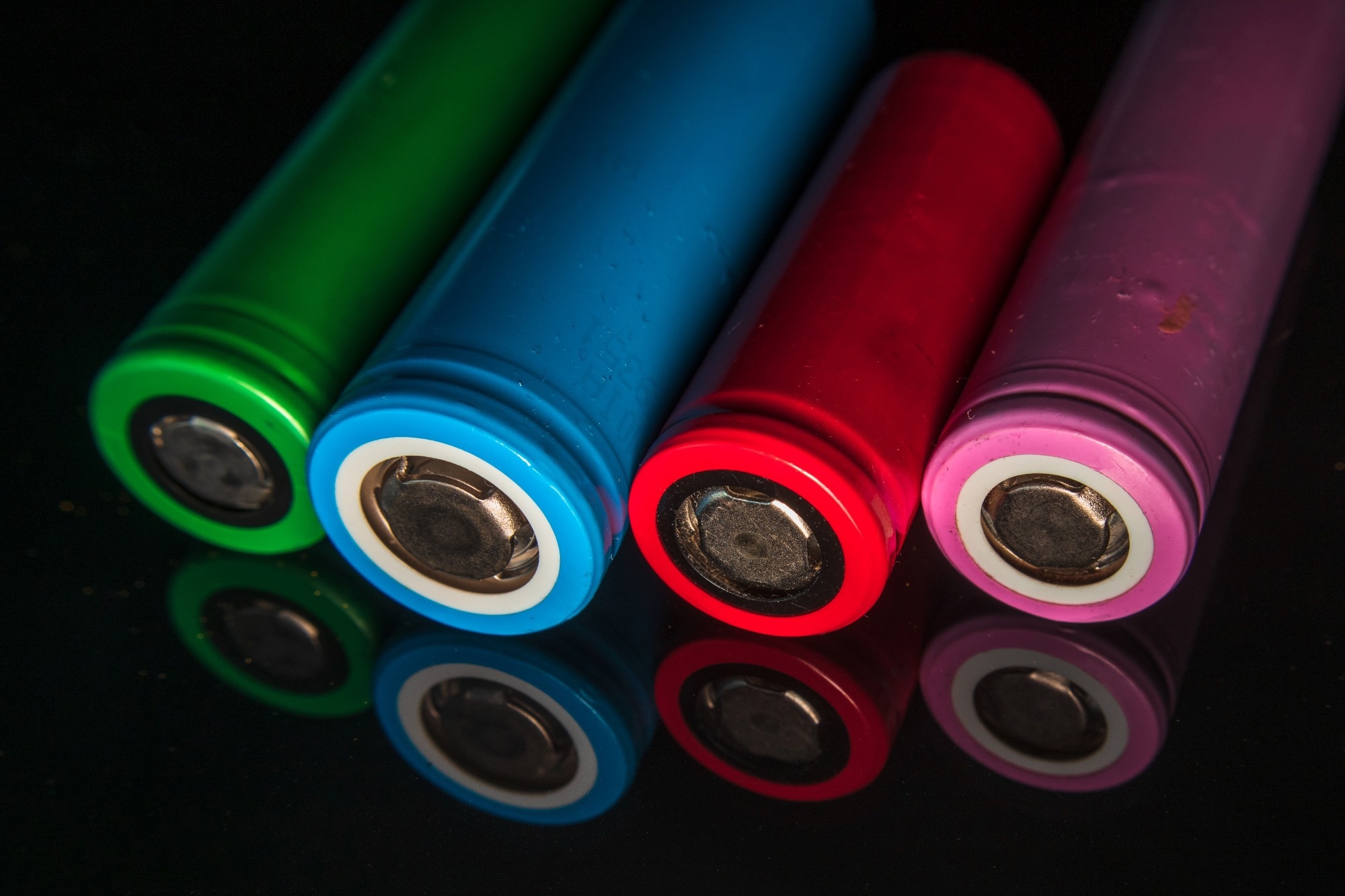
Lithium-Ion Batteries. Image Credit: DMZ001/Shutterstock.com
What Are Aqueous Zinc-Ion Batteries?
A typical AZIB pairs a zinc metal anode with a host cathode and a mildly acidic aqueous electrolyte, most commonly zinc sulfate. During discharge, zinc atoms at the anode are oxidized to Zn2+ ions, which migrate through the electrolyte and are stored at the cathode; charging reverses the process. Four main cathode storage mechanisms have been identified, including Zn2+ insertion/extraction, H+/Zn2+ co-insertion, chemical conversion, and dissolution/deposition.1
Zinc is a preferable anode because each ion transfers two electrons, giving a high theoretical capacity of 820 mAh g-1, and its redox potential of -0.76 V versus the standard hydrogen electrode is suited to aqueous systems.1 Zinc is also stable enough in air and water to be handled without protective atmospheres, simplifying cell assembly considerably.2
How Do Aqueous Zinc-Ion Batteries Differ From Lithium-Ion Batteries?
The most fundamental difference lies in the electrolyte. Lithium-ion cells depend on flammable organic solvents and are vulnerable to thermal runaway, whereas AZIBs use non-flammable, water-based electrolytes, largely removing the risk of fire or explosion.2
Performance profiles also diverge. Commercial lithium-ion cells operate at around 3.2-3.7 V and reach energy densities of roughly 150-300 Wh kg-1, while zinc-ion full cells typically operate at 1.2-1.5 V, and most reported systems remain below 100 Wh kg-1,2
Manufacturing requirements differ as well. Lithium-ion production demands moisture-free dry rooms and tightly controlled processing, whereas zinc-ion cells can be assembled in ambient air using established, low-cost infrastructure.
The United States Department of Energy identifies zinc batteries as strong candidates for long-duration stationary storage, where low cost, safety, and durability matter more than weight.3 In practice, the two chemistries, therefore, target different markets. Lithium-ion dominates where energy density is critical, such as vehicles and portable devices, while zinc-ion competes for grid and backup storage.
Click here to download a PDF copy of this page
Are Zinc-Ion Batteries Sustainable?
Zinc performs well on most sustainability measures. It is considerably more abundant in the Earth's crust than lithium, is mined and refined in many regions, and benefits from a recycling industry that has operated for around a century with high recovery rates.3
A life cycle assessment of laboratory-scale AZIBs reported an average footprint of 45.1 kg CO2 equivalent per kWh of capacity, making the chemistry environmentally competitive with lithium-ion, lithium-sulfur, and sodium-ion technologies, and attractive from a circular-economy perspective.4
The aqueous electrolyte avoids the toxic, flammable solvents used in lithium-ion cells, and recycling zinc electrodes consumes less energy than recovering lithium battery materials.4
Researchers are also developing electrolytes based on natural deep eutectic solvents and biomass-derived compounds to make the chemistry greener.5
What Materials Are Needed for Aqueous Zinc-Ion Batteries?
The anode is metallic zinc, used as foil or powder, and the electrolyte is usually a solution of zinc sulfate or zinc trifluoromethanesulfonate in water, often modified with functional additives.1
Cathodes fall into four main families:6
- Manganese oxides - Cheap and abundant
- Vanadium oxides - Offer high capacity but raise toxicity and dissolution concerns
- Prussian blue analogs - Provide higher voltages at modest capacity
- Organic compounds - Tunable and potentially renewable
Glass fiber or cellulose separators and stainless steel or carbon current collectors complete the cell. AZIBs require no lithium, cobalt, or nickel, avoiding the most contested materials in today's battery supply chains.3
Challenges and Recent Research
The zinc anode is the central obstacle. Uneven plating produces dendrites that can pierce the separator, and hydrogen evolution, corrosion, and passivation reduce coulombic efficiency and shorten cycle life.1
Recent research has focused heavily on electrolyte engineering in response. Functional additives that restructure the hydrogen-bond network of water have been shown to suppress dendrite growth and side reactions,7 and eutectic electrolytes that lower water activity have enabled highly reversible zinc plating and stripping.8
A 2025 study in Nature Communications demonstrated that regulating Zn2+ solvation chemistry allows zinc metal batteries to operate at low temperatures.9
Cathode stability is the other major concern. Manganese dissolution and structural degradation drive capacity fade in manganese dioxide cathodes, and a 2026 computational study traced this fade to the formation of manganese vacancies during cycling.10
Raising energy density toward practical targets is an ongoing design challenge addressed through high-voltage cathodes, lean electrolytes, and thicker electrodes.2
Commercial progress is also visible. Enerpoly has opened the world's first zinc-ion battery megafactory in Stockholm, with a target output of 100 MWh of batteries per year for grid and backup applications.11
Could Zinc-Ion Batteries Replace Traditional Batteries?
Zinc-ion batteries are unlikely to remove the need for lithium-ion entirely, as their lower energy density rules out most vehicle and portable applications for now. Their opportunity lies in the areas where lithium-ion is weakest, particularly stationary storage that must be cheap, safe, and durable.
If current anode and cathode challenges continue to yield to electrolyte and materials innovation, AZIBs could displace a meaningful share of lithium-ion demand in grid storage, easing pressure on lithium supply chains rather than replacing them outright.
References and Further Reading
- Recent advances in aqueous zinc ion batteries: Energy storage mechanisms, challenges, and optimization strategies. (2026). Batteries, 12(3), 109. https://doi.org/10.3390/batteries12030109
- High-energy-density aqueous zinc-ion batteries: Recent progress, design strategies, challenges, and perspectives. (2025). Advanced Materials. https://doi.org/10.1002/adma.202501361
- U.S. Department of Energy. (2023). Technology strategy assessment: Zinc batteries. Storage Innovations 2030. https://www.energy.gov/sites/default/files/2023-07/Technology%20Strategy%20Assessment%20-%20Zinc%20Batteries.pdf
- Iturrondobeitia, M., et al. (2022). Environmental impacts of aqueous zinc ion batteries based on life cycle assessment. Advanced Sustainable Systems, 6, 2100308. https://doi.org/10.1002/adsu.202100308
- Yaman Uzunoglu, G., & Yuksel, R. (2025). Toward green and sustainable zinc-ion batteries: The potential of natural solvent-based electrolytes. Small. https://doi.org/10.1002/smll.202411478
- A comprehensive review of cathode materials for advanced aqueous zinc-ion batteries. (2025). ACS Applied Energy Materials. https://doi.org/10.1021/acsaem.5c00602
- Unlocking long-term stability: Electrolyte additives for suppressing zinc dendrite growth in aqueous zinc metal batteries. (2025). Chemical Engineering Journal. https://www.sciencedirect.com/science/article/abs/pii/S1385894725008162
- Eutectic electrolytes enable highly reversible zinc-ion batteries by suppressing both dendrite growth and water activity. (2025). Journal of Energy Storage. https://www.sciencedirect.com/science/article/abs/pii/S2352152X25038460
- Gradient chaotropic regulation of Zn2+ solvation chemistry for low-temperature zinc metal batteries. (2025). Nature Communications, 16. https://doi.org/10.1038/s41467-025-67426-9
- Unveiling the origin of the capacity fade in MnO2 zinc-ion battery cathodes through an analysis of the Mn vacancy formation. (2026). arXiv preprint. https://arxiv.org/abs/2602.13116
- World's first zinc-ion battery megafactory opens for business. (2025). New Atlas. https://newatlas.com/energy/enerpoly-zinc-ion-battery-megafactory/
Disclaimer: The views expressed here are those of the author expressed in their private capacity and do not necessarily represent the views of AZoM.com Limited T/A AZoNetwork the owner and operator of this website. This disclaimer forms part of the Terms and conditions of use of this website.