A world-first food productivity system partly funded by La Trobe Eagle Fund has reached a significant milestone with the launch of its first production greenhouse and an agreement to establish the system in India.
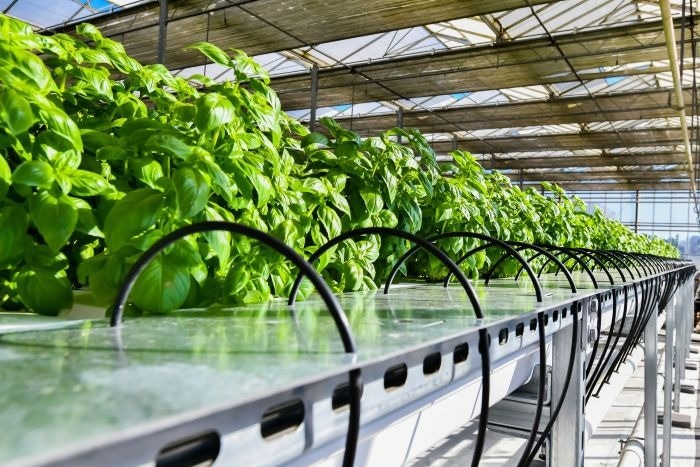 Image Credit: La Trobe University
The innovative hydroponic system was originally engineered with the help of researchers from La Trobe’s School of Computing, Engineering and Mathematical Sciences (SCEMS) and the School of Agriculture, Biomedicine and Environment (SABE) for the NASA deep space food program.
The La Trobe Eagle Fund – a joint investment fund between La Trobe University and Breakthrough Victoria - invested $1 million of the $1.75 million seed round last year to support the development and commercialization of the system, along with seed funding from Mandalay Venture Partners and LaunchVic’s Hugh Victor McKay Fund.
YieldX is now operating at commercial scale within a 4,000 square meter protected cropping greenhouse at Butler Market Gardens in Lyndhurst, Victoria. The commercial pilot has demonstrated the intelligent optimization of plant spacing, and when deployed across the full site, is projected to increase basil production by up to 1 million plants per year within the same greenhouse footprint.
The system is about to be established in India, following a multi-year agreement with Hyperpure by Zomato, the fresh supply chain arm of one of India’s largest publicly listed food and commerce platforms.
The agreement will see YieldX systems deployed across multiple controlled environment agriculture sites in and around New Delhi, supporting Hyperpure’s strategy to vertically integrate fresh produce supply and improve reliability through extreme summer heat and monsoon conditions.
La Trobe Deputy Vice-Chancellor Research and Innovation Professor Chris Pakes said YieldX’s success demonstrated the importance of Eagle Fund to connect industry partners with La Trobe’s expertise and intellectual property and advance concepts through to a commercially viable product.
“This incredible milestone by YieldX shows what can be achieved when research and industry come together to develop something truly innovative to help solve some of the biggest issues facing our world,” Professor Pakes said.
“We are delighted that through our partnership with Breakthrough Victoria, the La Trobe University Eagle Fund is helping bridge the gap between research and commercialization, drawing on the University’s innovation and world-class research across biotech, Agtech and biomedical sciences.”
YieldX Chief Executive Officer and Chief Technology Officer Nadun Hennayaka said the milestone represented the culmination of years of focused engineering and commercial discipline.
“This moment has been five years in the making. The NASA program proved the engineering, but our real ambition was always to make farming easier and more productive on Earth. We are focused on empowering growers with step change yet simple technology that helps ensure fresh food remains accessible to local communities. This is the first time growers can physically see what is possible at true commercial scale.”
Rick Butler, Chief Executive Officer of Butler Market Gardens, said the technology directly aligned with the future needs of commercial growers.
“We are excited to partner with YieldX on this pilot site. Increasing production capacity while improving labor efficiency is critical to our long-term strategy. In horticulture, standing still is not an option. Process and practice become obsolete very quickly if you do not innovate. We are proud to be part of this pioneering system and look forward to refining it to deliver results for growers around the world.”
The YieldX system was supported with expertise from La Trobe researchers Dr Alex Stumpf, Adam Console and Fernando Galetto, who helped develop two vertical farms as part of the NASA Deep Space Food Challenge (DSFC).
Dr Stumpf said seeing the first crop from the system now in supermarkets was a great validation of all the hard work they had put in.
The Lyndhurst demonstration site is now open to growers, distributors, industry leaders and investors, allowing the sector to see the system in operation, review performance data and understand how material gains in crop density, yield and land use efficiency can be achieved inside existing infrastructure.