A new study finds that active green walls can remove up to 98 % of indoor air pollutants under controlled conditions, highlighting their potential as a powerful complement to traditional air filtration systems.
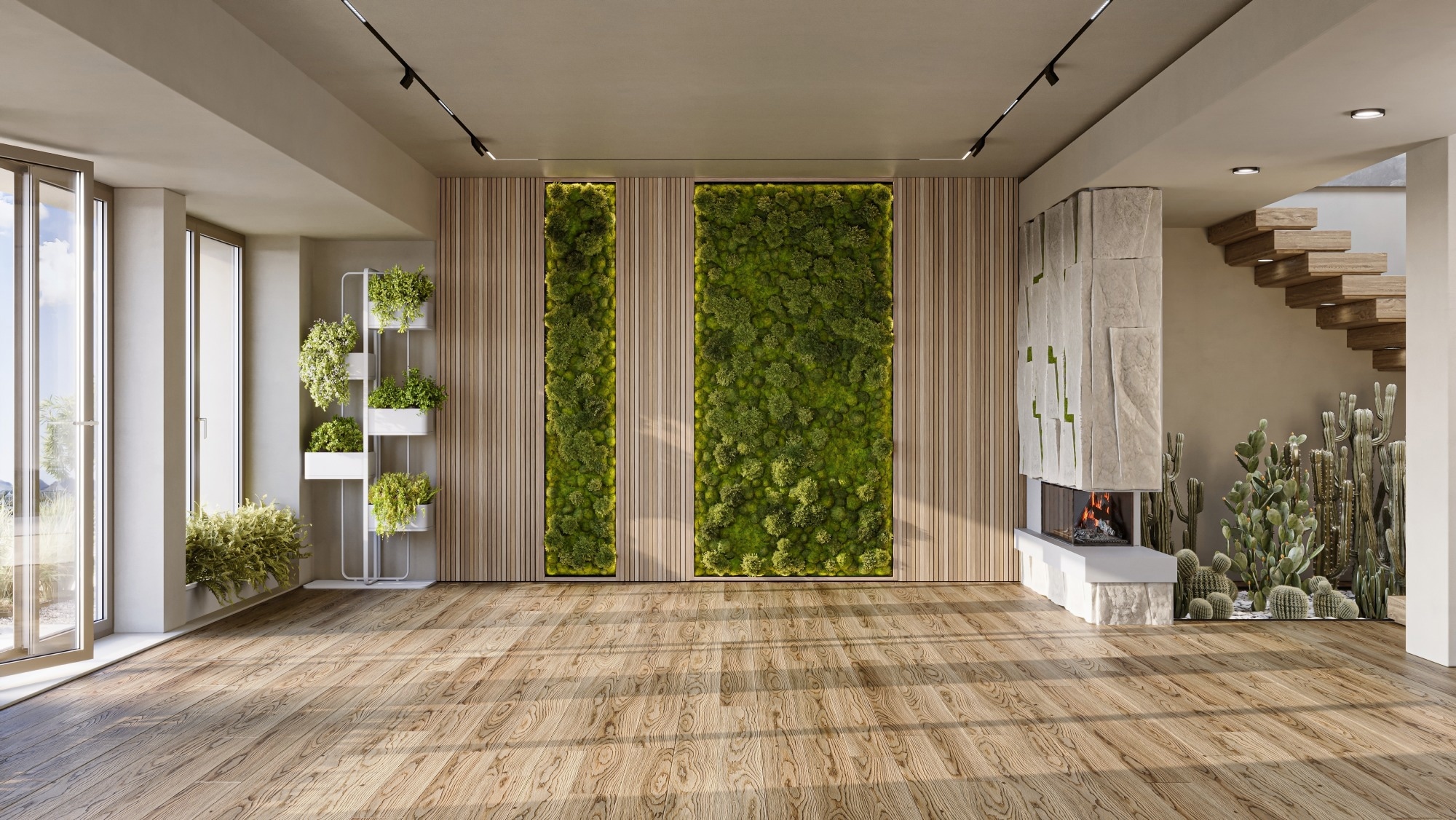
Study: Volatile organic compounds, SO2 and NO2 capture by means of an indoor active living wall. Image Credit: Laci_10/Shutterstock.com
In a recent article published in Atmospheric Environment, researchers investigated an indoor active green wall system designed to capture and reduce harmful gaseous pollutants, offering a promising route to improving indoor air quality.
Background
Indoor air pollution remains a significant global health concern, affecting comfort, productivity, and overall well-being.
Common indoor pollutants include nitrogen dioxide (NO2), sulfur dioxide (SO2), formaldehyde, and a range of volatile organic compounds (VOCs). These contaminants originate from both indoor sources, like building materials and everyday activities, and outdoor pollution that makes its way indoors. In many cases, conventional ventilation systems do not fully remove these pollutants.
Against this backdrop, green walls have emerged as a potential natural filtration strategy. These systems rely on plants’ physiological processes to absorb and process airborne contaminants. Gases can enter through leaf stomata or interact with the cuticle, after which they may be metabolized by the plant or broken down by microorganisms in the root zone.
However, not all plant species perform equally.
Their effectiveness depends on characteristics such as leaf surface area, structural traits, and associated microbial communities. While earlier studies have identified promising species, direct comparisons remain difficult due to differences in experimental methods, environmental conditions, and pollutant types.
The Current Study
To address these gaps, the researchers designed a controlled experiment using a sealed glass chamber that simulated indoor conditions, including stable temperature and humidity. Five plant species were tested individually: Spathiphyllum wallisii, Tradescantia zebrina, Philodendron scandens, Ficus pumila, and Chlorophytum comosum.
The team introduced known concentrations of pollutants (NO2, SO2, formaldehyde, acetone, n-hexane, and n-heptane) and tracked how their levels changed over a 24-hour period.
Measurements were taken using a portable air quality monitor equipped with electrochemical and photoionization sensors.
To isolate the effect of the plants, the researchers also conducted control experiments in an empty chamber under identical conditions. Between trials, the plant systems were placed in clean air for several days to prevent any carry-over effects.
Two key metrics guided the analysis: Pollutant Reduction (PR %), which reflects the percentage decrease over time, and Differential Reduction Efficiency (DRE %), which captures the additional reduction attributable specifically to the plants compared to the control.
Results and Discussion
Overall, the active green wall system reduced pollutant concentrations more quickly and more extensively than natural decay alone. After 24 hours, reductions in formaldehyde and sulfur dioxide reached 96–98 % across all species, demonstrating strong overall performance.
Some differences emerged when looking more closely at individual pollutants and plant species. Spathiphyllum wallisii, for instance, showed particularly strong performance in removing nitrogen dioxide, achieving about 60 % reduction within the first hour. Although the study did not directly examine the underlying mechanisms, this result likely reflects species-specific physiological traits.
For volatile organic compounds, removal patterns were more variable. Even so, the initial response was consistently rapid: within the first 15 minutes, total VOC levels dropped by roughly 24–40 % across most species. Chlorophytum comosum stood out for its strong early removal of both formaldehyde and total VOCs, a finding that contrasts with some earlier reports.
Plant structure also influenced performance, though not always in straightforward ways. For example, Ficus pumila, despite having smaller leaves, initially matched larger-leaf species in VOC removal before its effectiveness tapered off over time. This suggests that while morphology matters, it does not fully determine pollutant uptake.
Importantly, the system maintained consistent performance across repeated exposures, with no evidence of declining efficiency during the study period. This stability supports its potential for ongoing use in indoor environments.
Not all pollutants behaved the same way, however.
While sulfur dioxide ultimately reached high removal levels, its uptake was slower compared to compounds like formaldehyde, highlighting differences in how gases interact with plant-based systems.
The authors also emphasize that results from controlled chamber conditions may not directly translate to real-world settings, where airflow, environmental variability, and pollutant loads are less predictable.
Conclusion
This study demonstrates that active indoor green wall systems can significantly improve air quality by rapidly and consistently removing harmful gaseous pollutants. Their effectiveness depends on both plant selection and environmental conditions, with Spathiphyllum wallisii emerging as especially effective for nitrogen dioxide removal.
Rather than replacing conventional filtration, these systems offer a complementary, biologically driven approach to cleaner indoor air. Their ability to maintain performance over repeated exposures further supports their potential for practical use in buildings.
Journal Reference
Fernández-Espinosa A.J., Montiel-de La Cruz J.M., et al. (2026). Volatile organic compounds, SO2 and NO2 capture by means of an indoor active living wall. Atmospheric Environment, 371, 121856. DOI: 10.1016/j.atmosenv.2026.121856, https://www.sciencedirect.com/science/article/pii/S1352231026000853