As climate change intensifies water scarcity and environmental pressures across the Mediterranean, the European project RAINS (Resilient Irrigation Solutions) has unveiled pioneering results that point the way toward a more sustainable agricultural future.
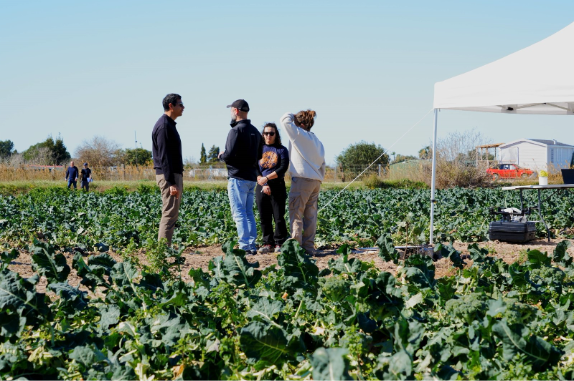 Image Credit: RAINS
A full-scale demonstration carried out in Guardamar del Segura during the 2025–2026 broccoli season shows that farmers can dramatically reduce water use, cut nutrient losses, and maintain high yields through a combination of precision irrigation and next-generation organo-mineral fertilizers. RAINS is working on the development of four organo-mineral biofertilizers, produced from compost, minerals, biochar, and insect frass. These pellets provide controlled nutrient release and improve soil structure. Their resistance to nutrient leaching proved especially valuable under furrow irrigation, where inorganic fertilizers were more easily washed away.
The GUA pellets are not just an ‘eco-friendly’ alternative; they are a high-performance agricultural tool.
Belén Miranda, Project Coordinator, RAINS
The research looks at two irrigation systems under real farming conditions: traditional furrow irrigation and modern drip irrigation. By combining efficient irrigation, circular biofertilizers, and digital monitoring, the project offers a replicable model for farmers across water-stressed regions.
A set of smart tools was used to understand what was happening in the soil and how the crops were reacting. Sensors in the ground measured moisture and how nutrients moved through the soil, while lysimeters placed 60 cm deep collected water that drained away so researchers could see how much nitrate and phosphate were being lost. WaterIQ sensors added real-time information on soil conditions, creating a kind of digital copy of the field that helped farmers make more accurate decisions.
Greenhouse gas measurements showed that better fertilization practices can cut emissions of nitrous oxide, a powerful climate-warming gas released from soils.
By using satellite images and drone photos to track leaf growth and plant color from above, it is possible to spot nutrient problems early and predict yields more accurately. Bringing together data from the soil and the sky is a major step toward farming that is both more efficient and more resilient to climate change.