The results of an eight-year study into the relationship between robust commercial farming and thriving pollinator populations have been published, coinciding with National Insect Week.
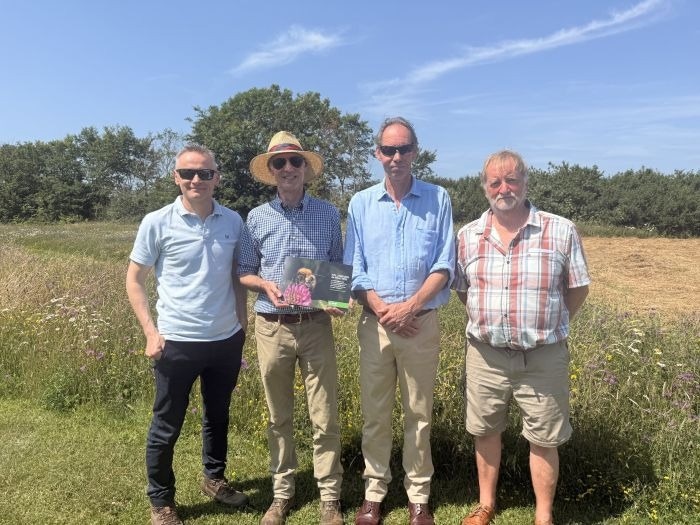 From left to right: Rob Gladwin (BASF Head of Technical Management), Andrew Pitts (host farmer), William Pitts (host farmer) and Marek Nowakowski (independent farmland ecologist). Image Credit: BASF Agriculture solutions
Pollinators in Practice: Connecting crops and pollinators with practical on-farm solutions, a collaboration with farmers and researcher to connect crops and pollinators for practical on-farm solutions, was commissioned by BASF, and demonstrates that robust commercial farming and thriving pollinator populations can co-exist.
Visiting every three to four weeks between 2018 and 2024, award-winning farmland ecologist Marek Nowakowski, who has been working with BASF for many years, recorded the presence of flowering plants and pollinators across an 850 ha Northamptonshire arable farm. Here he documented 89 species of unsown plants, and 83 sown species, as well as 22 butterfly species and 35 bee species.
“Pollinators in Practice distils our collective learning. Not only does it share the findings of the study, but it is a comprehensive, data-backed guide to enhancing pollinator populations on UK farms,” explains Rob Gladwin, BASF Head of Technical Management.
The study, conducted at The Grange, in Northamptonshire, bridges the gap between research and practice, demonstrating that hedgerow preservation, wildflower meadow rotation and other habitat enhancements are proven strategies that can be incorporated into commercial farming with tangible benefits.
“Pollinators are estimated to contribute £680 million annually to UK agriculture, fertilizing everything from oilseed rape to strawberries,” says host farmer, William Pitts, underscoring the financial necessity of conservation efforts.
Commenting on the project, Marek added: “This long-term study shows three key points. Firstly, the vital unbroken supply of pollen and nectar. The Spring delivery from unsown plants and summer supply from mainly sown flowers. Secondly pollinators can thrive on an intensive arable unit, if there are a range of quality habitats. And thirdly practical guidance for others to follow.”
Extending Reach
Like many of the previous projects, the pollinator study has attracted many individuals and organizations to The Grange from Defra to farming groups and conservationists.
“By opening the gates of The Grange to visitors, William has enabled policy makers to ground proof their work and decision-making. For the farmers that joined us, it was a benchmark, learning opportunity and access to much-needed support,” says Rob.
“I wish I could show everyone with a stake in British agriculture around The Grange. Being immersed in a landscape that pulses with life reminds you that agriculture can coexist with nature,” adds William.
The team’s deep commitment to the project has resulted in crucial data on pollinator abundance and habitat quality, showing the real-world impact of environmental and agronomic decision-making.
Practical Solutions for Enhancing Pollinator Populations
Beyond the trial results, Pollinators in Practice is packed with practical advice and actionable tips.
“Managing wildlife habitats requires different knowledge and skills to farming,” says William.
“Agriculture can make a measurable difference to the UK’s biodiversity. Pollinators in Practice offers practical signposts showing other farmers how to navigate the path toward profitable environmental stewardship. We hope it inspires more conversations, and importantly, action,” adds Rob.
For farmers looking to enhance natural capital without compromising productivity, it serves as an invaluable resource. It is a clear, evidence-based blueprint for a farming future that works with nature.
View Pollinators in Practice here.
7 Top Tips for Encouraging Pollinators on Your Farm
- Increase diversity – In plant species, in flower structures, in flowering windows. Diversity mitigates against shocks like poor weather
- Monitor and fill any hungry gaps – Pollinators need forage from spring through till autumn
- Adopt incremental hedge cutting – Hedges are a vital source of food in early spring but some woody species only flower on second year growth
- Allow the plants at the base of the hedge to regenerate – Species like brambles and nettles are another great source of nectar and pollen, as well as offering vital habitat for pollinators
- Choose native varieties when buying wildflower mixes – These tend to last longer than commercial cultivars
- Broadcast wildflower seed – Drilling can make some species enter dormancy
- Preserve what you have – Existing habitats often deliver the greatest long-term benefits