As global food demand continues to rise and environmental concerns intensify, precision agriculture has emerged as a solution for sustainable farming. Using advanced technologies such as Global Positioning System (GPS)-guided equipment, drones, sensors, and data analytics, precision agriculture allows farmers to optimize resource use, reduce waste, and minimize environmental impact while maintaining or even increasing crop yields. This article takes a closer look.
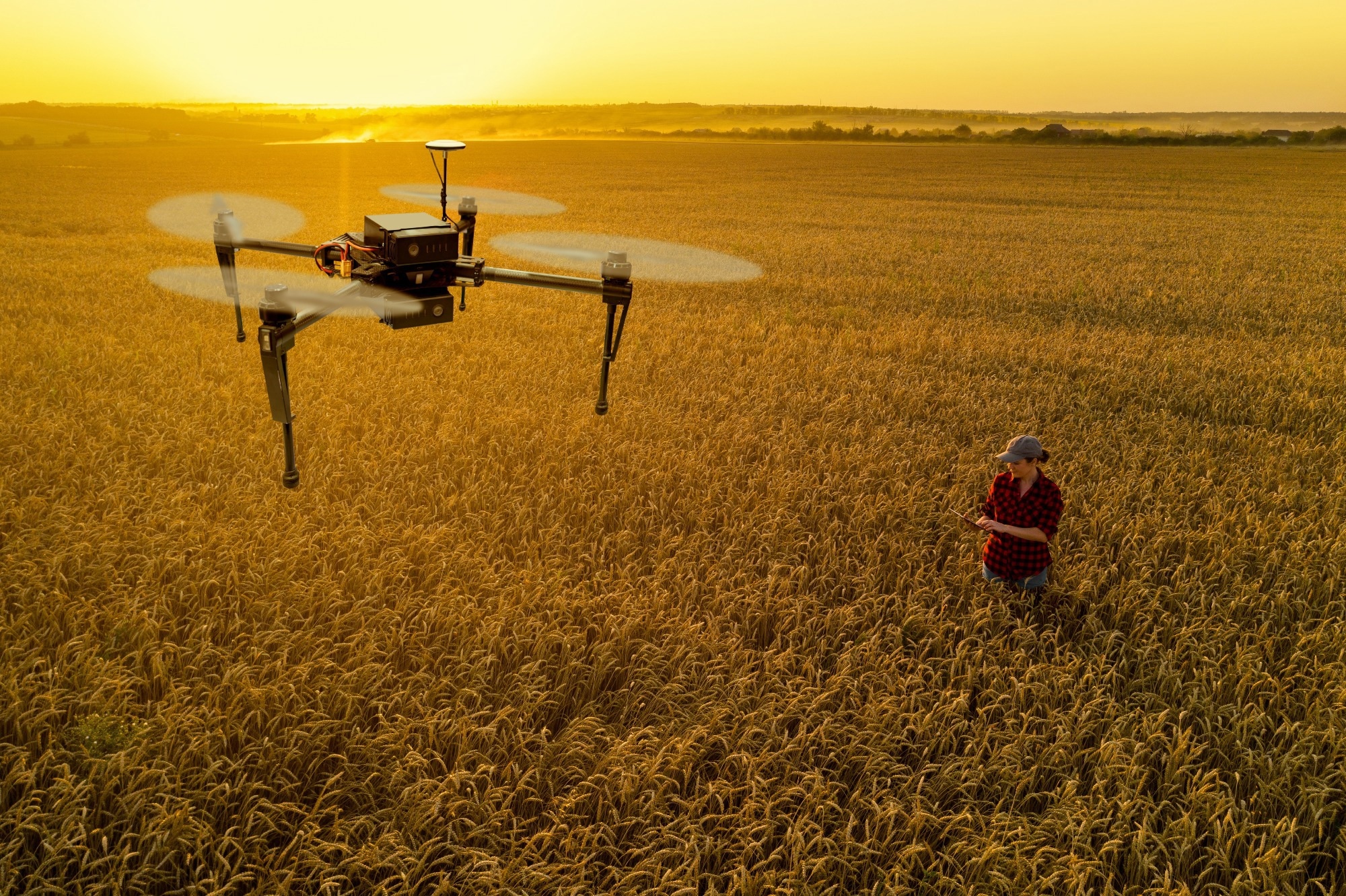
Image Credit: Scharfsinn/Shutterstock.com
What is Sustainable Precision Agriculture?
Precision agriculture uses smart mobile devices, satellite remote sensing, unmanned aerial vehicles (UAVs), the Internet of Things (IoT), artificial intelligence (AI), and cloud computing, to optimize agricultural productivity.1
Compared with conventional farming, by exploiting the real-time data from sensors and advanced technologies, farmers can deliver precise applications of water, fertilizer, and pesticides, maximizing resource efficiency while boosting crop yields.
Precision agriculture data management pulls together information from soil sensors, satellite imagery, weather forecasts, and crop health–monitoring systems into cloud-based platforms where farmers can access and analyze it in real time.²
Machine learning tools then help make sense of this data by spotting patterns - like how certain weather conditions affect crop yields - while predictive analytics offer a look ahead, estimating outcomes such as expected yields or the likelihood of pest outbreaks. With these insights, farmers can make more informed decisions, use resources more wisely, reduce risk, and keep their operations running smoothly.
At the same time, sustainable precision agriculture tackles some of today’s biggest farming challenges, including water shortages, declining soil health, and the overuse of chemical inputs.³ By applying inputs only where and when they’re needed, farmers can boost yields while reducing their environmental footprint. The result is a more balanced approach that supports productivity today and protects natural resources for the future.
Applications of Precision Agriculture for Sustainable Farming
Precision agriculture adoption is driven by the need to increase productivity, reduce environmental impact, and enhance sustainability.4
Developed nations have rapidly adopted precision agriculture practices with innovations such as AI, remote sensing, and automated machinery for real-time crop monitoring and resource optimization. In developing regions, precision agriculture adoption is growing steadily, despite challenges such as limited access to technology, high costs, and inadequate infrastructure.
Key areas where precision agriculture technologies have been applied for sustainable farming are discussed below:4
Water management
Precision agriculture optimizes water management using data from soil moisture sensors, weather forecasts, satellite imagery, and IoT devices to efficiently assess and meet crop hydration needs.5 Advanced irrigation systems, such as drip and variable-rate irrigation, minimize evaporation and runoff while adjusting water application by field zone. This approach conserves water, enhances yields, reduces disease risks, and promotes sustainable farming practices.
Soil management
Sensor-based technologies, Geographic Information Systems (GIS), Variable Rate Application (VRA) systems, GPS, remote sensing, and Internet of Things (IoT) devices enable site-specific soil assessment and management.6
By mapping soil properties like pH, nutrient levels, and moisture content, farmers optimize fertilizer and water inputs to increase yields while reducing environmental impacts.4 Continuous monitoring with sensors and drones enables early detection of soil degradation, pests, and deficiencies, while data analytics and machine learning support proactive management to promote long-term soil health and sustainable farming.
Crop monitoring
Satellite imagery and drones with multispectral cameras monitor crop health in real time, identifying pests, diseases, and nutrient deficiencies for variable-rate fertilizer and pesticide applications.4 Data analytics and machine learning algorithms analyze historical and real-time data to predict crop performance, optimize planting schedules, and improve yield predictions while reducing chemical overuse and promoting sustainable practices.
Planting and harvesting
Predictive models forecast weather patterns to optimize planting times and reduce crop failure risk. GPS-guided machinery and Variable Rate Technology (VRT) place seeds at optimal depths and spacing based on soil nutrient and moisture analysis, maximizing crop potential while reducing input costs.6 During harvesting, yield monitoring systems and remote sensing track crop health and maturity for optimal timing, while automated machinery enhances efficiency and minimizes weather-related losses.4
Click here to download a free PDF copy of this page
Pest and disease management
Precision agriculture integrates GPS, remote sensing, and GIS to monitor crop health and detect pest infestations through spatial and temporal data. VRT enables site-specific pesticide and fertilizer application, while predictive modelling forecasts disease pressures for proactive management. This supports Integrated Pest Management (IPM) strategies emphasizing ecological balance and natural pest control. For large-scale disease monitoring, integrating the lightweight MobileNetV3 architecture with MapReduce's distributed computing enables real-time, scalable precision farming applications.7
Climate adaptation
Precision agriculture technologies enable real-time monitoring of weather patterns, precipitation, temperature, and extreme events. Sensors track soil moisture levels, allowing farmers to adjust irrigation schedules, conserve water, and mitigate drought risks.8 Accurate field mapping supports climate-smart practices, including conservation tillage, cover cropping, and crop rotation tailored to specific areas. These practices sequester carbon, improve soil health and water retention, and reduce vulnerability to extreme weather.
Challenges and Future Prospects
Precision agriculture adoption faces several global challenges despite its promise for advancing agricultural productivity and sustainability.4
The initial investment required for implementing precision agriculture technologies can be prohibitive for many farmers, particularly smallholders.
Equipment costs for GPS-guided machinery, sensors, and drones, as well as costs associated with data collection and analysis, pose significant barriers to adoption. The lack of reliable internet connectivity and electricity in rural areas also hampers the effective deployment and operation of precision agriculture systems.
In developing regions, limited infrastructure and resources, including inadequate road networks and storage facilities, intensify challenges of transporting equipment and storing perishable produce. Climate and soil condition variability across the continent complicates the development of universally applicable precision agriculture solutions.
The future of precision agriculture holds transformative potential through technological advancement, including AI, machine learning, advanced robotics, and autonomous machinery for crop modelling, yield prediction, and automated farming operations.9
Next-generation sensors, hyperspectral imaging, IoT networks, and nanotechnology will enable comprehensive monitoring and molecular-level precision, while cloud platforms and mobile applications will democratize access to advanced analytics. Reducing technology costs, government subsidies, and institutional support will accelerate the global adoption of precision agricultural practices.
References and Further Reading
- Padhiary M, et al. Emerging technologies for smart and sustainable precision agriculture. Discov Robot. 2025;1, 6. https://doi.org/10.1007/s44430-025-00006-0
- Soussi A, et al. Smart Sensors and Smart Data for Precision Agriculture: A Review. Sensors. 2024; 24(8):2647. https://doi.org/10.3390/s24082647
- Gamage A, et ak. Advancing sustainability: The impact of emerging technologies in agriculture. Curr Plant Biol. 2024; 40, 100420. https://doi.org/10.1016/j.cpb.2024.100420
- Getahun S, et al. Application of Precision Agriculture Technologies for Sustainable Crop Production and Environmental Sustainability: A Systematic Review. Scientific World Journal. 2024;2024:2126734. doi: 10.1155/2024/2126734.
- Loconsole D, et al. Soil Moisture Sensing Technologies: Principles, Applications, and Challenges in Agriculture. Agronomy. 2025; 15(12):2788. https://doi.org/10.3390/agronomy15122788
- Karunathilake EMBM, et al. The Path to Smart Farming: Innovations and Opportunities in Precision Agriculture. Agriculture. 2023; 13(8):1593. https://doi.org/10.3390/agriculture13081593
- Asif M, et al. MapReduce-based deep learning framework for potato leaf disease detection in sustainable precision agriculture. Sci Rep. 2025; 16(1), 1607. https://doi.org/10.1038/s41598-025-30940-3
- Mba P C, et al. Enhancing resilience in specialty crop production in a changing climate through smart systems adoption. Smart Agricultural Technology. 2025; 11, 100897. https://doi.org/10.1016/j.atech.2025.100897
- Taha MF, et al. Emerging Technologies for Precision Crop Management Towards Agriculture 5.0: A Comprehensive Overview. Agriculture. 2025; 15(6):582. https://doi.org/10.3390/agriculture15060582
Disclaimer: The views expressed here are those of the author expressed in their private capacity and do not necessarily represent the views of AZoM.com Limited T/A AZoNetwork the owner and operator of this website. This disclaimer forms part of the Terms and conditions of use of this website.