Project engineers and developers exploring their energy generation and storage requirements have started to leverage water electrolysis as a recognized solution with a rapidly expanding technology base.
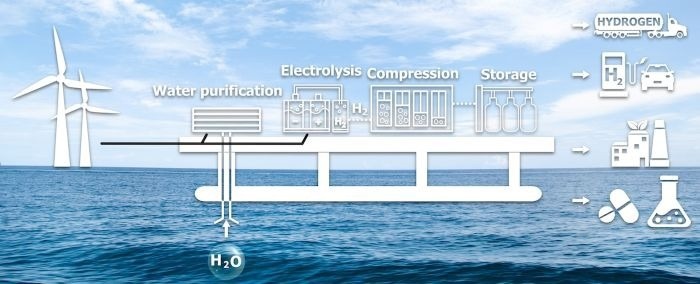
Image Credit: Power to Hydrogen
Electrolyzers replace fossil-intensive hydrogen sources such as steam methane reforming (SMR), eliminating these devices’ footprint by using renewable electricity.
Water electrolysis also enables localized hydrogen production, reducing pipeline requirements and transport emissions. Energy efficiency and supply chain reliability can be further optimized through the strategic placement of electrolysis grids.
Understanding Water Electrolysis
Water electrolysis works by separating water molecules (H2O) into hydrogen (H2) and oxygen (O2). Electrolyzers are used to facilitate this process: for example, Power to Hydrogen's industry-leading hybrid AEM electrolyzers.
When electricity flows through water in an electrolyzer, hydrogen forms at the cathode and oxygen forms at the anode. The electricity used in this process is generally sourced from renewable sources, making it a sustainable option with no carbon emissions.
Advantages of Using Water Electrolysis for Hydrogen Production
Hydrogen generation via electrolysis offers a range of advantages, including:
- Zero emissions: Water electrolysis produces hydrogen with no greenhouse gas emissions when it is powered by solar, wind, or hydropower.
- Renewable energy integration: The system can easily combine with wind and solar power.
- Energy storage capabilities: Hydrogen functions as a long-duration storage method, allowing surplus renewable power to be converted into a storable fuel.
- High-purity hydrogen: Electrolyzers produce hydrogen with very high purity and only minimal contamination, making it well-suited for fuel cells.
- Flexibility and scalability: Appropriately sized electrolyzers are suitable for projects from small-scale hydrogen production to utility-scale setups.
Types of Electrolyzers for Water Electrolysis
PEM (Proton Exchange Membrane) Electrolyzers
PEM electrolyzers employ a solid polymer membrane as the electrolyte, producing high-purity hydrogen and rapidly responding to changes in power input. They are ideally suited for use with renewable energy sources.
These electrolyzers depend on expensive metal catalysts, however, considerably increasing their cost compared to other technologies.
Alkaline Electrolyzers
Alkaline electrolyzers are one of the oldest and most widely used electrolysis technologies. They use a liquid electrolyte, generally potassium hydroxide (KOH), and their low cost and relative simplicity have led to a long history in industrial settings.
They are typically larger and often respond more slowly to power fluctuations, making them less efficient when used with variable energy sources.
AEM (Anion Exchange Membrane) Electrolyzers
AEM electrolyzers combine the advantages of alkaline and PEM systems. They enable more affordable hydrogen production with operational flexibility and high efficiency by leveraging solid anion exchange membranes and inexpensive, non-precious-metal catalysts.
Power to Hydrogen is working to further develop this technology, which is already showing promising returns in terms of its use in distributed and renewable-based hydrogen systems.
SOECs (Solid Oxide Electrolyzers)
SOECs function at extremely high temperatures, with ceramic materials used as the electrolyte. This high-temperature operation means that waste heat can also be employed in industrial processes.
These systems are impressively efficient and are best suited for stationary, large-scale applications with the potential for heat recovery.
The History of Electrolysis
The fundamentals of water electrolysis date back to the 18th century, with scientists like Michael Faraday and Alessandro Volta exploring how electricity affects chemical bonds and laying the groundwork for this technology.
Faraday’s laws of electrolysis were established in the 1830s, and these laws continue to act as the theoretical basis for today’s systems.
- Faraday’s First Law of Electrolysis: During electrolysis, the amount of chemical reaction taking place at any electrode under the influence of electrical energy will be proportional to the quantity of electricity passed through the electrolyte.
- Faraday’s Second Law of Electrolysis: If the same amount of electricity is passed through different electrolytes, the masses of ions deposited at the electrodes will be directly proportional to their chemical equivalents.
Industrial-scale electrolysis first emerged in the early 1900s and saw significant use in the chemical refining industry. The rise of renewable energy later led to water electrolysis beginning to make headlines as a sustainable alternative to traditional fossil-fuel-based hydrogen production.
Future Outlook for Water Electrolysis
Increasing Policy Support
Governments worldwide are introducing grants, tax credits, and hydrogen hub projects to expedite the deployment of hydrogen infrastructure.
Lowering Technology Costs
Costs remain an issue, with electrolysis systems still more expensive than Steam Methane Reforming with carbon capture. As electrolyzer manufacturing scales up and renewable energy becomes cheaper, hydrogen from water electrolysis is anticipated to reach cost parity by the 2030s.
Emerging New Markets
Hydrogen is no longer considered solely for industry or transportation. Meeting regulatory emissions targets will necessitate a more substantial transition to low-carbon hydrogen, with demand already increasing due to new use cases in data centers, agriculture, and long-haul shipping.
The Importance of Electrolyzer Efficiency
Electrolysis requires significant energy input, so efficiency in the context of electrolyzers refers to the amount of hydrogen produced per unit of electricity input.
Efficiency is improving, but some energy is lost during conversion and storage. Operating temperatures, the quality of materials used, and the design of the electrolyzer all impact efficiency, and it is expected that electrolyzer efficiency will continue to improve as technology advances.
Power to Hydrogen’s Approach to Water Electrolysis
Power to Hydrogen focuses on the development of Anion Exchange Membrane (AEM) electrolyzers. This next-generation technology delivers hydrogen production at reduced cost and with improved operational flexibility.
The company’s electrolyzers offer a range of advantages, including:
- Their durability is assured by engineering long-lasting electrolyzers for real-world conditions.
- High efficiency facilitates improved power-to-hydrogen conversion with minimal losses.
- Non-precious-metal catalysts reduce supply chain risks and material costs.
- The modular design makes it easy to scale from kilowatts to megawatts.

This information has been sourced, reviewed, and adapted from materials provided by Power to Hydrogen.
For more information on this source, please visit Power to Hydrogen.