Fangqun Yu, a senior research faculty member at the University at Albany’s Atmospheric Sciences Research Center, has developed an advanced model for simulating contrail formation and has published extensively on the formation and properties of contrail ice particles in the journal ACS ES&T Air.
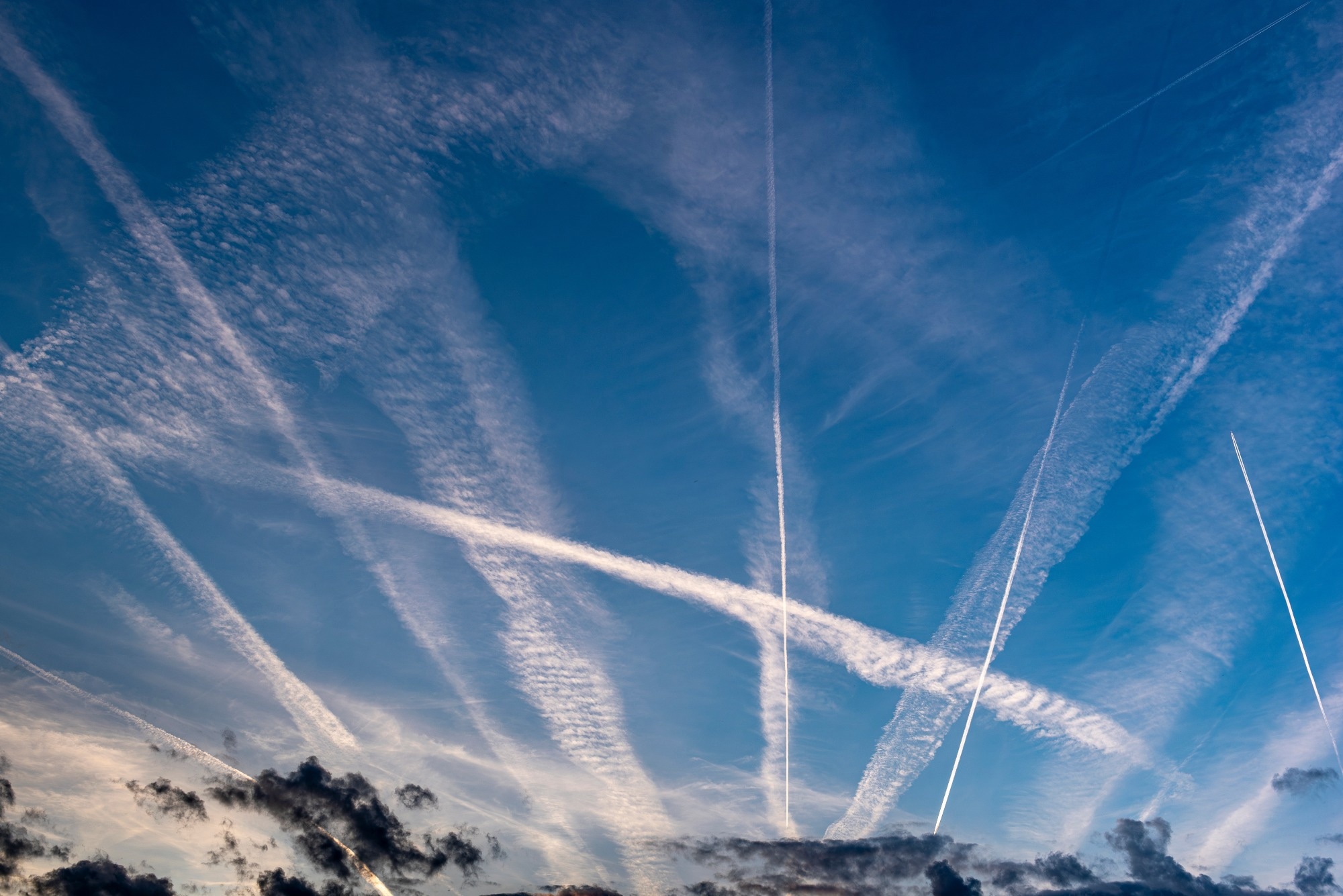
Image Credit: Frank Wagner/Shutterstock.com
Contrails, the thin, white cloud formations observed trailing aircraft, are a common atmospheric phenomenon.
The formation of these wispy ice clouds is a complex process, resulting from the mixing of hot exhaust gases with cold ambient air. Contrail ice particles can persist for varying durations, from short periods to several hours, contingent on atmospheric conditions. Before dissipating, these formations trap outgoing thermal radiation, contributing to climate change.
A study analyzing aviation’s climate impact from 2000 to 2018 concluded that contrails are responsible for 57 % of the industry’s warming effect, a contribution significantly greater than that of CO2 emissions from fuel combustion.
Yu proposes that introducing a minute quantity of ice-nucleating particles into aircraft engine exhaust could substantially reduce contrail harm by shortening their atmospheric lifespan.
This innovative method aims to create fewer, yet larger, ice crystals within the contrail, leading to faster dissipation and a reduction in trapped heat.
Ice-nucleating particles are tiny specks that act as seeds for ice crystals to form. Because they can trigger ice formation at warmer temperatures, they take up water vapor in the plane exhaust earlier and grow crystals large enough for gravity to draw them out of the atmosphere. That means shorter-lived contrails, ultimately reducing their warming effect to a very small level.
Fangqun Yu, Senior Research Faculty Member, University at Albany
Curbing Contrails in the Sky
Yu's technique involves introducing ice-nucleating materials, such as silver iodide, bismuth triiodide, or other environmentally benign and efficient freezing agents, into aircraft exhaust during flight.
This method was evaluated under simulated real-world conditions by Yu's research team using the Aerosol and Contrail Microphysics model, a simulation tool designed to track the immediate evolution of an aircraft exhaust plume.
The application of this method yielded a reduction of up to 50 times in the formation of contrail ice crystals.
The amount of ice-nucleating material needed is very small, comparable to, or even less than, the lubrication oil planes typically consume. Also, because the application would happen high in the atmosphere during flights, and in tiny amounts, our early modeling shows that the material reaching the ground would be negligible. Still, we need to further examine how these added particles might influence natural ice-nucleating particles, cloud formation, and precipitation.
Fangqun Yu, Senior Research Faculty Member, University at Albany
More Sustainable Aviation
Yu has focused on the microphysics of atmospheric particles, encompassing contrail formation and their environmental impact for two decades.
The Simons Foundation, a private organization supporting science and mathematics research, recently awarded him $1.5 million. This grant is partly allocated to advancing his contrail reduction technique.
Click here to download a free PDF copy of this page
While the technique requires additional research and testing before aircraft implementation, Yu views the preliminary results as encouraging.
“In the future, we hope to test and refine our proposed method through controlled laboratory experiments and field measurements. We will also carry out more simulations to further assess its efficacy and potential environmental impacts,” said Yu.
Concurrent with existing projects, Yu is engaged in a partnership with a GE Research team to advance comprehension of how clean aviation fuels and new engine technologies affect contrail formation.
Journal Reference:
Yu, F., (2025) Toward Sustainable Aviation: Minimizing Aircraft Contrail Ice Particle Formation and Climate Effects by Controlled Seeding of Ice Nuclei Particles. ACS ES&T Air. DOI:10.1021/acsestair.5c00241. https://pubs.acs.org/doi/10.1021/acsestair.5c00241.