Researchers at the University of Bonn have developed a new filter designed to remove microplastics from washing machine wastewater. The filter, which is patent-pending, was inspired by the gill arch system found in fish. Initial tests indicate that the filter can remove over 99 % of plastic fibers from wastewater. The study was published in the journal npj Emerging Contaminants.
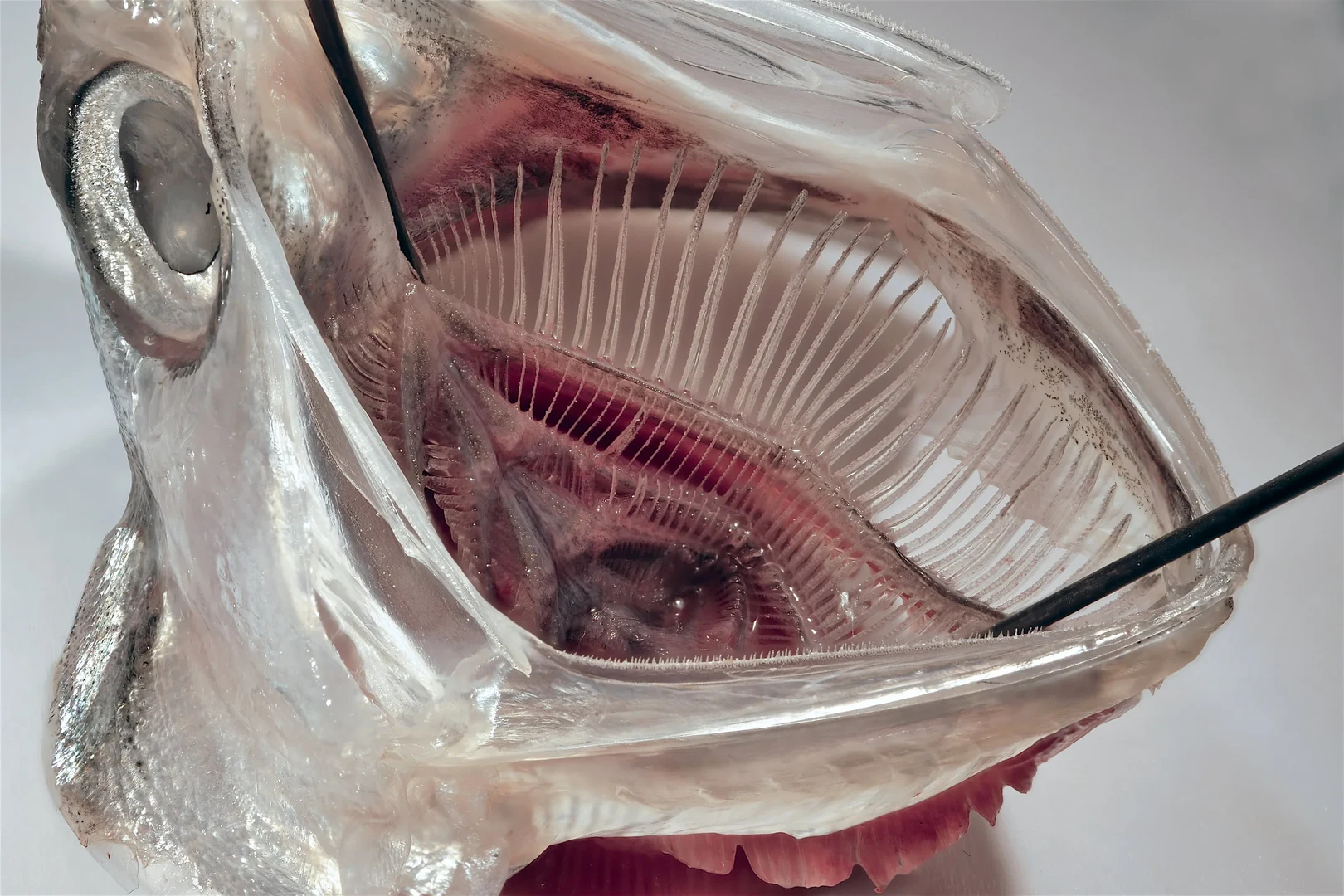 Inside the mouth of this anchovy, plankton particles are captured by the gill arch system. Image Credit: Jens Hamann
A four-person household's washing machine can release up to 500 grams of microplastics annually, primarily from textile abrasion, making household appliances a significant source of these particles. Currently, these microplastics enter wastewater treatment plants and can end up on agricultural fields when sewage sludge is used as fertilizer.
Many manufacturers are seeking methods to remove microplastics from wastewater to prevent environmental contamination.
The filter systems available so far, however, have various disadvantages. Some of them quickly become clogged, others do not offer adequate filtration.
Dr. Leandra Hamann, Institute for Organismic Biology, University of Bonn
Looking Inside the Mouths of Fish
The scientist, along with her doctoral supervisor, Dr. Alexander Blanke, and collaborators, has therefore investigated the animal kingdom for potential solutions. The team focused on fish that are adept at filtration, having evolved this capability over millions of years.
Certain fish, such as mackerel, sardines, and anchovies, feed by filtering water. The fish open their mouths to swim through water, using their gill arch system to sift out plankton.
We took a closer look at the construction of this system and used it as the model for developing a filter that can be used in washing machines.
Dr. Alexander Blanke, University of Bonn
Blanke is a member of the transdisciplinary research areas “Life & Health” and “Sustainable Futures.”
Through evolution, these fish developed a filtration technique similar to cross-flow filtration. Their gill arch system forms a funnel shape, wider at the mouth and narrowing toward the gullet. This funnel is structured by branchial arches, which have comb-like projections covered in small teeth, creating a mesh.
Self-Cleaning: Plankton Rolls Toward the Gullet
“During food intake, the water flows through the permeable funnel wall, is filtered, and the particle-free water is then released back into the environment via the gills. However, the plankton is too big for this; it is held back by the natural sieve structure. Thanks to the funnel shape, it then rolls towards the gullet, where it is collected until the fish swallows, which empties and cleans the system,” said Dr. Alexander Blanke.
This natural mechanism prevents the filter from becoming blocked, as fibers roll along the structure rather than hitting it directly. The system is also highly effective at removing plankton. The researchers replicated this gill arch system, experimenting with different mesh sizes and funnel opening angles.
Filter Achieves High Efficiency
We have thus found a combination of parameters that enable our filter to separate more than 99 % of the microplastics out of the water, but not become blocked.
Dr. Leandra Hamann, Institute for Organismic Biology, University of Bonn
The team utilized both experiments and computer simulations to achieve this. The nature-inspired filter is designed without complex mechanics, suggesting it could be inexpensive to manufacture.
The filtered microplastics accumulate at the filter's outlet and are suctioned away multiple times per minute. According to Dr. Hamann, who has since moved to the University of Alberta in Edmonton, Canada, the collected material could then be pressed to remove residual water, forming a plastic pellet. This pellet could be removed every few dozen washes and disposed of with general waste.
The University of Bonn and the Fraunhofer Institute for Environmental, Safety, and Energy Technology UMSICHT have applied for a patent for this development in Germany, with EU-wide patenting in progress. The researchers hope that manufacturers will further develop and integrate this filter into future washing machines, which could help reduce the spread of microplastics from textiles. This is considered necessary, as analyses suggest these particles may pose serious health risks, having been found in breast milk, the placenta, and even the brain.
The study received support from the Federal Ministry of Research, Technology and Space (BMFTR) and the European Research Council (ERC). The Transfer Center enaCom at the University of Bonn, in collaboration with PROvendis GmbH, is supporting the protection and marketing of the invention.
Journal Reference:
Hamann, L., et al. (2025) A self-cleaning, bio-inspired high retention filter for a major entry path of microplastics. npj Emerging Contaminants. DOI: 10.1038/s44454-025-00020-2. https://www.nature.com/articles/s44454-025-00020-2.