Marine fouling triggers ongoing economic losses for the global shipping industry through detrimental effects on structures and vessels – but tests by Flinders University researchers on a new type of anti-foul coating reveal a solution that is not detrimental to the environment.
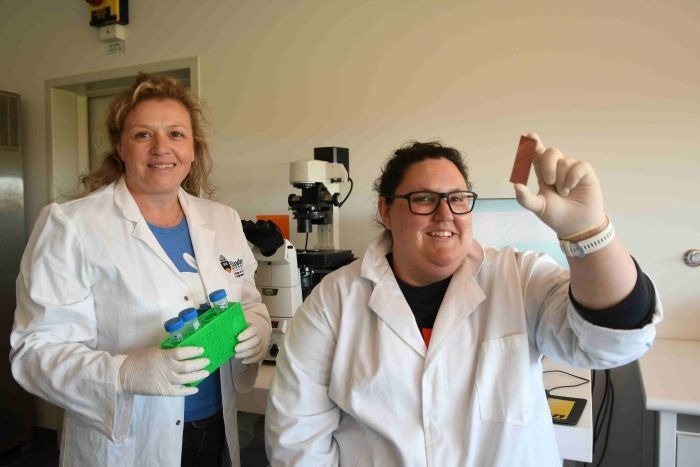 Sophie Leterme and Tamar Jamieson. Image Credit: Flinders University
Controlling marine fouling is complex, as many factors influence organism settlement on surfaces under water – and a majority of antifouling coatings that are currently in use are hazardous to the environment.
However, Flinders has successfully developed and tested a novel electrochemically active coating to remove macrofouling organisms and reduce microfouling attachment on marine surfaces.
“The development of an environmentally friendly antifouling treatment could revolutionize the shipping industry and eliminate any biosecurity risks,” says lead researcher Dr Tamar Jamieson, from the ARC Training Centre for Biofilm Research and Innovation at the College of Science and Engineering.
Items painted with the antifouling treatment were submerged in the Port Adelaide River harbor basin (at Osborne, South Australia) for 55 days. Scanning electron microscopy, flow cytometry, and 16S amplicon sequencing were undertaken to assess the antifouling efficacy of the coatings.
The results showed that no macro-fouling was present on any items coated with the electrochemical parameters – and a reduction in the number of attached micro-organisms was evident on the electrochemical coatings.
“An existing generation of antifouling coatings based on a slow release of biocides are generally not environmentally friendly and cause concerns of heavy metal pollution in harbors, marinas, and coastal water. The new environmentally friendly antifouling treatment eliminates those concerns,” explains Professor Mats Andersson, senior author of the new article published in the American Chemical Society journal ES&T Water.
“While micro-fouling could not be prevented from developing on the marine surfaces, the electrochemical activity significantly reduced the number of cells that attached to the surface,” says Professor Andersson, from the Flinders Institute for Nanoscale Science & Technology.
“Therefore, this novel electrochemically-active coating could effectively reduce macrofouling – and, with further development, also microfouling. It marks a significant positive development in the efficiency of controlling micro-fouling and macro-fouling.”
Coauthor Professor Sophie Leterme, director of the ARC Biofilm Research and Innovation training centre at Flinders University, says biofouling research aims to significantly reduce maritime emissions and the cost of large-scale environmental programs to eradicate exotic marine species.
Understanding and improving the design of corrosion and biofouling control systems will have a major economic impact on maritime industries, with biofilm build-up on naval and other large carrier and cargo ships linked to 40 % higher fuel consumption and the spread of exotic pests on marine vessels travelling between international ports.