Reviewed by Frances BriggsDec 30 2025Reviewed
Researchers have developed a new plastic derived from plant cellulose, which is not only sustainably sourced but also breaks down readily in natural environments.
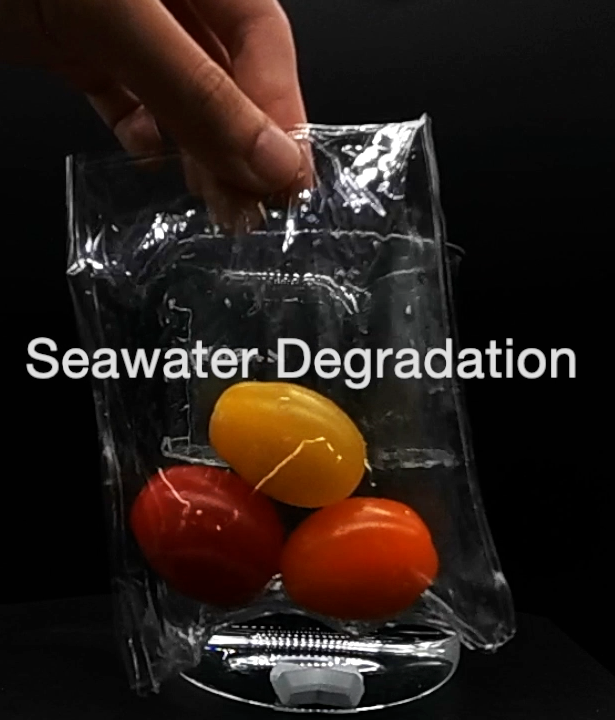 This plastic bag containing tomatoes is made from the new plant-based biodegradable plastic. Its ingredients are common, affordable, and FDA-approved. It is made simply by mixing them in water. Within two hours it can decompose completely in artificial seawater, without leaving any microplastics behind. Image Credit: RIKEN.
The team of researchers headed by Takuzo Aida at the RIKEN Center for Emergent Matter Science (CEMS) in Japan has made a significant advancement in addressing the microplastic issue with this finding. The study was published in the Journal of the American Chemical Society.
This new plastic is strong, flexible, and can quickly break down in natural settings, distinguishing it from other plastics labeled as biodegradable.
Microplastics are a global pollutant present in almost every ecosystem, from soil and oceans to the animals and plants inhabiting them. They have also been detected in human tissues and the bloodstream.
Although biodegradable plastics and cellulose-based plastics (cellulose nitrate or cellulose acetate) are not new, most plastics marketed as "biodegradable" struggle to break down in natural marine environments, or where they do, degrade very slowly and generate microplastics.
Last year, the Aida group created a plastic that could rapidly degrade in saltwater within hours, without producing any microplastics. This plastic was a supramolecular plastic composed of two polymers linked by reversible interactions known as "salt bridges." When exposed to saltwater, the bonds connecting the two polymers broke, causing the plastic to decompose.
However, this plastic was not suitable for practical production.
The new plant-based plastic is similar, except it began with a commercially available, FDA-approved, biodegradable wood-pulp derivative called carboxymethyl cellulose. Finding a compatible second polymer required some experimentation, but the team eventually found a safe crosslinking agent made from positively charged polyethylene-imine guanidinium ions.
When cellulose and guanidinium ions are mixed in room-temperature water, the negatively and positively charged molecules attract each other and form a critical cross-linked network that gives this plastic its strength.
Simultaneously, the salt bridges holding the network together broke as expected in the presence of salt water. To prevent unintended decomposition, the plastic can be protected with a thin surface coating.
Despite successfully producing a material that broke down rapidly, the new plastic was initially too brittle due to the cellulose. The resulting plastic was colorless, transparent, and very hard, but possessed a delicate, glass-like characteristic.
The team required a suitable plasticizer, a small molecule that could be incorporated into the mixture to enhance the plastic's flexibility while maintaining its hardness. After extensive experimentation, they found that the organic salt choline chloride was highly effective. By adding different amounts of this FDA-approved food additive to the plastic, the researchers could precisely control the plastic's flexibility.
Depending on the quantity of choline chloride, the plastic's properties varied between hard and glass-like to so elastic that it can stretch up to 130 % of its original length. The team was also able to form a strong, thin film with a thickness of just 0.07 mm from the cellulose-based material.
While our initial study focused mostly on the conceptual, this study shows that our work is now at a more practical stage.
Takuzo Aida, Center for Emergent Matter Science, RIKEN
The carboxymethyl cellulose supramolecular plastic, known as CMCSP, matches the strength of traditional petroleum-based plastics, and its mechanical characteristics can be modified as required, without compromising its inherent transparency, processability, seawater resistance, or closed-loop recyclability.
By using standard and affordable FDA-approved biodegradable components, Aida and his group have ensured that their plastic can be rapidly implemented in practical, real-world uses.
Nature produces about one trillion tons of cellulose every year. From this abundant natural substance, we have created a flexible yet tough plastic material that safely decomposes in the ocean. This technology will help protect the Earth from plastic pollution.
Takuzo Aida, Center for Emergent Matter Science, RIKEN
Plant-based and fully degradable plastic bag -- zero microplastics
This bag of tomatoes is made from the new plant-based plastic that uses FDA-approved ingredients. Watch as the bag completely dissolves in artificial seawater after just a few hours, without leaving any microplastics. Video Credit: RIKEN.
Journal Reference:
Hong, Y., & Aida, T. (2025). Supramolecular Ionic Polymerization: Cellulose-Based Supramolecular Plastics with Broadly Tunable Mechanical Properties. Journal of the American Chemical Society. DOI:10.1021/jacs.5c16680. https://pubs.acs.org/doi/10.1021/jacs.5c16680.