A recent study published in the Journal of Hazardous Materials: Plastics indicates that microplastics are hindering the oceans' capacity to absorb carbon dioxide, a process that scientists deem essential for maintaining Earth's temperature.
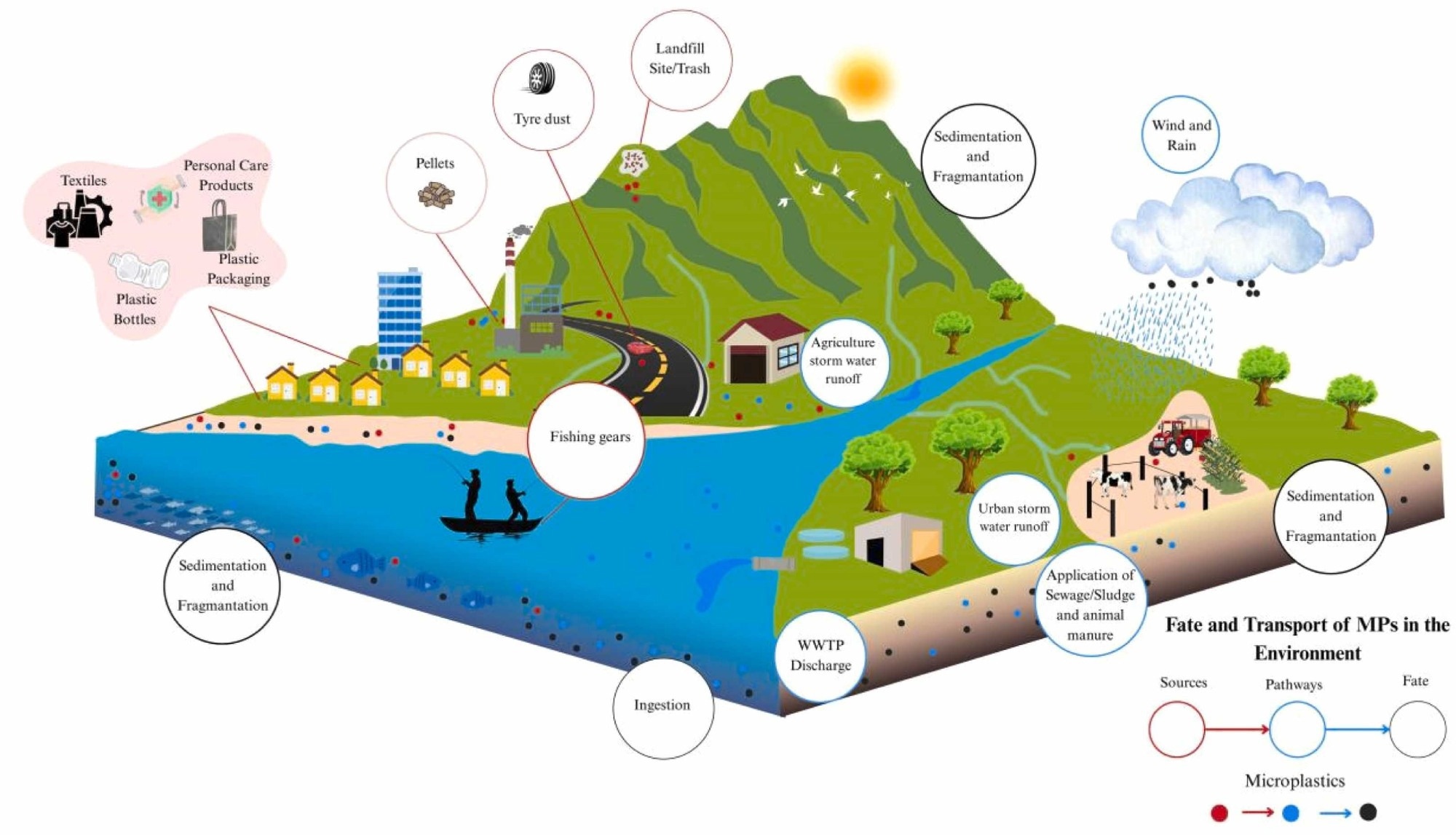 Sources, pathways and their interconnectedness for MPs transport. Concept adapted from Environmental Health Program, 2023. Microplastics Sources, Pathways and Fate Conceptual Diagram. Redrawn by the authors with minor modifications. Image Credit: Asim Nawab et al.
Characterized as tiny plastic particles measuring less than 5 mm, microplastics have become widespread. The plastic particles can be found in nearly every environment, including deep ocean waters, freshwater sources, the atmosphere, soil, Arctic ice, and even within human bodies. Their widespread presence presents significant threats to the environment. They transport toxins that are ingested by living organisms, including humans, leading to various diseases, disrupting ecosystems, endangering aquatic life, and diminishing soil fertility.
The researchers have discovered that, despite the pressing global issue of climate change, the impact of microplastics in this crisis, especially their prevalence in marine ecosystems, has not been adequately addressed.
“Climate disruption and plastic pollution are two major environmental challenges that intersect in complex ways. MPs (microplastics) influence biogeochemical processes, disrupt oceanic carbon pumps, and contribute directly to greenhouse gas (GHG) emissions,” explained the researchers.
They added, “In marine ecosystems, MPs alter the natural carbon sequestration by affecting phytoplankton and zooplankton, which are key agents of carbon cycling. Additionally, the plastisphere, a microbial community colonizing MPs, plays a significant role in GHG (greenhouse gas production) due to its diverse microbial networks.”
Our study shows they also interfere with the ocean’s ability to absorb carbon dioxide, a process critical for regulating Earth’s temperature.
Dr. Ihsanullah Obaidullah, Study Corresponding Author and Associate Professor, Integrated Water Processing Technologies, University of Sharjah
Dr. Obaidullah added, “Microplastics disrupt marine life, weaken the 'biological carbon pump, and even release greenhouse gases as they degrade. Over time, these changes could lead to ocean warming, acidification, and biodiversity loss, threatening food security and coastal communities worldwide.”
A Hidden Climate Threat
Dr. Obaidullah describes the study as a “collaborative perspective” involving scientists from China, Hong Kong, Pakistan, and the United Arab Emirates.
“We have highlighted an overlooked link between microplastics and climate change. We call for urgent global action to address this emerging threat,” said Dr. Obaidullah.
The study provides a scoping review that outlines the characteristics, scope, and breadth of current research on this subject. The scientists reveal a concealed greenhouse effect that has seldom been emphasized previously by pinpointing deficiencies in the existing literature.
“Oceans are Earth’s largest carbon sink. Microplastics are undermining this natural shield against climate change. Tackling plastic pollution is now part of the fight against global warming,” explained Dr. Ihsanullah
The research highlights that "biological carbon pumping" – the ocean's inherent process that transfers carbon from the atmosphere to the deeper layers of the sea – is the primary mechanism linking microplastics to global warming and climate change.
“MPs interfere with this process by reducing phytoplankton photosynthesis and impairing zooplankton metabolism,” noted the authors.
The authors suggest another connection that pertains to the plastisphere, a collection of microbes found in aquatic environments that form biofilms on various surfaces.
“The plastisphere is home to a variety of microorganisms, the majority of which are involved in biological processes like the nitrogen and carbon cycles,” said the authors.
Alarmingly, they assert that microplastics release greenhouse gases as they degrade, thereby worsening their effect on climate systems.
Unseen Connections
The researchers employed an integrative narrative methodology to examine prior studies, as opposed to utilizing a systematic or scoping review. Their analysis is based on desktop research, utilizing peer-reviewed articles, reports from international organizations, and other credible sources to critically synthesize information regarding microplastics, ocean health, climate change, and associated socio-environmental challenges.
In contrast to protocols like PRISMA, no strict inclusion or exclusion criteria were enforced. Instead, the focus was on conceptual integration and thematic connections across various disciplines, as stated by Dr. Ihsanullah. A total of 89 studies, primarily published after 2015, were reviewed, encompassing literature from 2010 to 2025. This methodology facilitates a comprehensive discussion of emerging evidence, knowledge deficiencies, and policy ramifications within the framework of climate change, the Sustainable Development Goals (SDGs), and human rights.
The study aims to fill knowledge gaps identified in the literature, which, according to the authors, have predominantly focused on the identification of microplastics and the formulation of cleanup strategies.
The scientists wrote, “The extent to which microplastics affect climate change, ocean health, and associated systems is currently unknown. This can be mostly because the issue is novel, intricate, and multifaceted. The significant ecological effects of plastic pollution in the oceans are well recognized, but its exact connections to these extensive environmental processes are not well understood.”
The researchers investigated the complex effects of microplastics on ocean health and climate change, advocating for future research to emphasize the internal connections between microplastics and the dynamics of climate change to address the existing gaps. The researchers contend that such dynamics could encourage a transformation in the "perspective in research and policymaking."
The study aims to enhance the understanding of plastic pollution and inform the development of more effective mitigation strategies by examining the ecological and economic impacts of microplastics on the ocean, particularly in addressing the role of microplastics in exacerbating environmental issues such as oxygen depletion and ecosystem destabilization.
Ubiquitous and Versatile
Plastics are ubiquitous and exceptionally versatile, cost-effective, and long-lasting. They play a crucial role in contemporary life, utilized in a wide array of applications including food, healthcare, retail packaging, pipe construction, insulation and windows, aircraft components, fuel interiors, electronics, consumer products, and medical uses.
The global production of plastics is enormous. According to a 2025 U.N. report, annual plastic production surpasses 400 million tons, with half of this amount intended for single-use purposes, and less than 10 % being recycled. Forecasts suggest that, without significant intervention, annual plastic production could increase threefold by 2060.
The total global production of plastic has exceeded 8.3 billion tons, with 80 % of this material ending up in landfills or the natural environment. Disturbingly, only 9 % of this vast quantity is recycled.
While plastics deliver undeniable benefits to society, the authors warn that “their environmental footprint across the entire life cycle has become a growing concern. These plastics, being highly persistent, have become a pressing global environmental challenge.”
“The increasing demand for and excessive consumption of plastic have led to serious challenges for human and ecosystem health, posing threats to environmental sustainability and food safety,” warned the authors.
Integrated Action is Required to Address Issues
The researchers strongly advise policymakers against underestimating the enduring effects of microplastics on both ecosystems and human life, despite the fact that their present impacts may seem negligible.
The researchers caution that “while their (microplastics) current impacts may seem minor, their growing accumulation suggests future significance. The impact of MPs on ocean health, particularly concerning potential ocean warming and acidification, remains an area of concern.”
The authors advocate for a comprehensive strategy, emphasizing that microplastic pollution and climate change must not be tackled separately.
“In this way, the effects of climate change could be lessened by taking appropriate action to slow down the production of microplastics,” noted the researchers.
Among other recommendations, the authors urge the United Nations to revisit its Sustainable Development Goals, pointing out that “plastics are currently represented by a single indicator, which may not adequately capture the widespread risks posed by microplastics across diverse ecological systems.”
The researchers also advocate for immediate and coordinated efforts to “develop governance frameworks that tackle both MP pollution and climate change, particularly their links to ocean acidification and warming.”
To protect the oceans and maintain their capacity to absorb carbon dioxide, they delineate essential priorities that encompass minimizing single-use plastics, enhancing waste management, advocating for biodegradable alternatives, and furthering research on the impact of microplastics on ocean temperature and carbon cycles.
Moreover, the researchers suggest utilizing AI-powered monitoring and cutting-edge materials to mitigate plastic waste.
When asked about future research directions, Dr. Ihsanullah said, “Our next step is to quantify the climate impact of microplastics and develop integrated solutions. This is not just an environmental issue; it’s a global sustainability challenge.”
Journal Reference:
Nawab, A., et al. (2026) From pollution to ocean warming: The climate impacts of marine microplastics. Journal of Hazardous Materials: Plastics. DOI: 10.1016/j.hazmp.2025.100032. https://www.sciencedirect.com/science/article/pii/S3051060025000320.