Reviewed by Frances BriggsJan 20 2026Reviewed
The creation of a new solid electrolyte may address challenges in hydrogen storage technology.
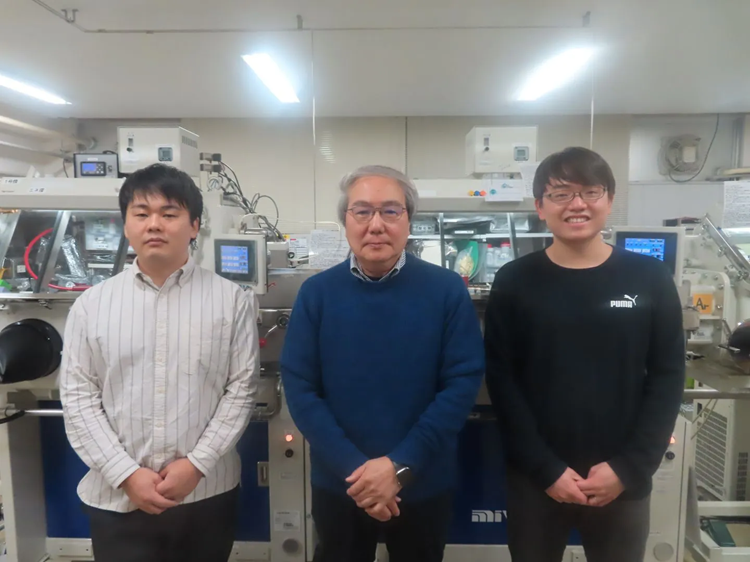 From left: Assistant Professor Naoki Matsui, Institute Professor Ryoji Kanno, and Assistant Professor Takashi Hirose. Image Credit: Institute of Science Tokyo
A research team at the Institute of Science Tokyo (Science Tokyo) has developed the novel solid electrolyte, Ba0.5Ca0.35Na0.15H1.85. In this electrolyte, hydrogen can move easily, even at room temperature, as H-.
Hydrogen power generation, whose only byproduct when combusted is water, is frequently regarded as the pinnacle of clean energy. However, a significant obstacle in its progress is the safe storage of the hydrogen required for power generation.
Compressing hydrogen into high-pressure tanks or liquefying it at extremely low temperatures below −253 °C allows for the storage of substantial quantities of hydrogen in a compact space, yet managing high-pressure gas and cryogenic liquids requires meticulous attention: hydrogen is a combustible gas.
These challenges associated with hydrogen storage have been insurmountable for researchers for decades.
But one promising method involves confining hydrogen within a solid for storage. This concept isn't new: Investigations into hydrogen-absorbing alloys capable of storing and releasing hydrogen commenced in the 1960s, and during the 1980s, a mechanism was suggested for the electrical insertion and extraction of hydrogen as ions.
However, these techniques still pose several challenges, including the need to heat the hydrogen-storing metal to temperatures exceeding 300 °C, as well as the deterioration of the metal following multiple storage and release cycles.
In recent years, hydrogen storage materials functioning at room temperature have also been documented, yet the processes of storing and retrieving hydrogen continue to create difficulties. Reactions may halt midway, for instance, rendering practical application still a distant goal.
Get all the details: Grab your PDF here!
The research team at the Institute of Science Tokyo (Science Tokyo) was led by Institute Professor Ryoji Kanno, Assistant Professor Naoki Matsui, and Takashi Hirose.
Molecular-motion simulations have shown that H- travels in three dimensions through the spaces between metal atoms within the crystal structure of the solid electrolyte - navigating through tetrahedral and octahedral voids.
This type of structure, which allows ions to move with such freedom, is uncommon, and it is this characteristic that contributes to the material’s exceptional ionic conductivity.
The team integrated this robust electrolyte with magnesium (Mg). By applying an electric current, they facilitated the movement of hydride ions, allowing them to be inserted into Mg. They also verified that reversing the current's direction enables a seamless transition between "inserting" and "extracting" hydride ions in Mg.
In essence, the system operates as though opening and closing a door, permitting the metal to accept hydrogen.
Using a prototype hydrogen storage device, the team successfully stored hydrogen at 90 °C, achieving an amount equivalent to 7.7 % of the mass of Mg. This performance level previously necessitated temperatures exceeding 300 °C, indicating that it was accomplished at less than one-third of the traditional temperature.
At an even lower temperature of approximately 60 °C, they also achieved the repeated storage and extraction of hydrogen at over 84 % of the theoretical maximum. In doing so, they demonstrated for the first time globally that a safe, rechargeable hydrogen storage device, capable of being "charged" with electricity, can be realized.
To realize a hydrogen-based society, technologies that enable hydrogen to be stored safely and used freely are essential. This achievement is a first step toward that future. There is still room for improvement, but we will continue our research with the goal of making “hydrogen stored with electricity” something that feels completely normal.
Naoki Matsui, Assistant Professor, Research Center for All-Solid-State Battery, Institute of Integrated Research, Science Tokyo
Future of Solid Electrolytes for Hydrogen Energy
This technology establishes a basis for innovative hydrogen storage devices capable of securely and efficiently storing hydrogen and electrical energy, as well as retrieving them when necessary. It is anticipated to significantly advance the development of efficient systems that use hydrogen as an energy carrier.
Should safe and highly efficient hydrogen storage and power generation systems be developed, the transformation of societal energy management may no longer be a mere aspiration.