A collaborative study between UChicago PME and Northwestern University, published in Nature Chemistry, details a novel approach to eliminating PFAS pollutants. The researchers successfully repurposed the specific chemical conditions that typically cause battery degradation to create an effective method for breaking down these persistent water contaminants.
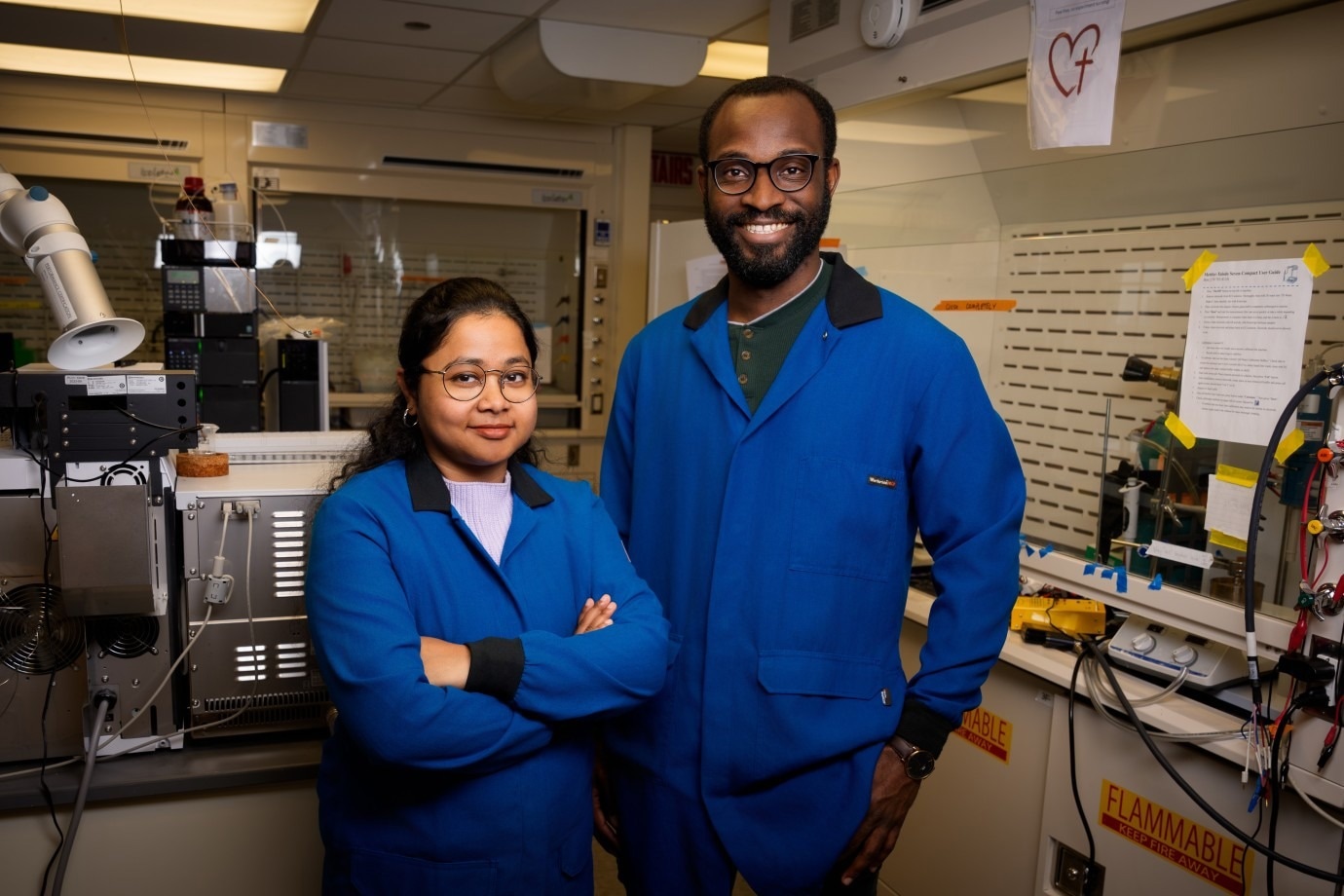 University of Chicago Pritzker School of Molecular Engineering postdoctoral researcher Bidushi Sarkar (left) and Assistant Prof. Chibueze Amanchukwu studied how batteries fail to create a new method of destroying the water pollutants known as per- and polyfluoroalkyl substances, or PFAS. Image Credit: Jason Smith
The researchers in the laboratory of Assistant Professor Chibueze Amanchukwu at the University of Chicago Pritzker School of Molecular Engineering (UChicago PME) dedicated three years to investigating failures, meticulously examining academic literature for accounts of battery malfunctions and deteriorated electrolytes.
If somebody complains, ‘Oh, this compound degrades in this manner and leads to a poorly cycling battery,’ we get excited about that. Because we can flip it around for PFAS degradation.
Chibueze Amanchukwu, Assistant Professor, University of Chicago Pritzker School of Molecular Engineering (UChicago PME)
The study demonstrates the impressive outcomes in decomposing the long-chain PFAS molecule perfluorooctanoic acid (PFOA) into mineralized fluorine, without generating short molecular chains that can be even more challenging to eliminate from water. This innovative source of fluorine can be utilized to produce PFAS-free compounds, converting pollutants into valuable commercial products.
We achieve about 94 % defluorination and 95 % degradation. That means we break nearly all the carbon–fluorine bonds in PFAS. We are mainly mineralizing and pushing complete breakdown of PFAS instead of just chopping it into shorter fragments.
Bidushi Sarkar, Study First Author and Postdoctoral Researcher, University of Chicago Pritzker School of Molecular Engineering (UChicago PME)
University of Illinois Chicago Chemical Engineering Prof. Brian Chaplin, who was not involved in the research, praised it as “a useful conceptual advance for future reductive PFAS treatment strategies.”
“This work is novel in its thoughtful use of lithium-mediated electroreduction, instead of the more common oxidative pathways, to achieve high PFOA conversion and near-complete defluorination in a non-aqueous system without generating shorter-chain PFAS byproducts,” said Chaplin.
As scientists worldwide develop methods to eliminate the resilient PFAS molecules using UV light, elevated temperatures, plasmas, plastic-eating microbes, or other approaches, this recent study introduces electrochemistry – the interplay between electricity and molecular bonds – into the fight.
“The reason people love electrochemistry is that it is quite modular. I can have a solar panel with batteries, and I can have an electrochemical reactor on site that is small enough to deal with any local waste streams. You don’t need a large plant that operates at high temperatures or high pressures, which are in some of the systems that people are trying to build today,” said Amanchukwu.
Stubborn Chemicals, a Stubborn Question
PFAS represent a category of thousands of robust and resilient chemicals utilized in various products such as firefighting foams, raincoats, non-stick cookware, and even the lab coats worn by the research team. However, this durability renders PFAS extremely challenging to eliminate from groundwater, surface water, or drinking water, leading to their designation as "forever chemicals."
“All of these properties – fire resistant, water resistant, oil resistant – are because of these strong carbon-fluorine bonds in PFAS. These properties that make PFAS so useful are also what make them so difficult to degrade,” said Sarkar.
This PFAS research represents a significant advancement for UChicago PME’s Amanchukwu Lab, which is dedicated to the design of electrolytes for batteries and electrocatalytic reactors essential for transitioning the planet away from fossil fuels. However, following conference presentations and various lectures, Amanchukwu, Sarkar, and their team members continued to receive inquiries regarding a different environmental issue.
“No exaggeration, when I would give talks, I guarantee you a question I would get at the end would be ‘Professor, why are you making more forever chemicals?” said Amanchukwu.
While the Amanchukwu Lab is at the forefront of developing PFAS-free battery electrolytes, it is important to note that many existing electrolytes still contain PFAS, albeit in minimal quantities and not of the type associated with cancer or other health issues. Instead of disregarding the inquiry, the team approached it from a different angle: If PFAS-based electrolytes are already subject to degradation within batteries, what insights can scientists gain from this phenomenon?
The Hunt for Failure
The electrochemistry is simply putting electrodes into a solvent. If you have these molecules dissolved into solvents, and then you pass current from the electrodes through the solvent, Chibueze and his team developed a scheme where that destroys the PFAS.
George Schatz, Study Co-Author and Professor, Chemistry, Northwestern University
Merely zapping water is insufficient. Decomposing PFAS through oxidation – which involves removing electrons until atomic bonds become unstable – poses challenges due to fluorine's chemical properties.
“Fluorine is the most electronegative element, so it really loves electrons. This makes oxidizing fluorinated compounds hard to do. It is much easier to reduce them,” said Amanchukwu.
Efforts to diminish the compounds by introducing electrons until the bonds reach instability inadvertently resulted in the reduction of the surrounding water, consequently decomposing it into hydrogen and oxygen. Analyzing research articles that reported PFAS unintentionally degrading in water-free battery electrolytes inspired a novel strategy.
“Our innovation here was working with non-aqueous electrolytes that have high reductive stability, such that when we add a fluorinated compound to it, it’s the fluorinated compound that is reductively degraded. That has been the breakthrough that has made this possible,” said Amanchukwu.
The new procedure was completed by treating copper electrodes with lithium, which is typically present in batteries.
Their success with PFOA showed promise when applied to other substances within the extensive "forever chemical" family for future research.
Of the 33 PFAS compounds evaluated, 22 exhibited degradation levels exceeding 70 %, with some reaching 99 %.
“People have done electrochemistry for a long time. If it was easy, it would have already been discovered,” said Schatz.
The results emerged from a partnership established through the Advanced Materials for Energy-Water Systems (AMEWS) Center, which is an Energy Frontier Research Center funded by the U.S. Department of Energy and directed by Argonne National Laboratory.
“The intention is to try to get scientists to interact with each other who might not normally interact. This has been an exciting outcome associated with the AMEWS Center,” said Schatz.
Journal Reference:
Sarkar, B., et al. (2026) Lithium metal-mediated electrochemical reduction of per- and poly-fluoroalkyl substances. Nature Chemistry. DOI: 10.1038/s41557-025-02057-7. https://www.nature.com/articles/s41557-025-02057-7