A research team led by Dr. Dandan Gao from the Department of Chemistry at Johannes Gutenberg University Mainz (JGU) has developed a new method for the sustainable production of ammonia and formic acid. Ammonia is indispensable in modern agriculture and, like formic acid, an important industrial feedstock. Conventionally, ammonia is produced using the Haber-Bosch process, which is extremely energy-intensive and causes significant CO2 emissions. It is also possible to produce ammonia via electrolysis, i.e., using electrical current, but this remains a relatively young field of research. Electrolysis offers a sustainable alternative for production because it can be powered by renewable electricity.
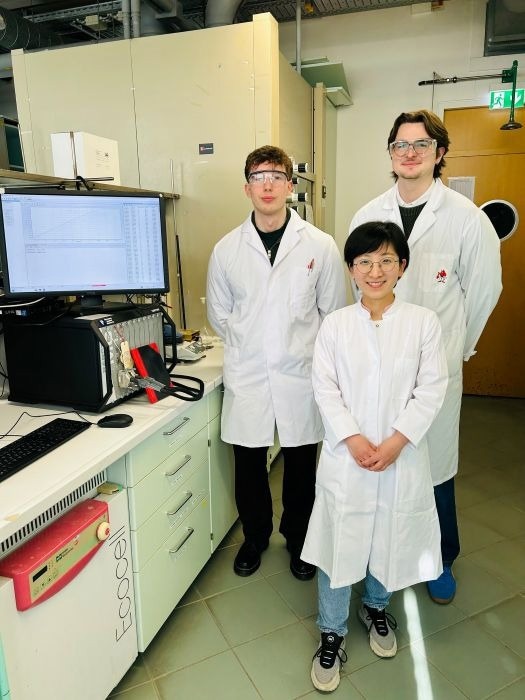 Dr. Dandan Gao with her colleagues Christean Nickel (l.) and David Leander Troglauer (r.). Image Credit: © Jennifer Christina Schmidt
"We have now achieved three key advances," said Gao, who led the current study. "First, we developed a catalyst composed of copper, nickel, and tungsten that significantly increases the ammonia yield during electrolysis. Second, we were able to further boost the yield by using pulsed instead of static electrolysis. And third, within the coupled electrochemical process, we simultaneously produce formic acid as an additional product." The new method was published this week by Gao and her colleagues Christean Nickel and David Leander Troglauer in the renowned scientific journal Angewandte Chemie.
Novel Catalyst Design
The researchers developed a novel so-called three-component tandem electrocatalyst to enable the electrochemical reduction of nitrate to ammonia to proceed as efficiently as possible. "We chose copper, nickel, and tungsten for the following reasons," explained Gao. "To obtain ammonia from nitrate, oxygen must first be removed from the nitrate – this step is catalyzed by copper. Hydrogen must then be generated, where nickel exhibits its catalytic strength. Finally, the hydrogen must not escape into the atmosphere or undergo side reactions but instead bind selectively to nitrogen – this is the role of tungsten. Compared to tandem catalysts made of copper and nickel, which were already considered promising, our catalyst achieves more than 50 percent higher ammonia yields," said Gao.
Pulsed Instead of Static Electrolysis
Using pulsed instead of static electrolysis increases the yield by a further 17 percent. The setup is identical in both cases. The only difference lies in the electrical potential applied to the electrodes. In static electrolysis, the voltage remains constant, whereas in pulsed electrolysis it continuously alternates between two voltage values.
Additional Production of Formic Acid
In every electrolysis process, not only does a reduction reaction occur at the cathode, but an oxidation reaction also takes place at the anode. "Normally, this is water oxidation, which produces oxygen," said Gao. However, oxygen is neither particularly valuable nor in high industrial demand. In the new method, the researchers therefore replace water oxidation and instead oxidize glycerol, a waste product from biodiesel production. This yields formic acid, which is widely used in industry, for example as a precursor for chemicals and pharmaceuticals.
"In this way, we can obtain two valuable products at once: ammonia at the cathode and formic acid at the anode," said Gao. "The strategic coupling of the two reactions highlights the potential of this method to sustainably produce value-added chemicals via energy-efficient coupled electrolysis."