Low Carbon Hub, a social enterprise which develops community-owned renewable energy projects in Oxfordshire has been inviting people to invest in the UK’s first community-owned solar energy battery at Ray Valley solar park in Arncott, near Bicester. Thanks to a high level of support, it has raised 80 % of its £500,000 community investment target with over a month still to go.
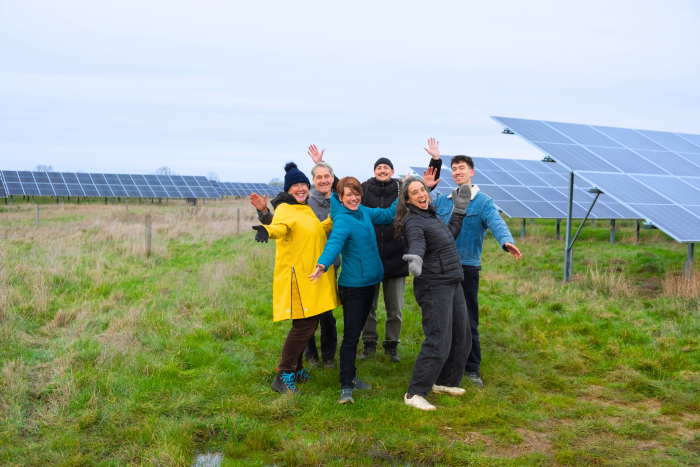 Image Credit: Low Carbon Hub
So far, 200 investors have invested a combined £440,000 to install battery storage at Ray Valley Solar, one of the largest community-owned solar energy parks in the UK. Ray Valley was set up by Low Carbon Hub in 2022 and can generate enough clean electricity to power around 7,000 homes.
Solar energy used to be heavily dependent on the time the sun was out, but adding battery storage makes the clean power more reliable and consistent day and night. The battery will mean more clean energy is used, and more money is generated, which Low Carbon Hub invests in other community energy projects.
The battery costs £1.8 million, and by funding this through community investment, the project will be owned, in part, by the community. Members of the public and organizations can buy community shares in the Community Energy Fund via the direct impact investing platform, Ethex. Investments start at £100, with a maximum investment of £100,000. The community share offer opened on 26 March 2026 and will close on 26 June 20206.
Dr Barbara Hammond MBE, CEO, Low Carbon Hub says: “The response from investors has been genuinely exciting - people are getting behind something truly unique: the UK’s first community-owned battery located alongside a community-owned solar park. If this momentum continues and we overraise, even more of the project will be community-owned, and we will reduce our reliance on loans, keeping more of the project in community hands. That means even more of the profits flow back into other community projects through Low Carbon Hub’s work.”
Currently, not all of the energy generated at Ray Valley can be used when it’s needed most. On very sunny days, the park produces more electricity than the local grid can use so some clean energy is lost. Energy prices are also usually lower during the day, when more solar energy is produced, meaning that power that is generated earns less money than it could. Installing a battery means more of the clean energy will get used and the park will earn more money.
All profits from Low Carbon Hub’s renewable energy projects are invested into other community sustainability initiatives such helping schools, homes and businesses become more energy efficient and reduce carbon emissions.
The share offer gives people the chance to invest in, and co-own vital clean energy infrastructure which is taking action on climate change. Investors get a fair return on their investment and will see profits invested in other low carbon projects.
Eleanor Watts, an investor in the project said: “I invested in the Low Carbon Hub because its projects help to normalize the use of renewable energy. So far, I have been rewarded by a good rate of interest and the knowledge that some of the profits go to local environmental groups like the one I’m involved with. I feel happy that my money has done a little bit to combat the climate emergency.”
The battery will capture surplus solar electricity that would otherwise be wasted and store it for use later in the day. Each year, it is expected to save around 809 MWh of clean electricity from being wasted – enough to power around 300 homes annually. By releasing that stored solar power during peak demand, when the grid is more carbon intensive, the battery will deliver an additional 102 tons of carbon savings every year – equivalent to taking around 45 cars off the road.
Low Carbon Hub is one of the biggest community energy organizations in the UK and has 56 community owned renewable energy projects across Oxfordshire. This project was catalyzed by a philanthropic loan through the We Have The POWER project.