The HyCavern project has officially launched, bringing together a European consortium of 15 partners to develop and validate nextgeneration underground hydrogen storage solutions based on mined, lined rock caverns. Coordinated by SINTEF Industry, with Dr. Pierre-Rolf Cerasi and Dr. Mohammad Masoudi leading the project coordination, HyCavern aims to address one of the key challenges facing Europe’s future hydrogen economy: the need for largescale, safe and geographically adaptable hydrogen storage.
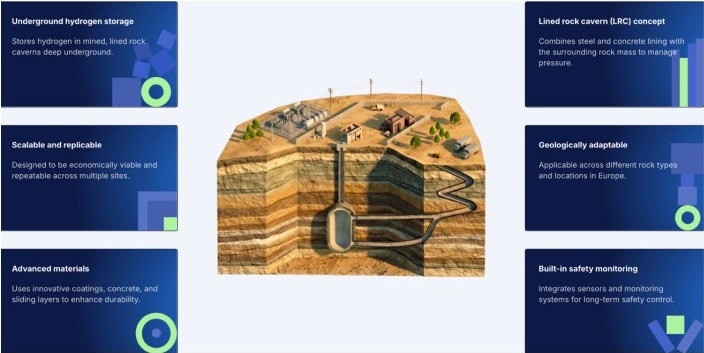 The lined rock cavern (LRC) concept for underground hydrogen storage. It shows a cross-section of a mined cavern deep underground, connected to surface infrastructure, with surrounding panels highlighting key features: scalability, geological adaptability, advanced materials, steel and concrete linings, and built-in safety monitoring systems for long-term hydrogen storage. Image Credit: HyCavern
As Europe increases the share of renewable energy in its energy system, hydrogen is expected to play an important role in balancing supply and demand, supporting industrial decarbonization, and strengthening energy security. However, many current underground storage options depend on specific geological formations, limiting their deployment across Europe.
HyCavern responds to this challenge by developing lined rock cavern systems that can potentially enable hydrogen storage in regions where conventional underground storage solutions are not available.
The project will develop cost-effective, safe and standardized solutions for hydrogen storage in mined, lined rock caverns, combining engineered lining systems, advanced materials, digital tools and real-time monitoring technologies.
Over the next three years, the project will focus on:
- Developing advanced steel liner solutions using laser welding and protective coatings to reduce hydrogen embrittlement, fatigue and leakage risks;
- Testing low-carbon concrete and rock–interface systems to improve long-term structural integrity and environmental performance;
- Creating simulation and optimization tools to support safe cavern design across different geological settings;
- Integrating advanced monitoring systems, including fiber-optic sensing, 3D-printed sensors and digital twins;
- Validating the full lined rock cavern concept under realistic operating conditions;
- Developing a GIS-based site selection toolkit to support deployment across Europe;
- Assessing techno-economic feasibility, market potential and business models for future uptake.
A key ambition of HyCavern is to make underground hydrogen storage more scalable and replicable by adapting cavern designs to diverse geological conditions. By doing so, the project aims to unlock storage potential in areas that may not be suitable for conventional underground hydrogen storage, helping to support Europe’s clean energy transition.
The project is supported by the Clean Hydrogen Partnership and its members. The HyCavern consortium brings together leading research organizations, universities, technology providers and industry partners from across Europe, including:
SINTEF (NO), Fundación Hidrógeno Aragón (ES), The University of Edinburgh (UK), Hive Ventures (MT), Delft University of Technology (NL), Fraunhofer ILT (DE), University of Oxford (UK), AGH University of Krakow (PL), Comec Innovative SRL (IT), Federal Office of Topography swisstopo (CH), Baker Hughes (UK), Deloitte (FR), Planck Technologies (NO) and Picum MT GmbH (DE).
The project will also place strong emphasis on communication, stakeholder engagement and exploitation, ensuring that results are shared with industry, policymakers, researchers and other stakeholders involved in the future hydrogen storage value chain.