The Carbon Cost of Modern Construction
Low Carbon Cement Solutions
Notable Companies Pursuing Low-Carbon Cement
Challenges Facing Widespread Adoption
Building Towards a Lower-Carbon Foundation
References and Further Reading
Cement supports nearly every building, road, and bridge in the modern world, yet its production carries a substantial carbon footprint. As demand for cement continues to grow, researchers and manufacturers are racing to find replacements that can match its performance without the environmental costs.
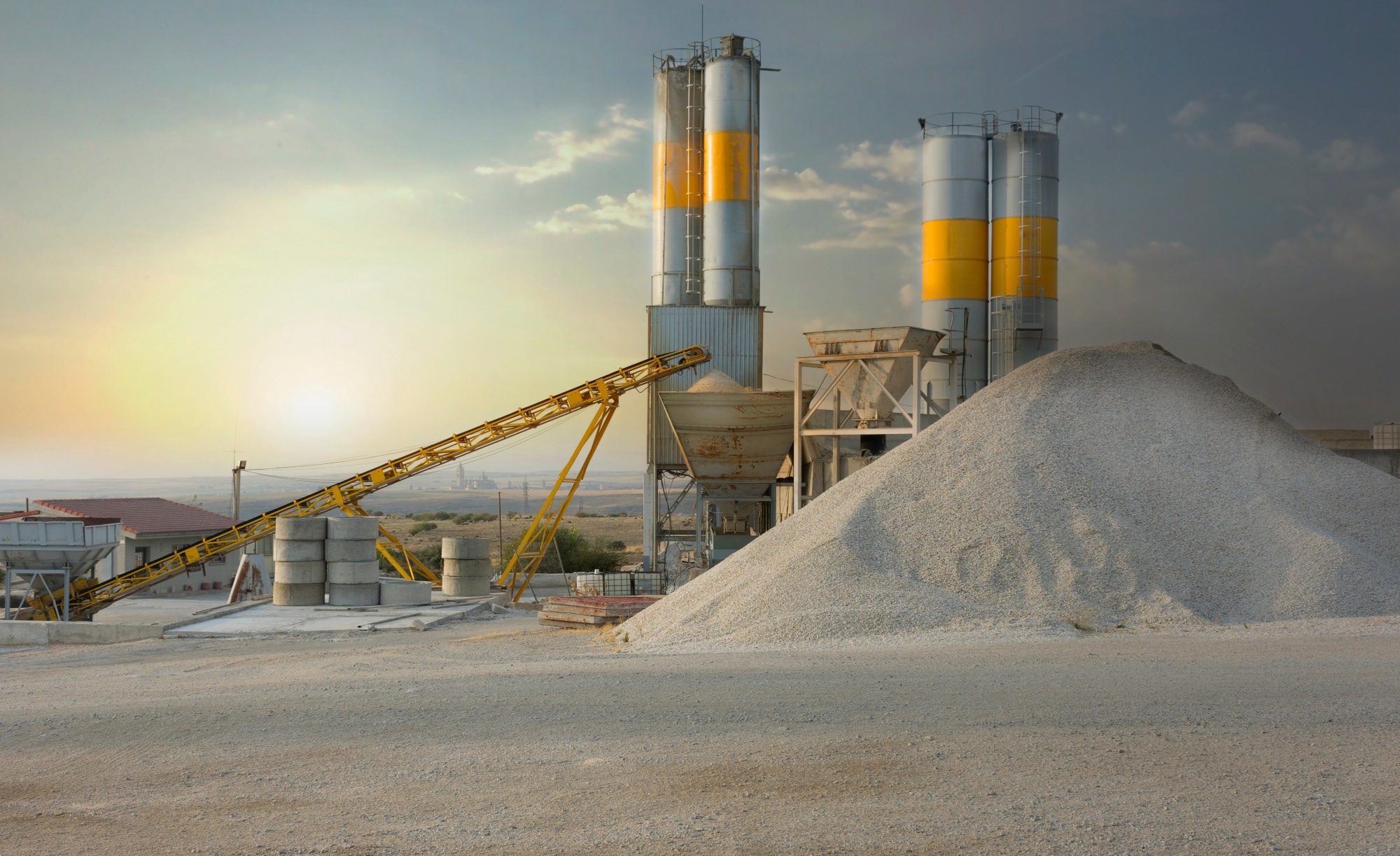
Image Credit: Juan Enrique del Barrio/Shutterstock.com
The Carbon Cost of Modern Construction
Ordinary Portland cement (OPC) is among the world’s most widely used construction materials, essential for buildings, transportation networks, energy infrastructure, and other critical infrastructure. With population growth, urbanization, and infrastructure development driving demand, global cement production is projected to rise from approximately 3.90 billion tons in 2020 to 5.8 billion tons by 2050. This growth carries a high environmental cost, as cement production already accounts for approximately 5% to 8% of global anthropogenic CO2 emissions.
Most of that carbon footprint traces back to a single step: the high-temperature calcination of limestone, which chemically releases CO2 as it decomposes and consumes large amounts of energy. Cutting emissions therefore depends on reducing cement clinker content or otherwise mitigating the emissions clinker production creates.
The challenge is compounded by geography. Limestone itself is abundant, but access to economically viable deposits is often constrained by transport distances, environmental regulation, permitting requirements, and competing land uses.
These pressures have driven growing interest in low-carbon cement, which aims to preserve the structural performance and durability of conventional cement while lowering energy consumption and emissions.1,2
Low Carbon Cement Solutions
Natural Volcanic Pozzolans
Natural pozzolans, particularly volcanic materials such as zeolite, pumice, perlite, volcanic ash, and scoria, can partially replace Portland cement as supplementary cementitious materials.
Their reactive silica and alumina consume calcium hydroxide during hydration, forming additional C-S-H that can reduce cement demand while improving pore structure and durability.
Performance studies show that around 20% zeolite can maintain sufficient compressive strength, while mortar containing 20% ultra-fine volcanic ash achieved 69.6 MPa at 91 days, compared with 68.1 MPa for OPC. In addition, pumice replacement up to 30% can reduce permeability, while zeolite at 5 to 30% improves resistance to chloride penetration, sulfate attack, water permeability, and carbonation.1
Limestone Calcined Clay Cement (LC³)
Limestone calcined clay cement (LC3) combines clinker, calcined clay, limestone, and gypsum to substantially reduce the clinker content of conventional Portland cement.
Calcined clay contributes to strength and durability while lowering the energy use and CO2 emissions associated with clinker production, and its widespread availability allows LC3 to be produced using existing cement infrastructure.
A formulation containing 50% clinker, 30% calcined clay, 15% limestone, and 5% gypsum has demonstrated mechanical performance comparable to conventional CEM I cement from seven days while reducing CO2 emissions by approximately 30%.
It can also be up to 25% cheaper to produce than conventional Portland cement, and broader estimates suggest its adoption could avoid roughly 500 million tons of CO2 emissions annually by 2030.3,4
Geopolymers and Alkali-Activated Materials
Geopolymers are low-carbon cementitious binders produced by activating alumina- and silica-rich materials, such as metakaolin, fly ash, and industrial waste, with an alkaline solution.
Rather than relying on the calcium-based hydrates that give Portland cement its strength, geopolymers form three-dimensional aluminosilicate networks that can match its mechanical and durability performance while requiring far less clinker. Suitable feedstocks, including volcanic rock, lateritic soils, and kaolin-rich clays, exist in quantities that far exceed global cement demand.
Their performance can also be tuned through precursor composition, activator chemistry, curing conditions, and additives. For example, a geopolymer made from 50% granulated slag, 48% rockwool, and 2% silica fume reached 39.12 MPa compressive strength after 28 days, while nano-CaCO3-modified alkali-activated composites reached as much as 81.5 MPa.4,5
Recycled and Waste-Derived Aggregates
Waste-derived mineral materials offer another pathway toward low-carbon cement by reducing reliance on conventional Portland cement and incorporating industrial and construction waste into cementitious systems.
Waste rock dust can replace approximately 41–58% of natural sand while improving strength and durability, while incineration bottom ash has been used at replacement levels of up to 20% as a cementitious material, with studies reporting environmental benefits from such substitution. Air-cooled blast furnace slag can also serve as a major cementitious component, with alkali-activated slag systems demonstrating the potential to completely replace Portland cement in some applications.
Their effectiveness ultimately depends on material composition, reactivity, contamination, and appropriate processing to ensure consistent performance.5
Agricultural and Biomass Waste
Rice husk ash (RHA) is an agricultural-waste-derived supplementary cementitious material produced by controlled combustion of rice husks, offering a way to reduce Portland clinker while converting an abundant waste stream into a value-added resource.
Global rice production reached approximately 800 million tons in 2023, generating around 160 million tons of rice husks containing nearly 20% amorphous silica by mass. Under controlled combustion conditions, these rice husks can be converted into rice husk ash (RHA) containing more than 95% SiO2, with the silica predominantly amorphous and exhibiting high pozzolanic reactivity.
These properties enable RHA to be used as a partial cement replacement while reducing the environmental impacts associated with dumping, landfilling, and uncontrolled burning of rice husks.6
Notable Companies Pursuing Low-Carbon Cement
Alongside clinker reduction and supplementary cementitious materials, several companies are targeting the chemical processes behind cement’s emissions directly.
Sublime Systems, based in Massachusetts, US, uses an electrochemical process to produce lime from limestone at near-ambient temperatures, potentially allowing the process to run on renewable electricity.
The company is developing a demonstration plant in Holyoke, Massachusetts, with a planned capacity of around 30,000 tons of cement per year.
Fortera, based in California, US, has developed a process that integrates with existing cement plants and converts captured kiln CO2 into additional cement.
Its ReAct technology combines CO2 with calcium oxide to form a cementitious material. Its demonstration facility in Redding, California, is designed to capture around 6,600 tons of CO2 annually while producing 15,000 tons of low-carbon cement, cutting emissions by roughly 70% on a ton-for-ton basis.
Brimstone takes a different approach, replacing limestone with calcium silicate rock as its calcium source. Because calcium silicate can yield calcium oxide without the carbonate decomposition that releases CO2 in conventional clinker production, the process could eliminate a substantial share of cement’s process emissions.
Brimstone’s planned facility is designed to produce up to 140,000 tons per year of ordinary Portland cement and supplementary cementitious materials while avoiding around 120,000 tons of CO2 annually.3
Challenges Facing Widespread Adoption
Despite their potential to reduce clinker consumption, emissions, and demand for virgin resources, adopting low-carbon and recycled mineral composite materials remains challenging.
Material variability and quality control remain key concerns because the composition and reactivity of waste-derived materials can vary with their source and processing, while activation methods may improve performance but add energy, cost, and environmental burdens.
Geopolymer and alkali-activated materials may also require chemical activators such as sodium silicate, whose energy-intensive production can generate significant CO2 emissions, while limited standards and certification frameworks can restrict market confidence and wider deployment.
Policy support, economic incentives, and reliable supply chains are also needed to encourage large-scale recovery and reuse of waste-derived materials.
Finally, limited long-term performance data remains a critical barrier, highlighting the need for extended testing, standardized characterization, life-cycle assessment, and field validation to establish the reliability of these materials for large-scale infrastructure.1,5,6
Building Towards a Lower-Carbon Foundation
Cement is unlikely to disappear from construction anytime soon, but the way we make and use it is already beginning to change.
From volcanic ash and agricultural waste to electrochemistry and entirely new binder chemistries, no single material may replace Portland cement outright. Instead, the future is likely to involve a mix of solutions tailored to local resources, costs, and performance requirements.
The real test now is whether these promising alternatives can move beyond laboratories and demonstration plants and into the roads, bridges, and buildings being constructed every day. If they can, one of the world’s oldest and most carbon-intensive industries could end up looking very different in years to come.
References and Further Reading
- Nassiri, S., Butt, A. A., Zarei, A., Roy, S., Filani, I., Pandit, G. A., Mateos, A., Haider, M. M., & Harvey, J. T. (2024). Opportunities for Supplementary Cementitious Materials from Natural Sources and Industrial Byproducts: Literature Insights and Supply Assessment. Buildings, 15(17), 3099. [https://doi.org/10.3390/buildings15173099](https://doi.org/10.3390/buildings15173099)
- Khaiyum, M. Z., Sarker, S., & Kabir, G. (2022). Evaluation of Carbon Emission Factors in the Cement Industry: An Emerging Economy Context. Sustainability, 15(21), 15407. [https://doi.org/10.3390/su152115407](https://doi.org/10.3390/su152115407)
- Tharika Lecamwasam. (2024). Three emerging technologies for low-carbon concrete. ClimateWorks Foundation. [https://www.climateworks.org/blog/three-emerging-technologies-for-low-carbon-concrete/](https://www.climateworks.org/blog/three-emerging-technologies-for-low-carbon-concrete/)
- The Institute of Structural Engineers. (2025). Beyond Portland cement: Low-carbon alternatives. [https://www.istructe.org/resources/guidance/beyond-portland-cement-low-carbon-alternatives/](https://www.istructe.org/resources/guidance/beyond-portland-cement-low-carbon-alternatives/)
- Zhang, R., Zhang, Y., Sun, G., & Wei, H. (2024). Low-Carbon and Recycled Mineral Composite Materials for Sustainable Infrastructure: A Comprehensive Review. Sustainability, 17(17), 7908. [https://doi.org/10.3390/su17177908](https://doi.org/10.3390/su17177908)
- Akintayo, B. D., Babatunde, O. M., Akintayo, D. C., & Olanrewaju, O. A. (2025). Transforming Industrial Waste into Low-Carbon Cement: A Multi-Criteria Assessment of Supplementary Cementitious Materials for Sustainable Concrete Design. Recycling, 10(6), 211. [https://doi.org/10.3390/recycling10060211](https://doi.org/10.3390/recycling10060211)
Disclaimer: The views expressed here are those of the author expressed in their private capacity and do not necessarily represent the views of AZoM.com Limited T/A AZoNetwork the owner and operator of this website. This disclaimer forms part of the Terms and conditions of use of this website.