Climate change remains one of humanity’s most pressing challenges, and the global demand for low-carbon, high-purity energy sources has never been greater.
Hydrogen (often called "the fuel of the future") is expected to play a central role in the transition to net-zero emissions. Its appeal lies in a unique mix of advantages: high energy density, zero emissions at the point of use, renewable production potential, and the ability to decarbonize hard-to-abate sectors. Unsurprisingly, demand is rising fast.
Yet despite its promise, hydrogen still faces a major hurdle in becoming a truly viable and sustainable energy option.
Large-scale, low-carbon, and cost-effective hydrogen production doesn't always happen near where it's needed. On top of that, hydrogen is notoriously challenging to store and transport. Without a practical, global solution for moving hydrogen from where it's produced to where it’s used, consistent worldwide access remains difficult.
That’s where ammonia could offer as a solution, as it is both a hydrogen carrier and a scalable solution for storage and transport. Proven ammonia cracking technologies are now making it possible to bridge this critical supply-demand gap.
Advantages of Ammonia as an Energy Carrier
- Well-established infrastructure
- Scalable supply
- Low-carbon and renewable production routes
- Global supply chain
- The carbon-free liquid that has the highest energy and hydrogen density
- Diverse off-take channels
- Easy to liquify and transport
- Can be stored at atmospheric pressure and modest cooling
- Crackable energy carrier
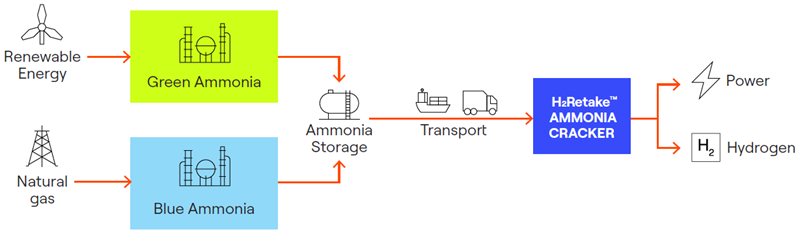
Image Credit: Topsoe
Ammonia as the Ideal Hydrogen Carrier
Ammonia has the potential to be the best hydrogen transporter for long-distance transport at scale. In fact, there is a growing consensus in the industry that ammonia will be the preferred route for delivering hydrogen over large distances. And this is for good reason.
Ammonia's long-standing usage in the industrial fertilizer and chemical industries has resulted in a well-established infrastructure that could ease the transition to hydrogen energy distribution.
Ammonia also stands out as the carbon-free liquid with the highest energy and hydrogen content. It is also reasonably easy to transport and disseminate across great distances. This is due to its capacity to be liquefied and kept in liquid state at ambient pressure for lengthy periods of time, with temperatures as low as -33 °C easily achieved.
To take full advantage of ammonia’s potential as a hydrogen carrier, only one key piece is needed: an efficient method to convert ammonia back into hydrogen.
At Topsoe, that solution is H2Retake™, a highly energy-efficient ammonia cracking technology designed to do exactly that.
Want to read the full article? Click here

This information has been sourced, reviewed and adapted from materials provided by Topsoe.
For more information on this source, please visit Topsoe.