How AI Forecasts Traffic-Related Pollution
How Do Cities Use AI Pollution Forecasts?
Limits Cities Need to Plan For
Prediction Is Not Prevention
References and Further Reading
Road traffic is a leading source of nitrogen dioxide and fine particles in cities, and polluted air carries a heavy health cost. The World Health Organization estimates that outdoor air pollution caused 4.2 million premature deaths worldwide in 2019, and that 99% of the global population lived in places that did not meet its guideline levels.1 Cities have traditionally learned about a pollution spike only after it has happened. Researchers and municipal authorities are now exploring whether artificial intelligence (AI) can forecast those spikes early enough to act on them.
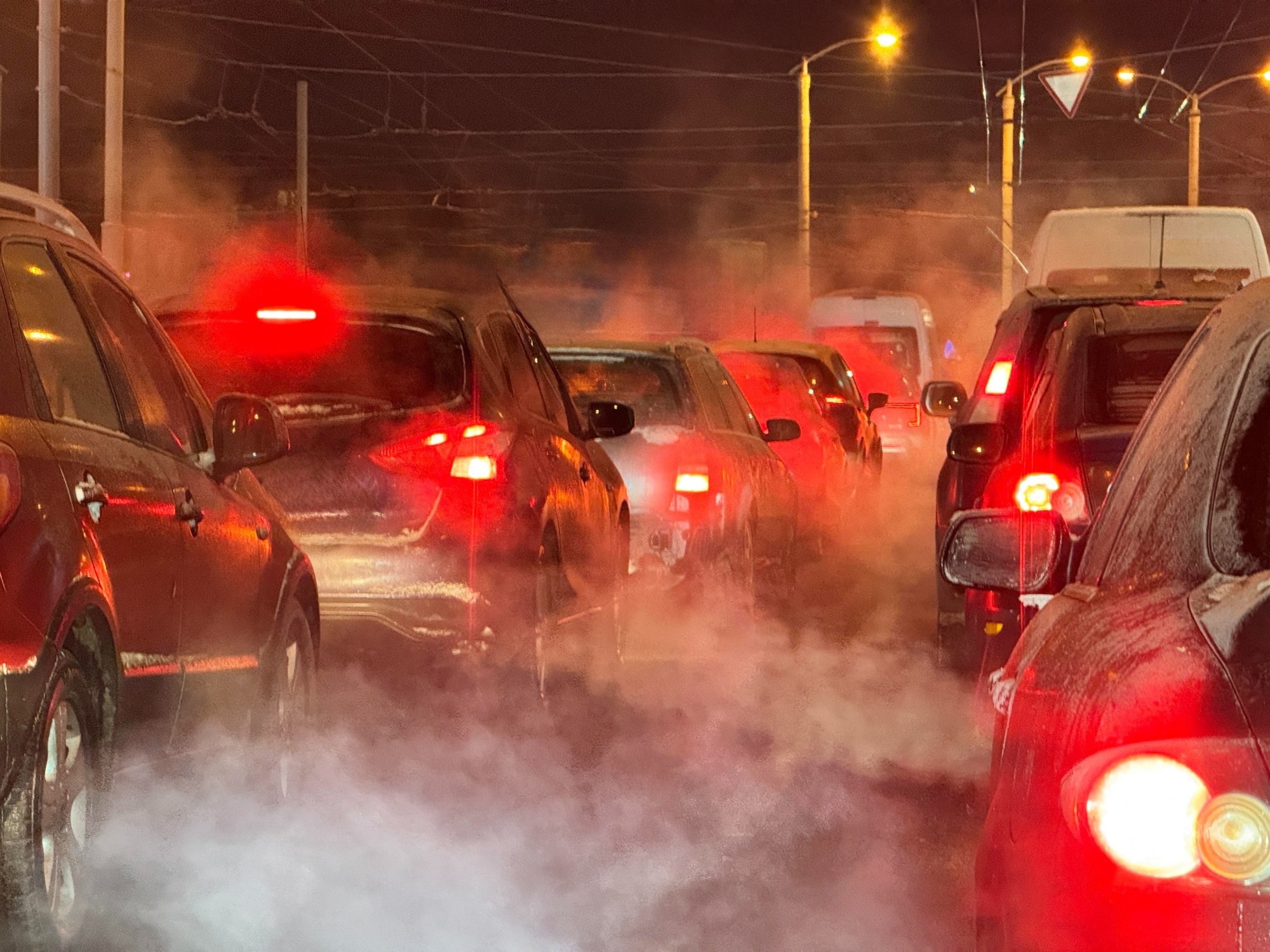
Image Credit: worldtophoto/Shutterstock.com
Using past records to learn the links between traffic, weather, and pollution, machine learning offers a new way to follow how traffic changes from hour to hour across a city – something conventional dispersion models find challenging.
Published in 2025, a review of 103 studies from between 2013 and 2023 describes how researchers have used tree-based and neural network methods to predict urban air quality from on-road traffic conditions.2 It explains how a typical system merges four kinds of data:
- Traffic counts, speeds and congestion indicate how much exhaust is being released.
- Weather records, including wind, temperature and rain, indicate how quickly it disperses or settles.
- Years of past pollution readings teach the model recurring patterns such as rush-hour peaks.
- Live readings from air quality sensors let it check and adjust its forecasts.
Together, these inputs allow the model to estimate how concentrations will vary from street to street and hour to hour.2
SOCAIRE
Madrid's operational forecasting tool, SOCAIRE, shows this approach in use. It draws on past pollutant concentrations, numerical weather and pollution predictions, and information on human activity, and it produces daily forecasts for the next 48 hours.3
Sensors add street-level detail that few reference monitors can provide. The Breathe London pilot ran 100 low-cost nitrogen dioxide sensors across Greater London for two years, and its readings captured long-term trends, daily and weekly cycles and pollution episodes that the city's reference network confirmed.4
Click here to download a PDF copy of this page
How Do Cities Use AI Pollution Forecasts?
Using Madrid’s SOCAIRE as an example, in December 2016, during a spell of stagnant weather, the city used its strictest stage for the first time and halved private car access to the center using number plates. An analysis of that episode concluded that the restrictions may have prevented further rises of up to 15% in the city center, although levels in the outskirts stayed the same or rose slightly.5
SURTRAC
Traffic management is a different application as it acts on emissions without forecasting pollution. SURTRAC, an adaptive signal system developed at Carnegie Mellon University, replans green times as often as once a second based on approaching vehicles. In an early pilot on nine intersections in Pittsburgh, it improved the measures studied, including travel time, stops, fuel use and estimated emissions, by 20% to 40% overall.6
Breathe London
Sensor data also informs planning. According to the Mayor of London's office, Breathe London readings supported the decision to extend the Ultra Low Emission Zone; nine of the 33 schools with sensors were on course to exceed the legal nitrogen dioxide limit and were offered audits and grants, and a hotspot near a bus garage led Transport for London to work with the operator on measures such as preventing idling.7
Improving Public Health
Forecasts also aim to improve public health. The WHO identifies air pollution as one of the greatest environmental risks to child health.1 Alerts can help children, older adults and people with heart or lung conditions limit time outdoors on high-pollution days. However, the studies cited here do not show that forecasts alone reduce illness, because the benefit depends on people and authorities acting on them.
Limits Cities Need to Plan For
Forecasts depend on the quality of the underlying data. In the London network, calibrated sensors had an average uncertainty of around 35%, with multi-week periods in summer when performance dropped and readings were biased.4
Reference-grade monitors are more accurate but expensive, and the London team relied on keeping some sensors beside reference instruments to track how far readings could be trusted, adding cost.4
Beyond the sensors, a forecasting system needs communication links, data storage, and staff to maintain and retrain the models as traffic and vehicle fleets change.
Reviews of the field also list data quality and interpretability among the persistent difficulties.8 Interpretability is essential when a forecast is used to justify a traffic restriction, and one review of traffic and air quality models calls for more attention to it and for better input data.2
Human oversight is also required. People set the thresholds that trigger restrictions, judge whether a forecast was right afterward, and weigh the cost of limiting traffic against the health risk. The Madrid analysis noted how hard it is to measure the effect of such measures from observations alone.5
Prediction Is Not Prevention
A forecast can tell a city when to act, but not which measures will be effective. During Madrid’s 2016 pollution episode, only the strictest stage of the city’s response protocol significantly reduced peak nitrogen dioxide levels, while surrounding areas saw no measurable improvement.5
Reducing traffic emissions therefore requires more than accurate predictions. The WHO identifies cleaner transport as a key policy priority for tackling outdoor air pollution.¹ AI can help cities implement these measures at the right time and in the right places, but it cannot replace the policies and infrastructure needed to make a lasting difference.
References and Further Reading
1. World Health Organization. (2024, October 24). Ambient (outdoor) air pollution [Fact sheet]. https://www.who.int/news-room/fact-sheets/detail/ambient-(outdoor)-air-quality-and-health
2. Du, Z., Li, H., Chen, S., Zhang, X., Zhang, L., & Liu, Y. (2025). Advancements in machine learning for spatiotemporal urban on-road traffic-air quality study: A review. Atmospheric Environment, 346, 121054. https://doi.org/10.1016/j.atmosenv.2025.121054
3. de Medrano, R., de Buen Remiro, V., & Aznarte, J. L. (2021). SOCAIRE: Forecasting and monitoring urban air quality in Madrid. Environmental Modelling & Software, 143, 105084. https://doi.org/10.1016/j.envsoft.2021.105084
4. Peters, D. R., Popoola, O. A. M., Jones, R. L., Martin, N. A., Mills, J., Fonseca, E. R., Stidworthy, A., Forsyth, E., Carruthers, D., Dupuy-Todd, M., Douglas, F., Moore, K., Shah, R. U., Padilla, L. E., & Alvarez, R. A. (2022). Evaluating uncertainty in sensor networks for urban air pollution insights. Atmospheric Measurement Techniques, 15(2), 321–334. https://doi.org/10.5194/amt-15-321-2022
5. Borge, R., Artíñano, B., Yagüe, C., Gomez-Moreno, F. J., Saiz-Lopez, A., Sastre, M., Narros, A., García-Nieto, D., Benavent, N., Maqueda, G., Barreiro, M., de Andrés, J. M., & Cristóbal, Á. (2018). Application of a short term air quality action plan in Madrid (Spain) under a high-pollution episode - Part I: Diagnostic and analysis from observations. Science of the Total Environment, 635, 1561–1573. https://doi.org/10.1016/j.scitotenv.2018.03.149
6. Smith, S., Barlow, G., Xie, X.-F., & Rubinstein, Z. (2013). Smart urban signal networks: Initial application of the SURTRAC adaptive traffic signal control system. Proceedings of the International Conference on Automated Planning and Scheduling, 23(1), 434–442. https://doi.org/10.1609/icaps.v23i1.13594
7. Mayor of London. (2019, July 24). Mayor publishes first data from Breathe London network [Press release]. London City Hall. https://www.london.gov.uk/press-releases/mayoral/first-breathe-london-data-published
8. Bernacki, J., & Scherer, R. (2025). A comprehensive review of data-driven techniques for air pollution concentration forecasting. Sensors, 25(19), 6044. https://doi.org/10.3390/s25196044
Disclaimer: The views expressed here are those of the author expressed in their private capacity and do not necessarily represent the views of AZoM.com Limited T/A AZoNetwork the owner and operator of this website. This disclaimer forms part of the Terms and conditions of use of this website.