In a recent article published in the journal Scientific Reports, researchers evaluated the effectiveness of Aagri-photovoltaic (APV) systems in achieving the dual objectives of producing renewable energy and maintaining sustainable agriculture.
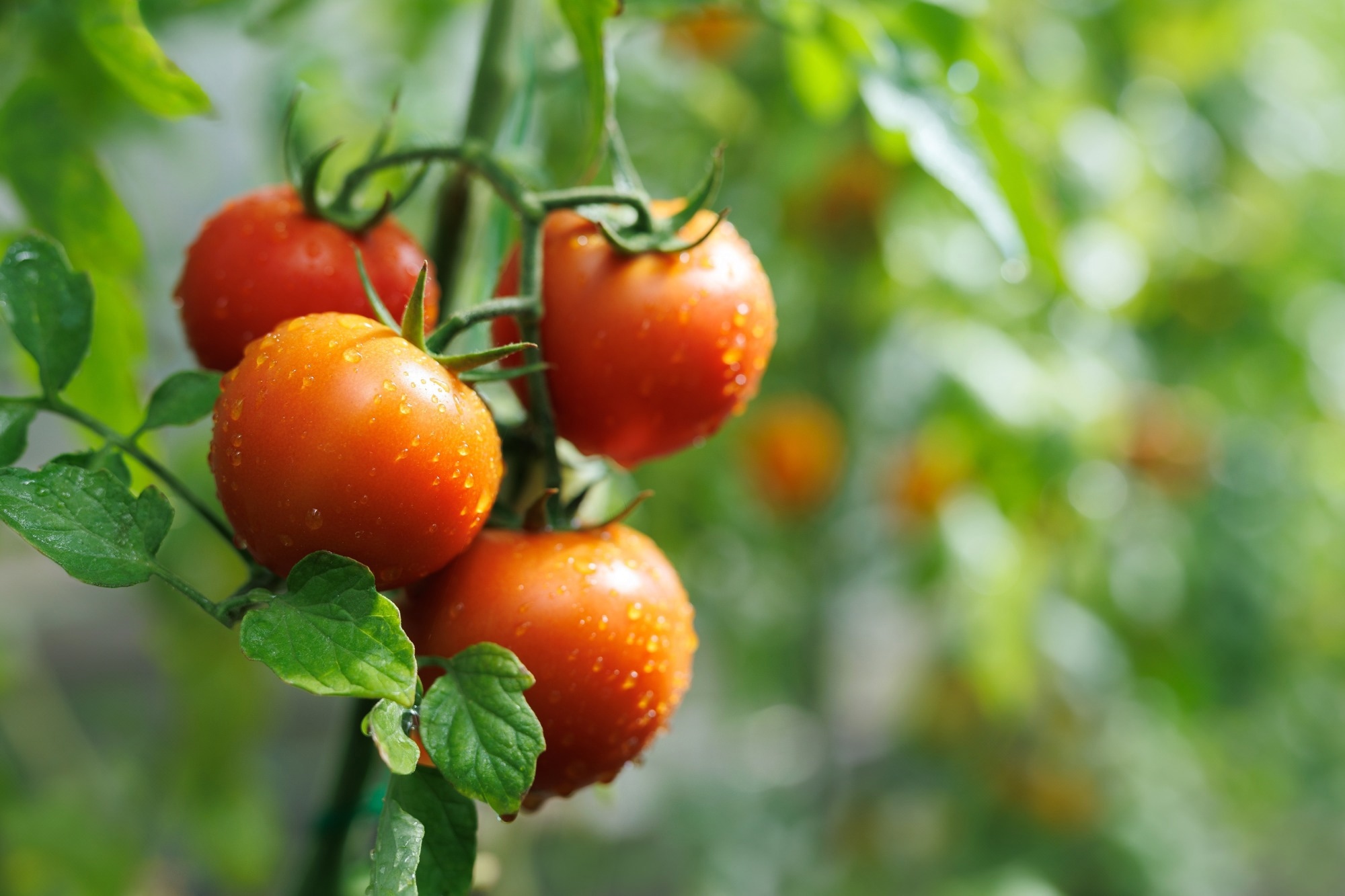
Image Credit: Studio Peace/Shutterstock.com
Background
APV systems, particularly those equipped with sun-tracking photovoltaic (PV) panels, allow for dynamic shading adjustments to optimize both agricultural and energy outputs. The physiological effects of shading on crops, especially shade-sensitive varieties, are still not well understood.
Despite the recognized benefits of APV in enhancing energy production and land-use efficiency, its widespread adoption is hindered by high initial investment costs and a lack of clear regulatory frameworks.
A critical regulatory concern is determining the maximum proportion of land that can be covered by PV modules without significantly impairing agricultural productivity. Prior studies have indicated varying yield responses depending on the shading level and PV configuration.
Tomato (Solanum lycopersicum) is a globally significant crop and serves as an ideal model for studying these effects.
The Current Study
Two separate field experiments were conducted during the spring seasons of 2022 and 2023 at the APV Farm at Bar-Ilan University, Israel. The experimental field measured 714 m² and utilized a setup with a Ground Cover Ratio (GCR) of 26 %, meaning 26 % of the ground area was shaded when the PV panels were horizontal.
Processing tomato plants (Heinz 1648 and Heinz 4107 cultivars) were grown in polystyrene containers filled with a soil mixture, including peat, volcanic stones, and compost. The plants were arranged in two sets of seven north–south-oriented rows (T1–T7), situated between pairs of PV arrays. The rows were spaced 0.8 m apart.
The PV setup consisted of three central north–south-oriented arrays, each 29 m long, carrying 25 east–west-facing modules. These modules were mounted 1.7 m above the ground and inclined at 205° eastward. Crucially, the system was equipped with single-axis sun trackers, allowing for dynamic shading adjustment.
Solar irradiation reaching the tomato crops was measured at various distances (0 m, 1 m, 2 m, and 3 m) from the PV modules to quantify the variable light environments created by the sun-tracking system. Chlorophyll content (SPAD) and flowering were monitored to assess the plant's response to shading.
Total biomass, fruit yield (fresh weight), and fruit quality parameters, such as percent dry matter and total soluble sugar content, were measured.
The Land Equivalent Ratio (LER) was calculated for different configurations (five, six, and seven rows) to quantify the benefit of the dual-use system compared to conventional mono-cropping.
Results and Discussion
The results revealed a clear positive relationship between cumulative photosynthetically active radiation and tomato yield. The shading imposed by the PV modules significantly affected light availability depending on the crop's proximity to the arrays. Plants in the central row, which received the highest light availability (only 1.96 % less light than adjacent open fields), served as the functional control.
The strongest negative effects were observed in plants directly under the PV modules (rows T1 and T7), where solar irradiation was drastically reduced (e.g., 51 µmol/m²/s at 0 m on June 8, 2023). These rows experienced the most pronounced yield reductions, amounting to 42 % and 57 %, respectively.
Plants at moderate distances (T2 and T6) experienced yield losses of 13 % and 20 %, while those receiving near-full sunlight (T3 and T5) showed minimal losses (0 % and 6 %). Across all seven rows, the total fruit yield loss compared to conventional cultivation was 19.4 %.
The physiological response to shading included a significant increase in chlorophyll content (SPAD) as shading intensified, suggesting a compensatory mechanism for light harvesting. However, this compensation was insufficient to prevent losses in fruit quality, as plants closer to the PV modules exhibited a lower percentage of dry matter and reduced total soluble sugars content.
The technical configuration of the APV system demonstrated excellent land-use efficiency and economic viability. Reducing the number of cultivated rows between PV modules decreased yield losses: five rows led to a 7.2 % loss, and six rows resulted in a 13.0 % loss.
Despite the 19.4 % yield loss in the seven-row configuration, it was determined to be the most efficient in terms of land utilization. The LER for five, six, and seven rows was calculated as 1.10, 1.18, and 1.24, respectively. An LER greater than 1.0 indicates that the dual-use system is more productive than using the same area solely for agriculture and solely for energy generation separately.
Conclusion
The findings confirm that APV is a highly profitable and sustainable technology, enabling the dual use of land for both crop production and electricity generation. Future research aims to compare the efficiency of the current APV facility with new, higher constructions equipped with different module arrays. The broader adoption of APV offers substantial benefits for both agricultural stakeholders and the environment, as it significantly reduces carbon emissions while maintaining high agricultural productivity.
Click here to download a free PDF copy of this page
Journal Reference
Naim Y.B., Ladell C. et al. (2025). Agri-Photovoltaic technology allows dual use of land for tomato production and electricity generation. Scientific Reports 15, 43717. DOI: 10.1038/s41598-025-27602-9, https://www.nature.com/articles/s41598-025-27602-9