University of Queensland researchers have developed a new method to produce industrial chemicals commonly used in agriculture, textiles and pharmaceuticals with only carbon dioxide (CO2), water and electricity.
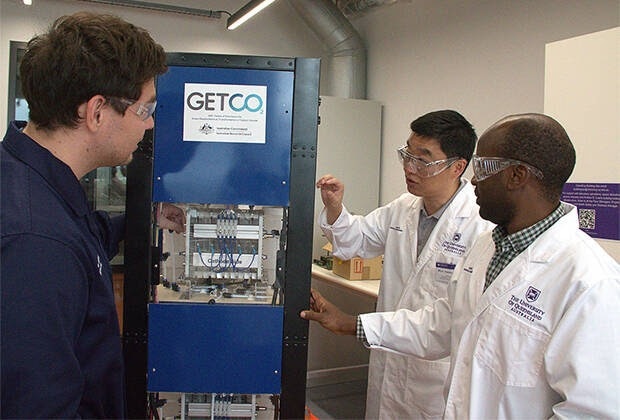 PhD student Rizal Evans, Professor Xiwang Zhang and Dr Mike Tebyetekerwa. Image Credit: University of Queensland
The first-of-its-kind electrochemical generator offers high-emissions industries a safer and more environmentally friendly pathway to convert waste CO2 into useful products, while reducing the need for fossil-fuel-based chemical manufacturing.
Designed by Professor Xiwang Zhang, Dr Mike Tebyetekerwa and PhD student Rizal Evans from UQ’s School of Chemical Engineering, the generator is powered by electricity and requires only water and captured carbon dioxide to create formate, the base compound for formic acid.
“With basic ingredients and the push of a button, we are able to deliver chemicals that are hugely important for a number of industries,” Professor Zhang said.
“It demonstrates that carbon dioxide can be reused, rather than treated solely as a waste product.
“There are industries that need formic acid, and others that have large amounts of CO2 they want to manage.
“This technology creates an opportunity to connect those 2 challenges.”
Formic acid is commonly used in agriculture, leather tanning, rubber manufacturing and other industrial processes.
Australia currently imports almost all of its formic acid, leaving local industry vulnerable to external supply disruptions.
Dr Tebyetekerwa said the generator had been designed to be modular, allowing it to be scaled up or down depending on industry needs.
“Instead of transporting and storing large volumes of formic acid, the idea is that it could be produced where it is needed,” Dr Tebyetekerwa said.
“That has implications for safety, supply security and emissions, particularly for industries that already produce CO2 as part of their operations.”
Mr Evans said potential applications ranged from agriculture and livestock production to resource and energy sectors.
“We have already had a resource company enquire about using it to produce formic acid as an antifreeze for its pipes,” he said.
“The technology is still in the testing phase, and not quite ready yet for commercial use.”
The researchers said field trials with industry partners would be required to assess how the generator performs under real-world conditions and how it could be adapted to different industrial settings.
The research is supported by the Australian Research Council (ARC) through its Centre of Excellence for Green Electrochemical Transformation of Carbon Dioxide (GETCO2).